Why NVIDIA’s China Exposure Still Matters for NVDA Investors
Key Takeaways
- •NVIDIA guided Q3 FY27 revenue to approximately $108.0 billion ±2% while explicitly assuming no Data Center compute revenue from China.
- •Q2 FY27 results included $96.2 billion in company revenue, $89.0 billion in Data Center sales, and a 75.0% GAAP and non-GAAP gross margin.
- •H20 policy actions previously produced a $4.5 billion charge in Q1 FY26, demonstrating that export rules can leave lasting inventory and margin effects.
- •Chinese authorities have discouraged or restricted domestic firms' purchases of NVIDIA AI chips in favor of local supply, meaning policy shapes demand from both the U.S. and Chinese sides.
- •NVIDIA returned approximately $26.0 billion to shareholders in Q2 FY27 and retained roughly $99.0 billion of repurchase authorization.
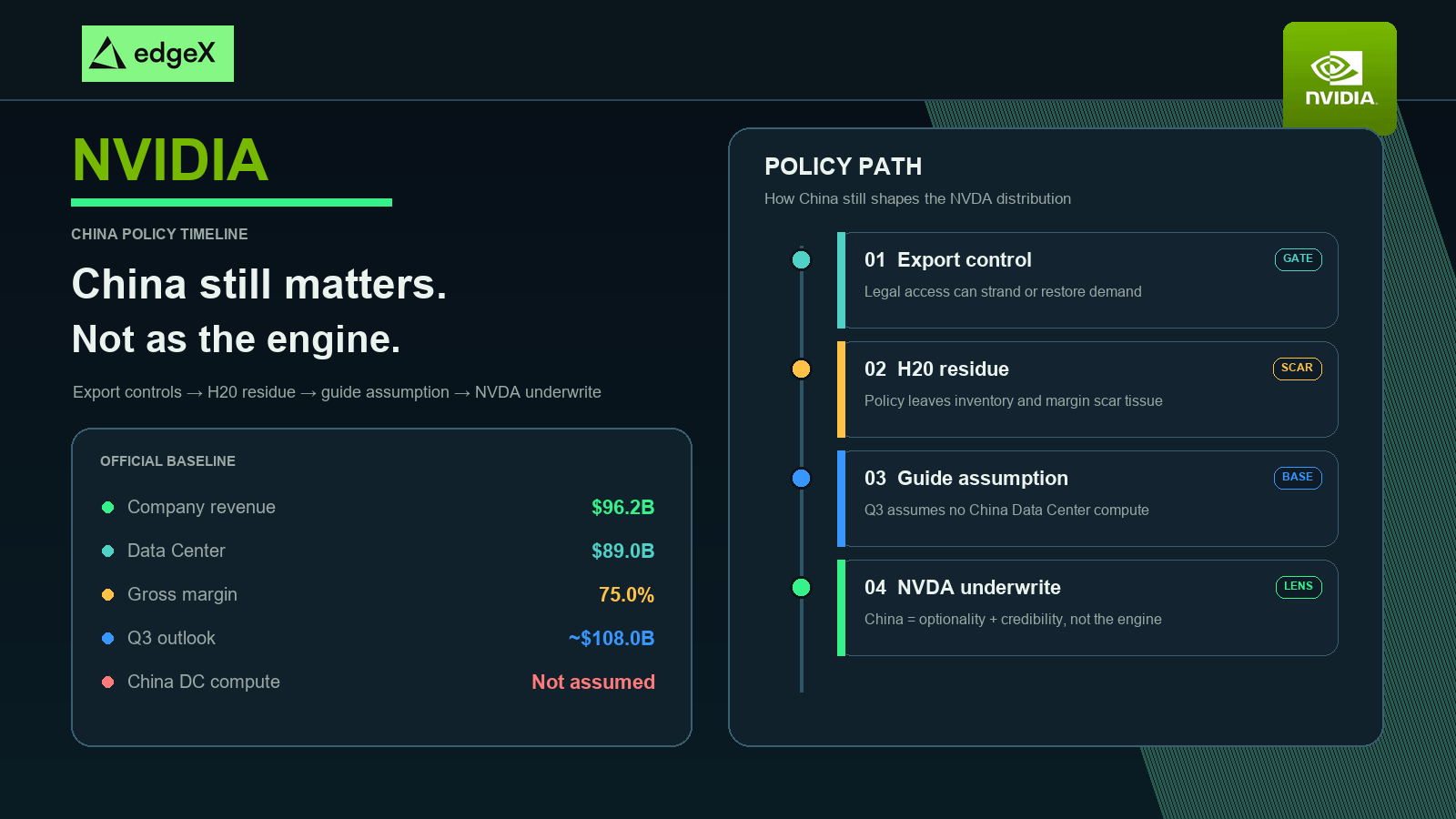
NVIDIA’s stock is priced on AI-infrastructure demand that is already enormous without China. That fact can tempt investors to treat export controls, H20-era inventory scars, and policy headlines as background noise. They are not. China exposure still matters for NVDA because it changes the shape of upside, the quality of guidance, and the market’s tolerance for surprise. In Q2 FY27, NVIDIA printed $96.2 billion in company revenue and $89.0 billion in Data Center sales while guiding Q3 revenue to about $108.0 billion ±2% with an explicit assumption of no Data Center compute revenue from China. The China debate is therefore less about whether NVIDIA can grow without China right now, and more about how policy can add or subtract optionality around an already elevated base.
This article explains why China exposure still belongs in the NVDA underwriting stack: how export-control and product-policy risk show up in guidance, what the H20 charge history teaches about margin and inventory shock, and which proofs investors should monitor next. It is not a full earnings walkthrough and not a valuation model. For the quarterly scoreboard, see NVIDIA earnings explained. For valuation framing, see the NVIDIA stock valuation guide.
Quick Answer
NVIDIA’s China exposure still matters for NVDA investors because policy risk changes the distribution of outcomes around an already large AI-infrastructure business. After Q2 FY27’s $89.0 billion Data Center print, NVIDIA guided Q3 to about $108.0 billion while assuming no China Data Center compute revenue. That means the stock can keep working on non-China demand, but China remains a live source of upside surprise, downside policy shock, and margin/inventory noise. Underwrite China as an optionality and credibility factor layered on top of the Data Center thesis, not as the engine that must carry the current quarter.
Why China Still Belongs in the NVDA Risk Stack
A common mistake is to confuse “China is not required for the current print” with “China no longer matters.” Those are different statements. NVIDIA’s latest quarter shows that non-China AI-factory demand can support extraordinary revenue and mid-70s profitability. It does not show that export controls, licensing regimes, and China-specific product rules have stopped shaping investor expectations.
China risk matters in three practical ways. First, it truncates or restores upside. If the published guide assumes zero China Data Center compute, then approved sales become potential upside rather than base-case fuel. Second, it affects credibility. Markets punish companies that appear to embed fragile policy assumptions inside guidance. NVIDIA’s explicit “no China Data Center compute” language is a credibility choice as much as a forecast choice. Third, it shapes competitive and sovereign narratives. If Chinese customers permanently substitute local accelerators or restricted alternatives, NVIDIA can still thrive globally while losing a long-duration market that once looked strategically important.
That is why China belongs beside, not beneath, the rest of the NVDA map. The NVIDIA stock guide covers the broader franchise. The NVIDIA risk framework covers the wider break-case set. This article stays on the China-policy layer that can move both upside and trust. If investors only track whether the latest quarter “needed” China, they will keep misreading policy headlines that change optionality without changing the current Data Center center of gravity.
An Investor Scorecard for NVIDIA’s China Exposure
The right scorecard uses official disclosure rather than invented China revenue decimals. NVIDIA’s latest release does not require investors to fabricate a current China Data Center compute line in order to underwrite the risk.
| China lens | Latest evidence | What investors should infer |
|---|---|---|
| Demand without China | Data Center revenue $89.0B; company revenue $96.2B in Q2 FY27 | The current franchise can deliver historic scale while China compute is not the quarter’s centerpiece |
| Guide conservatism | Q3 FY27 outlook ~$108.0B ±2%; no China Data Center compute assumed | China compute is outside the published base case; policy can create upside or keep the floor unchanged |
| Profit quality | GAAP & non-GAAP gross margin 75.0%; GAAP operating income $63.734B | Elite profitability is currently being earned on a non-China-assumed trajectory |
| Inventory/policy scar tissue | H20 charges/(releases) footnote: Q1 FY26 $4.5B vs Q1 FY27 none; Q2 FY26 ($180M) vs Q2 FY27 insignificant | Policy can leave accounting and inventory marks long after the headline export debate moves on |
| Expectation hurdle | Guided Q3 GM 74.0% ±50 bp after a 75.0% print | Non-China execution still has to clear a high bar; China noise can amplify any miss |
The scorecard’s point is simple. China does not need to be a large share of the latest quarter to remain material. It needs to remain capable of changing the upside case, the surprise distribution, or the market’s confidence in NVIDIA’s policy navigation. In a market this large, the right question is not “what percent of last quarter was China?” It is “what part of the next outcome distribution still runs through policy?”
Export Controls, Product Policy and Guidance Design
Export controls matter to NVDA less as abstract geopolitics and more as guidance architecture. When management says the Q3 outlook assumes no Data Center compute revenue from China, investors receive a clean underwriting instruction: do not bake China compute into the base case. That lowers the odds of a policy-driven guide miss. It also raises the importance of reading any later China-related sales as upside variance rather than confirmation of an embedded assumption.
Why the “zero China compute” assumption is the key line
The assumption is the cleanest official China signal in the latest package. It tells investors how NVIDIA wants the next quarter underwritten. It does not permanently answer whether China demand exists, whether licenses can be obtained, or whether future product generations will be saleable into China under then-current rules. It answers the narrower question that matters for near-term NVDA trading: what is inside the published $108.0 billion framework, and what is not.
H20 as a reminder that policy leaves residue
The H20 footnote still belongs in China analysis because it shows how policy can migrate from a market-access story into inventory and margin accounting. Prior-period H20 charges and later releases or insignificant impacts are not a reason to invent a current China revenue line. They are a reason to remember that restricted or uncertain China products can create charge cycles, release cycles, and narrative overhang even when the company is printing record Data Center dollars elsewhere.
Compliance risk is not the same as demand risk
Investors often collapse China into one bucket. Demand risk asks whether Chinese customers want NVIDIA products. Compliance and licensing risk ask whether NVIDIA can legally sell the relevant configurations, through which channels, and with what residual inventory risk. Those questions can diverge. Weak legal access can strand demand. Sudden legal access can create upside that was never in the guide. Both matter to NVDA even when the base business is already huge. The underwriting error is to treat every China headline as either proof of hidden dependence or proof of irrelevance. Most headlines are really about which of those two channels just moved.
How China Risk Changes Bull, Base and Bear Underwriting
In a bull case, non-China AI-infrastructure demand continues to clear rising guides, while any approved China compute sales become upside on top of a conservative assumption set. China then functions as free optionality rather than a dependency.
In the base case, NVIDIA keeps delivering around a non-China-assumed guide path, China remains tightly controlled or uncertain, and investors mainly watch whether the $89.0 billion-class Data Center machine and mid-70s margins stay intact. China headlines can still move the stock day to day without rewriting the cash engine.
In a bear case, China policy does not need to erase the current quarter to hurt NVDA. It can hurt by removing a long-duration growth geography, by forcing recurring inventory marks, by encouraging faster local-substitute adoption, or by making every guide season feel one licensing headline away from narrative shock. That is why China still belongs in scenario work even after a $96.2 billion company print.
Cash returns sit in the background of the same debate. In Q2 FY27, NVIDIA returned about $26.0 billion to shareholders with roughly $99.0 billion of repurchase authorization remaining. Those figures are funded by the broad franchise, led by Data Center. China risk does not have to finance or break that return capacity by itself. It can still change how expensive the market is willing to capitalize the duration of NVIDIA’s AI-infrastructure advantage.
Competitive and Narrative Risks Attached to China Policy
China risk is also a competitive-structure issue. If Chinese customers cannot reliably buy leading NVIDIA systems, local alternatives and workarounds gain a protected demand pool. That may not threaten NVIDIA’s near-term non-China Data Center dominance. It can still matter for long-run share of global AI compute and for the political narrative around technological dependence.
Narrative risk is the more immediate market channel. After an $89.0 billion Data Center quarter and a guide toward about $108.0 billion, NVDA trades with less patience for ambiguity. A China licensing headline can therefore move the stock through sentiment even when the official guide already excludes China Data Center compute. Investors who ignore that channel will keep being surprised by price action that does not show up cleanly in the segment tables.
The analytical discipline is to keep the channels separate. Ask whether a China headline changes the published guide math. Ask whether it changes inventory or charge risk. Ask whether it changes long-run competitive geography. Ask whether it is merely sentiment. Mixing those questions is how China coverage becomes either alarmist or complacent.
How Investors Should Underwrite China Exposure From Here
A practical China framework uses four proofs. First, official outlook language continues to state clearly whether China Data Center compute is assumed or excluded. Second, non-China Data Center demand remains strong enough that the franchise can clear high absolute guides without relying on China. Third, H20-style charge/release residue stays contained rather than re-accelerating into a recurring policy tax on margins. Fourth, competitive and sovereign developments do not convert China from an optionality debate into a permanent strategic loss that markets begin to capitalize as duration risk.
Those proofs connect cleanly to the rest of the cluster. Earnings readers can stay with NVIDIA earnings explained. Valuation readers can pressure-test multiples in the NVIDIA valuation guide. Broader break-case readers can continue into NVIDIA stock risks. The shared question is whether NVDA’s premium rests on durable AI-infrastructure execution under policy constraints the company can disclose and manage.
China will not decide whether NVIDIA remains the central AI-infrastructure vendor in the markets where it can freely sell. It can still decide how clean the upside distribution looks, how much trust investors place in guide design, and how expensive the market is willing to pay for duration. After Q2 FY27’s historic print and a Q3 outlook that assumes no China Data Center compute, that is exactly why China exposure still matters. Keep it in the model as policy optionality and credibility risk. Do not force it to be the quarter’s revenue engine, and do not pretend the headline risk has disappeared. If non-China demand keeps clearing the rising absolute bar, China remains a second-order but live variable. If non-China demand ever cools, the same China variable becomes much louder overnight.
Trade NVIDIA Perpetuals on edgeX - 24/7, No KYC Required
NVIDIA's story does not pause when markets close. For traders who want continuous exposure to NVDA price action without the constraints of traditional market hours, edgeX offers a decentralized alternative.
Continuous NVDA Market Access
edgeX lists NVDA/USDC perpetual futures with up to 10x leverage and no expiration date. Positions can be held as long as the thesis holds, with transparent on-chain settlement and no KYC requirement.
Institutional-Scale Execution With Self-Custody
edgeX is a decentralized exchange built for active traders who value performance and privacy. Users retain control of their funds and private keys. The platform cites $10 million of depth within a one-basis-point spread, sub-0.1-basis-point slippage on larger trades, and 100% trading-fee rewards through its Trade-to-Earn program.
Know the Risks Before Trading
Leverage can amplify gains and losses, including the risk of liquidation. Traders should verify current funding, fees, liquidity, product availability and contract specifications before opening a position. Explore NVDA/USDC perpetual futures on edgeX to see what decentralized derivatives trading looks like at institutional scale.
Frequently Asked Questions
These questions address the China issues investors raise most often after NVIDIA’s latest results: why exposure still matters, how the guide treats China compute, and what to monitor next.
Why does China still matter if NVIDIA can grow without it?
Because China changes upside optionality, guide credibility, and narrative risk. A business can be strong without China and still have material policy-driven variance around the base case.
What is the most important official China line in the latest outlook?
NVIDIA’s Q3 FY27 revenue outlook of about $108.0 billion ±2% assumes no Data Center compute revenue from China. That is the cleanest near-term underwriting instruction.
Did NVIDIA disclose a current China Data Center compute revenue figure in the Q2 FY27 release?
No clean standalone current China Data Center compute revenue line is required to underwrite this article. Use the official no-China-compute guide assumption plus the broader Data Center baseline rather than inventing a figure.
Why do H20 charges still appear in a China discussion?
Because the H20 footnote history shows how policy can create inventory and margin residue. Q1 FY26 showed a $4.5 billion charge against none in Q1 FY27; Q2 FY26 showed a $180 million release against an insignificant Q2 FY27 impact. That pattern is about policy residue, not a license to invent current China sales.
What should investors monitor next on China risk?
Official guide language on China compute assumptions, any reappearance of material H20-style charges or releases, licensing/compliance outcomes, and whether non-China Data Center demand continues to support high absolute guides and mid-70s profitability.
