CZ Explains Why He Recommended Pausing Withdrawals After the Bybit Hack
Key Takeaways
- •Bybit disclosed that approximately $1.5 billion in digital assets was stolen from one of its cold wallets in February 2025.
- •Zhao’s recommendation targeted exchanges generally and was framed as preventive risk management rather than confirmation of exposure at a specific platform.
- •A temporary withdrawal suspension could give security teams time to review private keys, transaction activity and potential unauthorized outflows.
- •The clip provides commentary on recommended practice, not verified evidence of actions taken by Bybit or other exchanges.
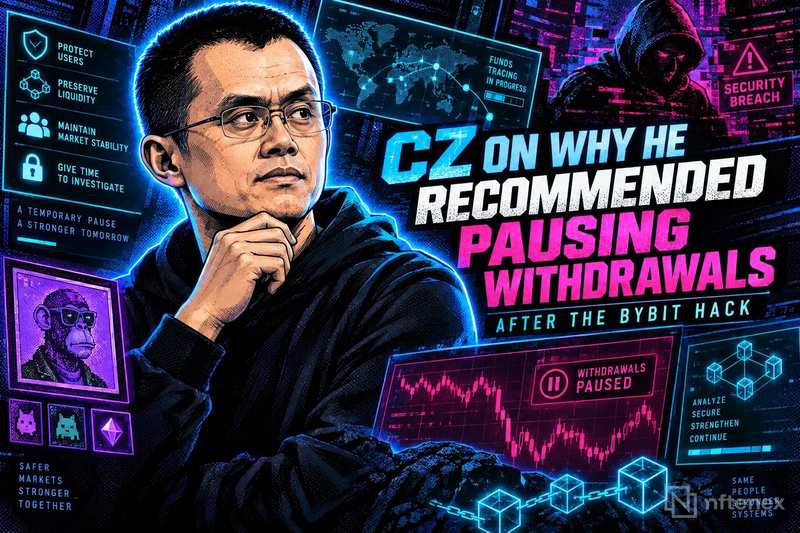
A highlight clip circulating in the crypto community features Binance co-founder Changpeng Zhao, widely known as CZ, explaining his reasoning for recommending that exchanges pause withdrawals in the immediate aftermath of the Bybit hack. In the clip, he frames the advice as a precautionary risk-management measure rather than a reaction to confirmed exposure at any specific platform.
The underlying incident dates to February 2025, when Bybit disclosed that attackers had drained roughly $1.5 billion in digital assets from one of its cold wallets — offline storage designed to isolate funds from internet-connected systems — a breach widely described as the largest theft from a cryptocurrency exchange on record. It triggered an industry-wide debate over how platforms should respond while investigations remain in progress.
The Recommendation Described in the Clip
According to the clip, CZ's recommendation was addressed to exchanges broadly rather than tied to Bybit's own operational decisions. He characterized a temporary withdrawal pause as a prudent step: until a team can confirm that its infrastructure is unaffected, allowing withdrawals to continue at full volume risks compounding an already uncertain situation.
The framing matters. A recommendation to pause is distinct from a confirmed halt, and CZ's comments appear aimed at the wider industry rather than serving as disclosure about any particular platform's internal response. Viewers and commentators who conflated the two have drawn broader conclusions than the clip itself appears to support.
This kind of cross-industry commentary from a high-profile figure is consistent with how security incidents tend to ripple through the exchange ecosystem. After the earlier Bitget hack and the tracing of stolen funds, breaches at one platform routinely prompted public statements from executives elsewhere about best practices during active threat windows. Because such commentary arrives while facts are still being established, it often shapes audience expectations ahead of verified details — which is why the distinction between advice and disclosure carries so much weight here.
Assessing Risk Before Normal Operations Resume
The core logic CZ described reflects a standard incident-response principle: when a major security breach occurs at a peer institution, the safest posture for other platforms is to assume potential systemic exposure until internal audits confirm otherwise. Withdrawal volumes during a panic window can outpace a team's ability to verify that its own hot wallets and signing infrastructure remain secure.
A temporary pause creates a buffer for security teams to audit transaction queues, confirm private key integrity, and check for anomalous outflows without the pressure of processing live withdrawals at the same time. It is a conservative call that prioritizes the safety of user funds over short-term operational continuity and for users, the immediate effect is a temporary inability to move funds off the platform, the trade-off the recommendation explicitly accepts.
CZ's willingness to publicly frame this as the recommended posture, rather than leaving each exchange to navigate the question privately, reflects the kind of industry-wide coordination that tends to emerge after large-scale incidents. Whether individual platforms acted on that recommendation remains a separate question the clip alone does not answer.
Commentary Versus Confirmed Incident Details
The clip captures CZ's stated rationale, not an operational log of what exchanges did or did not do. Viewers should treat the content as commentary on risk-management philosophy, not as confirmation of what Bybit or any other platform actually executed during the incident window.
For confirmed facts about the Bybit hack, including verified fund movements and official platform statements, the appropriate sources are Bybit's own announcements and on-chain data from block explorers, not secondary commentary clips. This is a recurring challenge with highlight-clip formats: they surface a perspective without the full investigative context needed to assess its accuracy or completeness. As efforts to trace the stolen funds continue and official platform updates emerge, those primary channels — not social-media commentary — remain where confirmed developments are documented.
As exchange security incidents continue to drive cross-industry conversation, the distinction between a public figure's personal recommendation and a platform's confirmed actions will remain important for anyone following the fallout closely.
Disclaimer: This article is for informational purposes only and does not constitute financial or investment advice. Cryptocurrency and digital asset markets carry significant risk. Always do your own research before making decisions.

