Cysic Halts Bridge After Attacker Mints 10 Million CYS on BNB Chain
Key Takeaways
- •An attacker exploited a flaw in Cysic's bridge contract logic to mint 10 million CYS tokens on BNB Chain without corresponding backing on the originating network.
- •Cysic suspended cross-chain bridge operations to contain the unauthorized minting, a measure that also blocks legitimate asset transfers for users.
- •The vulnerability class, attacker's address, dollar-denominated losses, exploit timing, and number of affected users remain unconfirmed, and figures circulating on social media beyond the 10 million CYS mint should be treated as unverified.
- •How Cysic addresses the unauthorized tokens—through a contract burn, snapshot rollback, or another mechanism—will be central to restoring credibility, alongside a public bridge reopening timeline tied to a completed audit.
- •Users holding CYS or bridge assets should rely solely on Cysic's official communications and on-chain evidence for status updates and guidance.
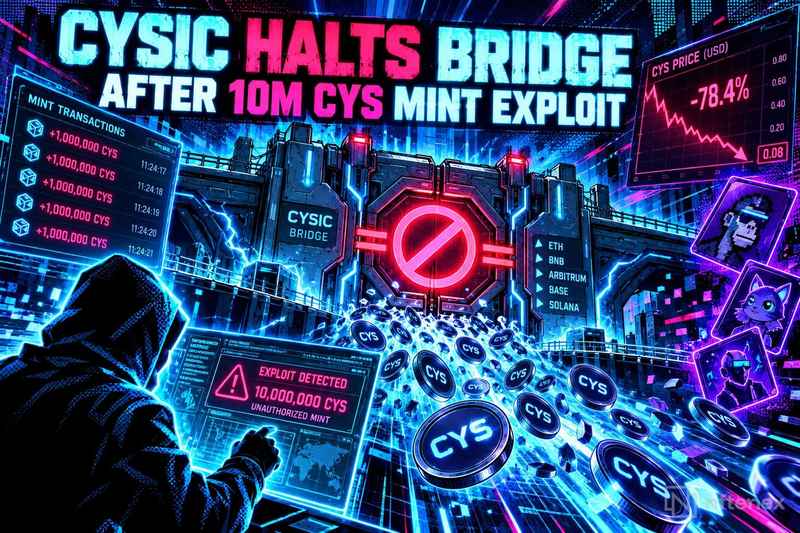
Cysic has suspended its cross-chain bridge after an attacker exploited a flaw in the protocol's bridge contract to mint 10 million CYS tokens on BNB Chain without corresponding backing on the originating network. The team paused bridge operations to contain any further unauthorized minting.
How the Exploit Unfolded
According to the reported incident, the attacker identified a flaw in Cysic's bridge logic and used it to generate 10 million CYS on BNB Chain. Cysic's deployment on that network was the targeted surface in the incident, and the company responded by enacting a bridge halt to stop additional unauthorized minting.
The setting is a familiar one for decentralized finance: bridge contracts hold pooled assets on both sides of a cross-chain transfer and rely on message-verification logic to decide when tokens may be minted on the destination chain, a combination that has made bridges a recurring target in the industry's largest security incidents.
Confirmed Details
Two facts have been established: a bridge halt was put in place, and 10 million CYS were minted without authorization on BNB Chain through a flaw in the bridge logic. Beyond those points, key specifics remain undisclosed. The precise vulnerability class, the attacker's address, and any dollar-denominated loss figure have not been confirmed in available disclosures at the time of writing.
The exact timing of the exploit, whether any liquidity was drained alongside the unauthorized mint, and the total number of affected users are also unconfirmed. Figures circulating on social media beyond the 10 million CYS mint should be treated as unverified until Cysic publishes an official post-mortem.
What a Bridge Halt and Unauthorized Mint Mean in Practice
A bridge halt suspends the movement of assets between chains on the affected protocol. The measure prevents further exploit attempts but also blocks legitimate transfers for existing users. It is a standard incident-response step that teams deploy while auditing contract state.
The more structurally significant issue is token-supply integrity. Minting tokens through a bridge exploit effectively inflates circulating supply without economic backing, which can distort the token's market representation on trackers and exchanges. Because BNB Chain hosts active decentralized exchanges, newly issued tokens can circulate on-chain quickly, which is why containment speed and supply reconciliation tend to draw close scrutiny in incidents of kind. How Cysic handles the 10 million unauthorized CYS—whether through a contract burn, a snapshot rollback, or another mechanism—will define the long-term credibility of the fix. Such supply-integrity decisions also carry downstream market weight, as abrupt token supply changes have historically contributed to sharp price dislocations across crypto assets.
What Users Should Verify Through Official Channels
Users holding CYS or assets in Cysic's bridge should confirm the current bridge status and any wallet guidance directly through Cysic's official communications before taking action. Unverified social posts claiming specific loss figures or attacker addresses should not be treated as confirmed until the project publishes on-chain evidence or a signed statement.
What to Watch Next from Cysic
The primary disclosure to watch for is a formal incident report from Cysic that identifies the vulnerable contract function, confirms the scope of the unauthorized mint on BNB Chain, and states whether any additional chains or bridge pairs were affected.
Bridge exploit narratives move quickly on social platforms, and secondary figures—estimated losses, attacker profits, and recovery timelines—often circulate before they are verified. For this incident, only statements from Cysic's official accounts or a linked audit report should be treated as authoritative.
Two concrete milestones will signal that the incident is being managed responsibly: a public timeline for bridge reopening tied to a completed audit, and explicit disclosure of how the 10 million unauthorized CYS will be addressed at the contract level. Until both appear, the bridge remains halted and the token-supply question stays open. Security-minded participants tracking DeFi infrastructure risk should monitor official Cysic channels for on-chain confirmation of any burn or rollback transaction.
Disclaimer: This article is for informational purposes only and does not constitute financial or investment advice. Cryptocurrency and digital asset markets carry significant risk. Always do your own research before making decisions.

