China's CXMT Shanghai Debut Sends Shockwaves Through KOSPI as Tech Rivalry Intensifies
Key Takeaways
- •CXMT Corp's July 28 listing on the Shanghai stock exchange triggered the KOSPI's sharp drop to a six-month low, as CXMT directly competes with Samsung and SK Hynix in the DRAM market.
- •CXMT shares surged more than 460% on their first trading day, surpassing high-profile Western IPO performances and establishing the company as China's most highly valued publicly traded firm.
- •CXMT's debut reflects Beijing's accelerated drive for semiconductor self-sufficiency in response to years of US export controls on advanced chips.
- •The global memory-chip sector, long dominated by Samsung, SK Hynix, and Micron Technology, now faces a new competitive variable with a publicly funded Chinese entrant backed by deep domestic capital markets.
- •Analysts indicate that future assessments of the KOSPI and related indices must incorporate China's growing technological competitiveness rather than treating them purely as reflections of US market sentiment.
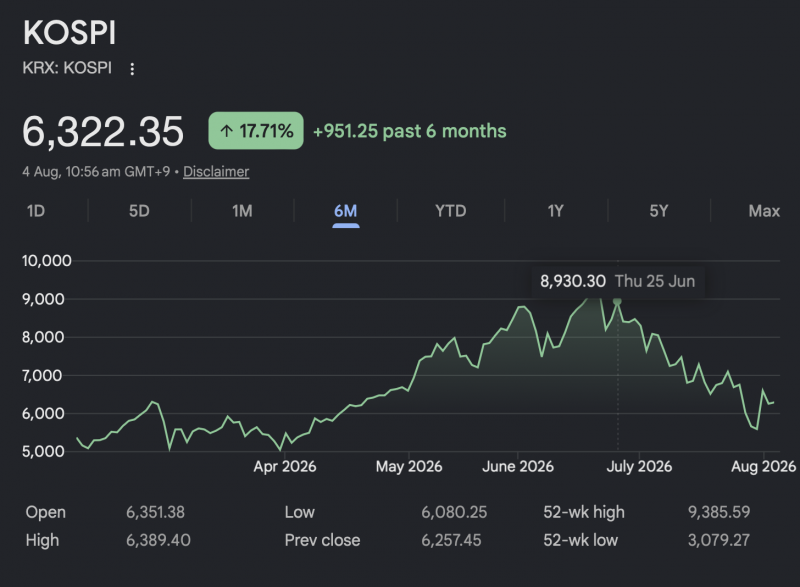
Over the past six months, South Korea's KOSPI index has exhibited volatility more commonly associated with meme stocks than a major national benchmark. The AI-driven rally, fueled primarily by Samsung and other data-hardware players such as SK Hynix — which recently listed on the NASDAQ — has mirrored the kind of surge seen in Japan's NIKKEI, drawing comparisons to a Trump-era style market rally.
The connection is straightforward: these markets are tech-heavy, and in the current climate, that effectively means AI-dependent. Both the KOSPI and the NIKKEI have moved in sympathy with Wall Street's tech-led gains.
Recently, however, tech exposure alone has not been sufficient to sustain upward momentum. The US market has faced a series of headwinds, including fluctuating tensions between the United States and Iran, Brent crude and WTI oil prices re-approaching US$100 per barrel before cooling again, and persistent inflationary concerns driven by oil volatility and ongoing tariff measures.
Adding to the uncertainty, new Federal Reserve Chair Kevin Warsh — despite a historically hawkish reputation — has largely ceased providing forward guidance to markets. Combined with the seasonal tendency for heavier selling in June and July, these factors have heightened investor anxiety. US earnings season has, however, begun to re-inject optimism into the broader market.
Given these dynamics, many market participants have been monitoring the KOSPI alongside the NASDAQ, as the Korean index has increasingly functioned as a barometer for bullish tech sentiment.
While the KOSPI has ticked higher on a five-day basis, its six-month chart tells a more sobering story: the broader Korean market has been retreating from its highs. Yet this pullback is not solely attributable to waning US bullishness.
The catalyst behind the KOSPI's sharp drop to a six-month low on July 28 originated not in the United States but in China. That day, the Shanghai stock exchange hosted the debut of CXMT Corp, China's domestic chip manufacturing giant. CXMT — formally ChangXin Memory Technologies — is China's leading DRAM producer, placing it in direct competition with the core memory-chip franchises of both Samsung and SK Hynix, the companies that have anchored the KOSPI's AI-era rally.
The geopolitical implications of CXMT's listing may not yet be fully visible at the level of trade flows and policy, but in the minds of market participants, the signal was immediate and clear: China is escalating its efforts to compete with the likes of NVIDIA and other Western semiconductor leaders by floating its own data-hardware powerhouse on public markets. The listing arrives amid years of US export controls on advanced semiconductors, which have accelerated Beijing's push for self-sufficiency in chipmaking — a strategic priority now being priced into public markets.
Notably, CXMT's July 28 listing also drew significant capital attention away from SK Hynix, whose own NASDAQ listing had recently made it a short-lived investor favorite.
The scale of interest in CXMT was striking. On its first day of trading in Shanghai, CXMT Corp shares surged more than 460% — a single-day performance that eclipsed even the most high-profile Western IPOs. By way of comparison, SpaceX, headed by Elon Musk, has not achieved a comparable public market debut.
The implications extend beyond a single stock. Some investors may now be less inclined to channel capital into US-aligned markets such as South Korea and Japan when China demonstrates the capacity to list its own technology champions and generate headline-grabbing IPO momentum independently.
CXMT's debut has also cemented the company's status as China's most highly valued publicly traded firm, underscoring the country's advancing technological capabilities as reflected in public markets. For the global memory-chip sector — long dominated by Samsung, SK Hynix, and US-based Micron Technology — a publicly funded Chinese entrant with access to deep domestic capital markets introduces a new competitive variable. Going forward, analysts suggest that the market will need to incorporate China's growing tech competitiveness into any assessment of the KOSPI and related indices — rather than treating them purely as a reflection of American market exuberance.

