What Happens When a Cryptocurrency Is Delisted From an Exchange?
Key Takeaways
- •A delisting removes an exchange's trading support but does not destroy the token, which continues to exist on its blockchain and can trade on other platforms.
- •A study of 101 Binance token delistings recorded median price declines of 26.3% within 24 hours and 36.9% after seven days, with about 38% of affected coins falling more than 30% in a single day.
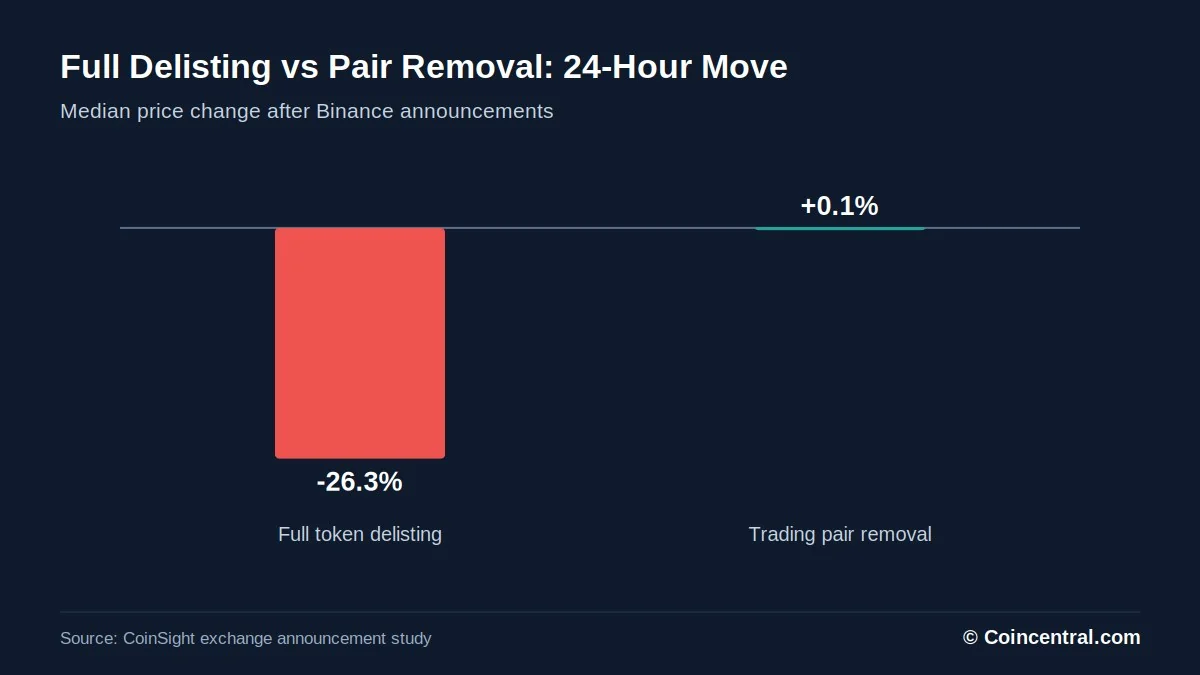
- •Full delistings and individual trading-pair removals carry very different consequences, with median 24-hour moves of -26.3% versus roughly +0.1% on Binance.
- •Exchanges cite factors such as low liquidity, inactivity, regulatory issues, security incidents, and fraud when removing assets, and some delisted tokens continue to function and trade in other regions.
- •Holders typically have a withdrawal grace period after a delisting, but leftover balances on some exchanges may be liquidated at prices well below recent quotes, so reviewing the official announcement and acting before deadlines is essential.
When an exchange delists a cryptocurrency, the asset does not simply disappear. The exchange stops supporting trading for it, but the underlying blockchain remains unchanged.
If Binance delists a token, its Binance trading pairs are removed. The token may still exist on its blockchain, remain in users’ wallets and trade on other exchanges or platforms. The more significant consequences involve liquidity, price and investor confidence, and the impact can be severe when the delisting occurs on a major exchange.
A 2026 study of 101 Binance token delistings found a median price decline of 26.3% within 24 hours of the announcement and 36.9% after seven days. About 38% of the affected coins lost more than 30% in one day.
The outcome depends on the circumstances. A viable token removed because of regulatory restrictions may continue trading elsewhere. A failing token with few remaining buyers, however, can become extremely difficult to sell. The data behind crypto delistings, the reasons exchanges remove assets and the options available to holders are examined below.
Key Crypto Delisting Statistics
The main figures discussed in this article include:
- Binance token delistings: median declines of 26.3% after 24 hours and 36.9% after seven days.
- Coins falling by more than 30% in one day: about 38% of the Binance delistings studied.
- Binance trading-pair removals: a median 24-hour move of approximately +0.1%.
- Median 24-hour moves after delistings on other exchanges: about -9.0% on Upbit, -6.3% on OKX and -5.2% on Bybit.
What Crypto Delisting Means
A delisting occurs when an exchange stops supporting a cryptocurrency or a particular market for that asset. Binance defines delisting as removing a cryptocurrency from its platform so that its trading pairs are no longer available.
For example, suppose a token called XYZ trades in the XYZ/USDT and XYZ/BTC markets. If XYZ is fully delisted, both markets may be removed and customers can no longer buy or sell the token on that exchange.
The decision does not alter the XYZ blockchain, wallets outside the exchange, other centralized exchanges, decentralized exchanges or the project’s developers. The exchange has withdrawn its support for the asset; it has not destroyed the asset itself.
Removing a Trading Pair Is Different From a Full Delisting
An exchange could remove the XYZ/BTC market while continuing to support XYZ/USDT. In that situation, XYZ has not been fully delisted because only one trading pair has been removed. Binance distinguishes between removing an individual trading pair and delisting a token entirely.
The price response can be substantially different. CoinSight found that Binance trading-pair removals produced a median 24-hour price move of approximately +0.1%, while full token delistings produced a median move of -26.3%.
Why Exchanges Delist Cryptocurrencies
Exchanges continuously review listed assets. Coinbase says its listed assets remain subject to monitoring against legal, compliance, technical-security and business standards.
Binance identifies 10 factors that can lead to a delisting. They include legal or compliance concerns, low user adoption, insufficient development, weak liquidity, low market capitalization, security incidents, problems involving a project team, suspected fraud, market abuse and the discontinuation of a project.
Kraken has described its 2026 delisting rounds as involving assets that no longer satisfy its performance or compliance standards. The reason for a delisting is important because the decision does not carry the same meaning in every case.
Low Trading Volume
When a token trades only a few thousand dollars per day, maintaining support may not be commercially practical for an exchange. Thin markets can also produce wider spreads, greater slippage and a higher risk of price manipulation.
A 2026 study published in the Asia-Pacific Journal of Financial Studies found that weaker liquidity, declining prices, higher volatility and negative project news helped predict Binance delistings. In some cases, a delisting is the final stage of a decline that had already begun.
Abandoned Projects
Some projects lose their developers or cease operating. Their websites may go offline, code updates may stop and community activity may diminish.
Kraken’s May 2026 notice included TEER. According to the notice, the project had ceased operations and on-chain transactions were no longer functioning. That represents a more serious problem than the loss of a single regional listing.
Regulatory Problems
A token may function properly from a technical perspective but still be difficult for an exchange to support legally. Potential issues include securities-law concerns, sanctions, privacy requirements, licensing restrictions and changes in regional regulation.
In such cases, a token may be removed from platforms in one country while continuing to trade elsewhere. Binance lists privacy projects and tokens facing regulatory issues among the types of assets it may consider for delisting.
Security Problems
A smart-contract exploit, blockchain instability, a 51% attack or a compromised bridge can make deposits and withdrawals unsafe. An exchange may respond by suspending support for the asset.
Coinbase says it may suspend support immediately, without the usual notice, in exceptional circumstances such as legal requirements or smart-contract security risks.
Fraud or Market Manipulation
Exchanges may also remove projects over suspected fraud, market manipulation, misleading disclosures or insider abuse. Binance includes evidence of fraud or market abuse among the factors it reviews.
In these circumstances, the delisting may indicate that the issue extends beyond weak trading volume.
How Much Can Prices Fall After a Delisting?
There is no universal decline, but available data shows that the reaction can be severe on a major exchange. CoinSight studied 2,959 cryptocurrencies across 1,867 exchange announcements from Binance, Bybit, OKX, Upbit and Bithumb. The study covered the period from August 2022 through October 2026.
Among 101 Binance token delistings, the median return was -26.3% after 24 hours and -36.9% after seven days. Approximately 38% of the affected coins fell by more than 30% during the first day.
The median reactions on other exchanges were smaller. Upbit delistings had a median 24-hour move of about -9.0%, compared with approximately -6.3% for OKX and -5.2% for Bybit.
These figures do not establish that a delisting caused every dollar of every decline. Some of the tokens were already losing value before the announcement. They nevertheless demonstrate the potential effect of losing access to a major trading venue.
Selling pressure is generally the first reaction. Once holders know that trading will end on one exchange, some may sell immediately. Buyers may withdraw from the market, while market makers may reduce their exposure.
How Liquidity Amplifies a Price Decline
Consider a token traded on Binance, Kraken and one small exchange, with Binance accounting for 70% of its trading volume. If Binance removes the token, the market loses its largest concentration of buyers and sellers.
If daily volume falls from $10 million to $2 million, a sell order that previously moved the price by 1% might move it by 5%. This is a hypothetical illustration and does not describe an actual token.
Less liquid markets tend to have wider spreads, greater volatility and more slippage. Those conditions can prompt additional selling, creating further downward pressure.
Findings From Academic Research
A 2025 paper on cryptocurrency market fragmentation found that price efficiency worsened after coin delistings. The authors estimated that efficiency declined by about 57% of its pre-delisting standard deviation after a coin was removed from a venue.
The mechanism is straightforward. A larger number of venues allows arbitrageurs and market makers to keep prices aligned. Removing one venue reduces competition and market depth, with the greatest effect on tokens that were already difficult to trade.
Quoted Value and Liquidation Value
A wallet might display a token balance worth $20,000 based on the asset’s last quoted price. If a decentralized exchange has only $5,000 in usable liquidity, selling $20,000 worth could cause the price to collapse.
The difference between the displayed price and the amount that can actually be realized is the gap between quoted value and liquidation value. For tokens in decline, available liquidity can be more informative than market capitalization.
Do Holders Lose Their Crypto When It Is Delisted?
Usually, they do not. Binance says customers do not automatically lose their assets when a coin is delisted. The exchange typically provides a grace period during which users can withdraw the asset to an external wallet.
Coinbase says users will normally retain the ability to withdraw an asset after trading has been suspended. The qualification is important: withdrawal support does not continue indefinitely.
A Typical Delisting Timeline
The dates differ by exchange and asset. Kraken’s July 2026 cycle provides one example.
Kraken disabled trading and deposits on August 10, 2026. Withdrawals were scheduled to remain available through November 6, 2026, approximately 88 days later. The remaining balances were scheduled for liquidation between November 9 and November 13.
What Happens If Users Take No Action
The result depends on the exchange. For several assets delisted in 2026, Kraken said balances remaining after the withdrawal deadline would be liquidated automatically.
Kraken warned that the amount returned could be substantially below recent reference prices. If the market has little or no liquidity, the amount could be minimal or even zero.
The warning reflects the difference between a last quoted price and an executable price. If a token was last seen at $1.00 but available bids are near $0.30, the exchange may be able to sell it only close to the lower level.
Binance says some delisted assets may later be converted into stablecoins on behalf of users. It says it will issue a separate notice beforehand. The value received depends on the token’s market price and available liquidity.
Survivorship Bias and the Coins That Disappear
Dead coins often disappear from view, which can make the crypto market appear safer than it is. Analyses may focus on Bitcoin, Ethereum, Solana and XRP and calculate returns using assets that survived. Thousands of other coins failed, disappeared or were delisted.
A study of 3,904 cryptocurrencies from 2014 to 2021 measured the resulting distortion. It estimated annualized survivorship and delisting bias at 0.93% for value-weighted portfolios. For equal-weighted portfolios, the bias reached 62.19%.
In practical terms, excluding failed assets from historical data can make crypto strategies appear more successful than they actually were.
Some Tokens Continue to Deteriorate After Delisting
The reverse situation also occurs: a project may already be failing before the exchange removes it. Development can stop, activity can decline and liquidity can dry up.
Eventually, the token may remain on its blockchain with almost no trading, no developers and no usable product. It can be technically active while having little or no economic value.
Delisting Does Not Always Indicate a Bad Project
A token removed because of regional regulation may remain active. Its network may continue to grow and trading may remain available in other parts of the world. In that case, the central issue is access rather than the quality of the project.
An older token version may also be delisted because a project is moving to a new blockchain or contract. Coinbase says token migrations often involve removing the older version while users move to a replacement.
Warning Signs Before a Delisting
Although delistings can appear sudden, research identifies indicators that may emerge earlier. A 2026 Korea University study of Binance delistings identified several predictors:
- Falling prices
- Large drawdowns
- Declining liquidity
- Higher volatility
- Negative news
- Increasingly negative community discussion
The study examined 104 Binance spot-delisting announcements from January 2023 through March 2025. On average, the announcement came approximately three days before the delisting. About 79% of the announcements were made only two days beforehand.
That leaves limited time to act after the formal notice. Monitoring the project’s condition before an announcement is therefore important.
Can a Token Recover After a Delisting?
Binance says a delisted token can be listed again if the project resolves the issues that led to its removal and later satisfies the exchange’s listing requirements. Relisting is not guaranteed.
A project facing a liquidity problem might rebuild its activity. A project that has been abandoned or linked to fraud is much less likely to return.
Some traders buy after a sharp decline on the expectation that the market reaction was excessive. That approach can sometimes succeed, but the risk is high. The decline may reflect disappearing liquidity, a failing project, fraud or strict regulatory constraints.
Large losses also require disproportionate gains to recover. A 90% decline reduces a $10,000 position to $1,000. Returning to $10,000 would require a 900% increase.
What Holders Can Do When a Token Is Being Delisted
The first step is to read the official exchange announcement rather than relying on screenshots or social-media posts. Record the trading-suspension date, deposit-suspension date, withdrawal deadline, conversion or liquidation policy, stated reason for the delisting and any migration instructions. The announcement should also make clear whether it removes individual trading pairs or delists the token entirely, because the two actions carry materially different consequences for liquidity and price.
Sell Before Trading Stops
Selling before trading ends is the simplest option for someone who no longer wants to hold the asset. However, many other holders may also be selling, causing the price to fall rapidly.
A market order may execute at a much lower price than expected. A limit order provides more control over the execution price, although it may not be filled.
Withdraw to Another Exchange
A holder who continues to support the project may send the token to another reputable exchange that supports it. Before transferring, check the deposit network, contract address, liquidity, trading volume and withdrawal availability.
An exchange that lists the token may report only $100 in daily volume. Such a venue is not a practical replacement for Binance.
Move the Asset to Self-Custody
If the blockchain continues to function, the token may be withdrawn to a compatible wallet. Before sending, confirm the blockchain, token contract, network and destination address. For a large holding, conducting a small test transaction is reasonable.
Self-custody protects control of the asset, not its value. The token could still become worthless later.
Complete Any Required Migration
Coinbase warns that migration deadlines are significant. Unless an exchange or project states otherwise, users may need to move the asset to self-custody and complete the migration manually. Missing the deadline can result in lost access or value.
Fake migration websites are a common phishing method. Use links from the project’s official documentation, verify contract addresses and never provide a seed phrase to upgrade a token.
Thin Markets Can Facilitate Manipulation
After a token loses major exchange listings, trading may move to smaller venues. Low liquidity makes pump-and-dump schemes, spoofing and wash trading easier.
A 100% price increase on $20,000 of daily volume does not have the same significance as a 10% increase on billions of dollars in volume. A sharp move may look like a recovery while remaining difficult to sell into.
Conclusion
When an exchange delists a cryptocurrency, trading normally ends on that platform, but the cryptocurrency itself continues to exist. Ownership is not usually lost immediately, and major exchanges generally provide a withdrawal period.
The most immediate risk is price. Across 101 Binance token delistings, the median decline was 26.3% after 24 hours and 36.9% after seven days.
Not every delisting means that a token is doomed. An asset may be removed because of regulation, a technical migration or the exchange’s own business rules and continue trading elsewhere. The important questions are why the asset is being delisted, when trading will stop, when withdrawals will end, whether the project still functions and whether genuine liquidity remains elsewhere.
Ignoring the announcement is generally the least useful response. Holders should read the official notice, identify the deadlines and decide whether to sell, withdraw, migrate or retain the asset in self-custody.
Delisting does not automatically destroy a cryptocurrency. For a weak project, however, losing a major exchange can make an already struggling position extremely difficult to exit.
Sources
- Binance: Delisting Guidelines and Frequently Asked Questions
- Kraken: Asset Delistings, July 2026
- Kraken: Asset Delistings, August 2026
- Kraken: Notice of Scheduled Delistings, June 2026
- Kraken: Notice of Scheduled Delistings, May 2026
- Coinbase: Asset Listings Process
- Coinbase: Consumer Protection Disclosures, Singapore
- Coinbase: Token Migrations
- CoinSight: Exchange Announcement Study
- Yang and Kwon: Developing Predictive and Explainable Models for Cryptocurrency Delistings
- Ammann, Burdorf, Liebi and Stöckl: Survivorship and Delisting Bias in Cryptocurrency Markets
- Brogaard, Dyhrberg and Rowberry: Market Fragmentation and Price Efficiency

