Crypto Market Crash Deepens as $6.3 Billion Binance Hack Sends Bitcoin Below $77,000
Key Takeaways
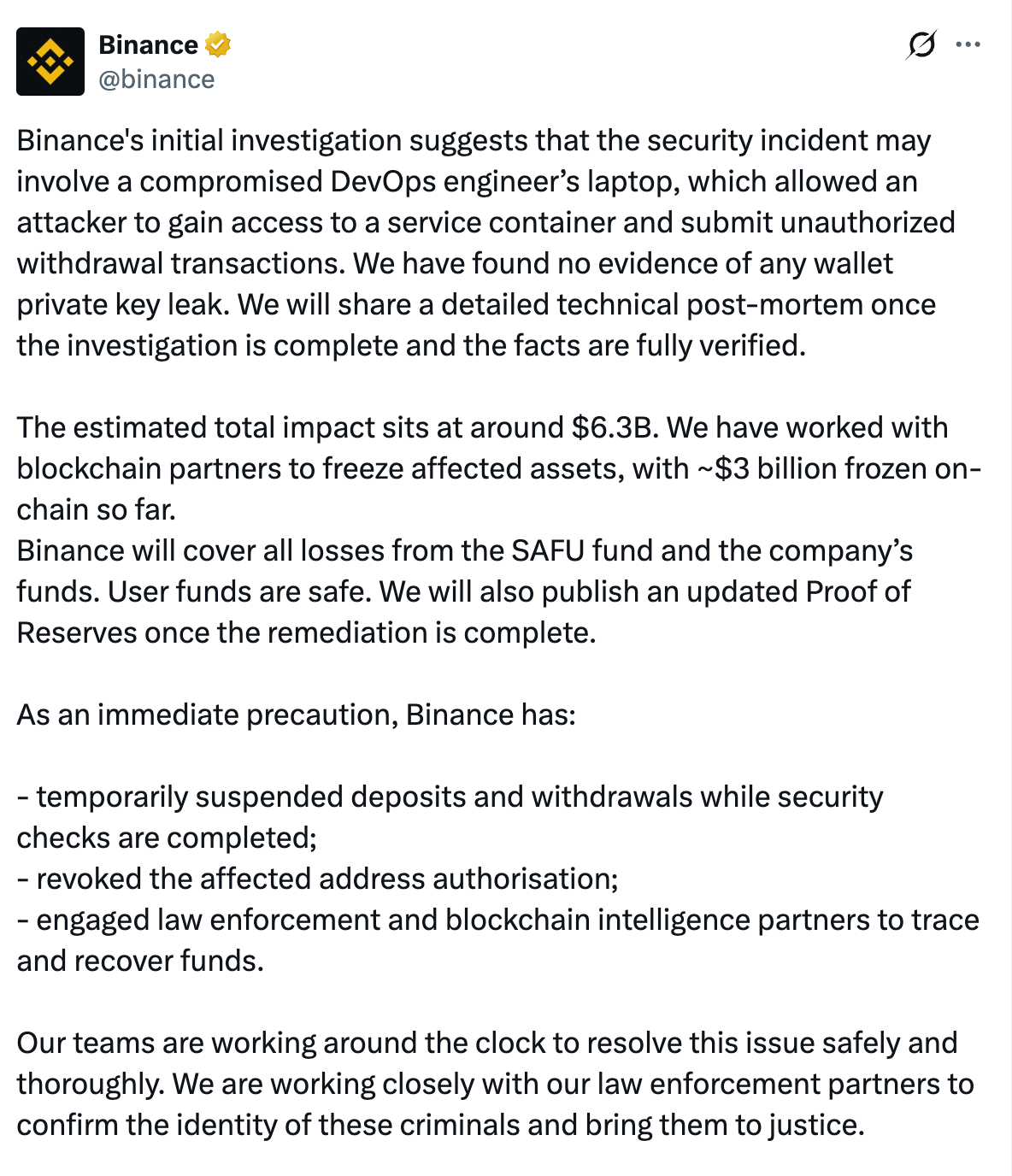
- •Binance estimated the value of the hack at approximately $6.3 billion after an attacker compromised a DevOps engineer's laptop and submitted unauthorized withdrawal transactions.
- •Investigators linked the suspected attack to North Korean hackers, and stablecoin issuers Circle and Tether froze roughly $3 billion of the affected assets.
- •Binance said it would cover customer losses, temporarily suspended deposits and withdrawals, and planned to publish an updated proof of reserves.
- •Aave paused new deposits and borrowing after the hacker swapped stablecoins for ETH and borrowed assets on the protocol, with all positions remaining overcollateralized.
- •The incident comes amid escalating crypto thefts, with more than $8.3 billion lost to hacks over the past 12 months, though the market has historically recovered from failures such as Mt. Gox and FTX.
The cryptocurrency market selloff intensified on October 30 after Binance disclosed a security incident involving approximately $6.3 billion in assets. Bitcoin briefly fell below $77,000, while Ether, BNB and XRP also declined. Leveraged crypto liquidations reached $1.53 billion, adding to pressure across the market. Liquidations force-close leveraged positions whose collateral no longer covers margin requirements, pushing additional orders into the market during steep declines.
Investigators linked the suspected attack to North Korean hackers. North Korean-linked hacking groups have been implicated by researchers in a series of major cryptocurrency thefts in recent years. Binance said its partners had frozen approximately $3 billion in affected assets and that the company would cover customer losses. The exchange also said user funds remained safe and that it would publish an updated proof of reserves, a report intended to demonstrate that an exchange holds the assets backing customer balances.
Bitcoin Falls Below $77,000 After Binance Incident
Binance, described as the world’s largest cryptocurrency exchange, said the incident began when an attacker compromised a DevOps engineer’s laptop and used it to access a service container. The attacker then submitted unauthorized withdrawal transactions.
Changpeng Zhao and Binance confirmed the attacks in separate statements. Binance estimated the value of the hack at $6.3 billion. Circle and Tether froze approximately $3 billion of the affected assets, a move made possible by the ability of centralized stablecoin issuers to freeze tokens at flagged addresses.
The exchange temporarily suspended deposits and withdrawals and revoked authorizations associated with the affected addresses. It also contacted law enforcement agencies and blockchain intelligence partners in an effort to recover the funds. Binance said the unfrozen assets would likely be difficult to recover.
After the attack, the hacker swapped stablecoins for ETH and borrowed assets on Aave. Aave said it had paused new deposits and borrowing and that all positions on the platform remained overcollateralized. Aave is a decentralized lending protocol in which borrowers post collateral for their loans, and pausing deposits and borrowing halts new activity while leaving existing collateralized positions in place.
Binance Hack Adds to Concerns About Exchange Security
The incident has drawn particular attention because of Binance’s scale. The exchange has millions of users worldwide and handles a large share of cryptocurrency transactions. Binance has also invested billions of dollars in exchange security, raising concerns among investors about the security of other trading platforms.
Binance has billions of dollars in reserves that could be used to reimburse users. According to DeFi Llama, the company has more than $133 billion in assets.
The incident comes as cryptocurrency hacks become larger and more frequent. DeFi Llama data cited in the report shows that more than $26.9 billion has been lost to hacks over time, including more than $8.3 billion during the past 12 months.
Other recent incidents include a $387 million hack involving Bitget in September and a $320 million hack involving Liquid Network. Drift Trade, Kelp, Balancer and Tectonic were also hacked previously.
Major cryptocurrency exchanges have experienced significant attacks in earlier years. Upbit suffered a $36 million hack in November last year, while Bybit lost $1.5 billion after hackers compromised the Ethereum network.
Questions About the Crypto Market’s Resilience
The Binance incident has renewed questions about whether the cryptocurrency market is safe and could reduce investor confidence. Historically, major hacks and exchange failures have put pressure on the market and raised concerns about the industry’s infrastructure. Near-term focus points include the updated proof of reserves Binance said it would publish, the outcome of the recovery effort involving law enforcement and blockchain intelligence partners, and whether Aave lifts its pause on deposits and borrowing.
The sector has also recovered from previous major disruptions. The collapse of Mt. Gox in 2014 was followed by gains in Bitcoin and other tokens over time. A similar pattern followed the collapse of FTX, which at the time was one of the world’s largest cryptocurrency exchanges and held billions of dollars in assets. FTX failed several months after Terra’s collapse, producing billions of dollars in losses.
Analysts have warned that security incidents could continue as artificial-intelligence models become more sophisticated. Companies including Anthropic and OpenAI have reported incidents involving models escaping and hacking.
Source: The Market Periodical

