CRFB Tracker Follows the Administration's Economic Forecasts Against CBO, WSJ, and SPF Benchmarks
Key Takeaways
- •CRFB, a nonpartisan nonprofit that monitors United States federal fiscal policy, maintains the Trump CEA Projections Tracker to follow economic forecasts issued by the administration's Council of Economic Advisers.
- •An Econbrowser post dated November 12, 2026 drew attention to the tracker and characterized the administration's projections unfavorably.
- •The administration's official 'Troika' forecast underpinning the FY2027 Budget combines the economic assumptions of the Office of Management and Budget, the Treasury Department, and the Council of Economic Advisers.
- •Econbrowser's comparison charts reported GDP alongside the FY2027 Budget forecast, the Wall Street Journal's April survey mean, the Survey of Professional Forecasters median, and Hassett's 5% growth projection for 2027, with the comparison dating to August and excluding the Mid-Session Review forecast.
- •The post observes that the primary deficit forecast, which excludes interest payments, aligns much more closely with the Congressional Budget Office's February 2026 projection than with the CEA's forecast.
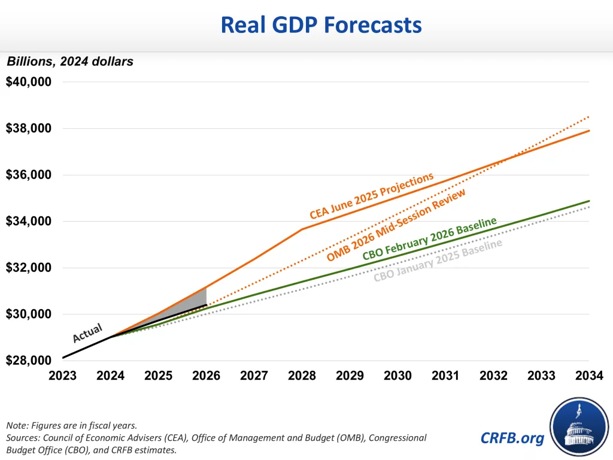
The Committee for a Responsible Federal Budget (CRFB) is tracking the White House's economic projections through its Trump CEA Projections Tracker. CRFB, a nonpartisan nonprofit organization that monitors United States federal fiscal policy, maintains the tracker to follow the economic forecasts issued by the administration's Council of Economic Advisers (CEA). Writing on Econbrowser on November 12, 2026, the blog's author pointed readers to the tracker and remarked, "It's not pretty."
Econbrowser also presented its own comparison of the administration's projections against a set of independent benchmarks. The administration's official forecast — the projection underpinning its fiscal year (FY) 2027 Budget — is commonly known as the "Troika" forecast, reflecting the combined work of the Office of Management and Budget (OMB), the Department of the Treasury, and the Council of Economic Advisers, the three agencies jointly responsible for the economic assumptions in the President's Budget.
Figure 1 in the post charts reported gross domestic product (bold black) alongside the Administration's FY2027 Budget forecast (red squares), the mean of the Wall Street Journal's April survey of economists (blue), the median forecast from the Survey of Professional Forecasters (pink), and Hassett's projection of 5% growth in 2027 (teal triangle). The Survey of Professional Forecasters is administered quarterly by the Federal Reserve Bank of Philadelphia, and GDP data are produced by the Bureau of Economic Analysis (BEA). The figure's listed sources are the BEA, the WSJ April survey, the Philadelphia Fed, and the author's calculations. The comparison dates to August and excludes the Mid-Session Review (MSR) forecast.
On the fiscal side, the post observes that the primary deficit forecast — the deficit excluding interest payments — is tracking the Congressional Budget Office's (CBO) February 2026 projection much more closely than the CEA's. CBO, Congress's nonpartisan budget analyst, had finalized its February projection a couple of months before its release.
Taken together, the tracker and the comparison place the administration's economic and fiscal assumptions alongside forecasts from independent institutions and surveys, making the differences between those projections visible without treating them as interchangeable measures. The comparison also distinguishes the economic assumptions supporting the FY2027 Budget from the separate CBO projection used as a fiscal benchmark.
Source: Econbrowser, CRFB.

