August Consumer Confidence Posts Downside Surprise as Expectations Remain Mired at Low Levels
Key Takeaways
- •The Conference Board’s Consumer Confidence Index declined in August from the prior month’s revised level.
- •Consumers’ assessment of current conditions improved during August.
- •The Expectations Index fell and stayed at low levels.
- •The expectations component is used in The Conference Board’s Leading Economic Index for the United States.
- •Consumer sentiment readings are closely watched because household spending accounts for about two-thirds of U.S. economic output.
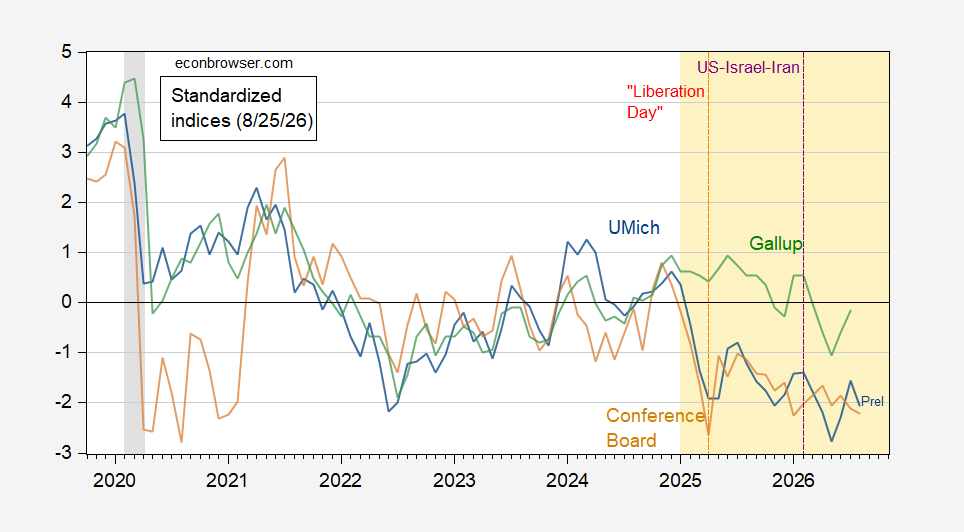
The Conference Board's Consumer Confidence Index registered a decline in August relative to July's confidence level, which had been revised downward, delivering a downside surprise in the latest monthly reading of U.S. household sentiment.
While consumers' perceptions of current conditions improved during the month, the expectations component declined and remains mired at low levels, according to data released by The Conference Board. That forward-looking component draws particular attention because The Conference Board incorporates consumer expectations into its Leading Economic Index for the United States, a composite gauge designed to help signal turning points in the business cycle.
The Conference Board's Consumer Confidence Index is based on a monthly survey of U.S. households conducted by The Conference Board, a business research organization. The headline index is derived from two main components: the Present Situation Index, which measures consumers' assessment of current business and labor market conditions, and the Expectations Index, which reflects their short-term outlook for income, business, and employment. The index is benchmarked so that 1985 equals 100. Readings like this are widely followed because household consumption accounts for roughly two-thirds of U.S. economic output, making consumer mood a closely tracked input for assessing spending conditions.
The August result can be viewed in context alongside other closely tracked gauges of consumer mood, including the University of Michigan's Index of Consumer Sentiment and Gallup's economic confidence series. As shown in the chart accompanying the Econbrowser analysis, the three measures — U. Michigan economic sentiment (blue), the Conference Board Confidence Index (brown), and Gallup confidence (green) — are plotted after being demeaned and divided by their standard deviations over the period 2021M01–2025M02, based on data from UMichigan, Gallup, and the Conference Board, together with the author's calculations. Successive monthly releases from the three measures will show whether the August pattern — firmer current conditions against persistently weak expectations — carries into coming months.

