Condo Prices Fall 15% to 33% in 33 Bigger US Markets as Historic Condo Bubbles Deflate; Six Markets Back Below 2006 Peaks
Key Takeaways
- •Mid-tier condo prices in 33 larger US markets have declined 15% to 33% from their peaks, which occurred between 2021 and 2024 with the vast majority in mid-2022, according to a Wolf Street analysis of Zillow ZHVI data through July.
- •Nine of the 33 markets have seen prices fall 21% or more, and three markets located in California and Florida are down more than 30%.
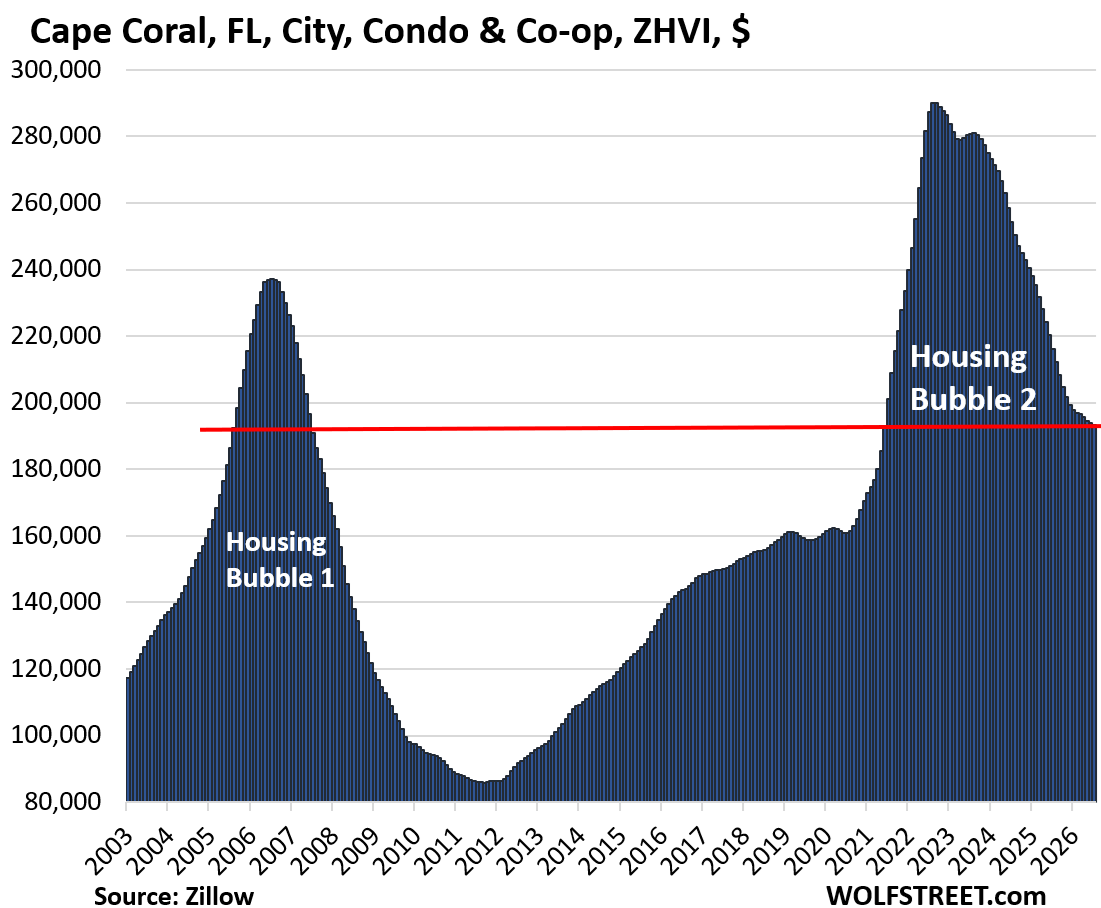
- •Six markets — Oakland, Sarasota County, Cape Coral, Contra Costa County, Fort Myers, and Orlando — have dropped below their 2006 Housing Bubble 1 peaks and returned to mid-2005 price levels.
- •Houston and Tempe crossed the -15% threshold in July to join the list, while no market left it, and 37 other larger cities have recorded declines of 8% to 14% from their peaks.
- •The report attributes the slump to prior price excesses, rising HOA fees and special assessments, Fannie Mae blacklist financing barriers, normalized mortgage rates, retreating foreign buyers, and competition from newly completed higher-end apartment buildings.
Prices of mid-tier condos in 33 bigger US markets have dropped by 15% to 33% from their respective peaks in prior years, with data through July, according to an analysis by Wolf Street. Those peaks occurred between 2021 and 2024, with the vast majority in mid-2022. The report presents these markets in a set of charts under the heading "Historic Condo Bubbles deflate in 33 charts," describing them as bigger markets that broke under their own weight.
In nine of the 33 markets — from Oakland, California, to Jacksonville, Florida — prices of mid-tier condos have fallen by 21% or more; in three of them, located in California and Florida, prices are down by more than 30%. The report characterizes these as substantial price declines over a multiyear period.
In six of the 33 markets, condo prices have already dropped below their Housing Bubble 1 peaks of 2006 and are back where they had been 20 years ago — at mid-2005 levels. Those markets are:
- Oakland, CA
- Sarasota County, FL
- Cape Coral, FL
- Contra Costa County (East Bay), CA
- Fort Myers, FL
- Orlando, FL
Two cities moved up into the line-up of 33 markets in July as their condo prices dropped further and pushed them over the -15% line: Houston, TX, and Tempe, AZ. No market that was on the list in June came off the list in July.
In another 37 bigger cities, condo prices have dropped by 8% to 14% from their respective peaks. There are also many smaller markets where condo prices have dropped just as much or more, but they are not included here because the markets are too small.
Why condos are different
Condos are subject to different dynamics than single-family homes — dynamics that fuel eye-watering booms and massive busts, the report notes. Part of the issue now is the breath-taking two-year price explosion from mid-2020 to mid-2022, which reached 50%, 60%, or even 70% in some cities and came on top of already high and soaring prices. In the 10 years leading up to the peak, prices had soared by 180% to 350% in these markets.
"We're looking at the charts below and are shaking our heads. What were these people thinking, we're thinking with hindsight," the report's author writes. The assessment is that these massive condo bubbles have started to deflate — relentlessly in most cases and brutally in some. For buyers, sellers, lenders, and condo associations, the shift matters because condo pricing can move quickly once financing, fees, insurance, and investor demand all turn less favorable at the same time.
Most of the markets in the line-up are cities. But the list of 33 markets where prices declined by 15% or more includes a few counties whose cities — though household names — are too small to be included individually, as well as New York County, which is Manhattan, where condos are a huge part of the market. It also includes one metropolitan statistical area that groups together several smaller cities.
In some densely populated big cities, condos and co-ops make up a big part or the majority of home sales. In most other markets, condos are a relatively small portion of home sales, which helps explain why the same national housing backdrop can produce very different price patterns across local markets.
Methodology and data
The prices cited are seasonally adjusted three-month averages of "mid-tier" condos and co-ops from the Zillow Home Value Index (ZHVI), a backward-looking index based on millions of data points in Zillow's "Database of All Homes." The underlying data come from public records (tax data), MLS, brokerages, local Realtor Associations, real-estate agents, and households across the US, and include pricing data for off-market deals and for-sale-by-owner deals.
The tables accompanying each market show, from left to right: the price decline from the peak, the change from the prior month (MoM), the change year-over-year (YoY), and the remaining increase since January 2000.
Back to 2005
Prices of mid-tier condos are back to mid-2005 — that is, 21 years ago. Prices have returned to where they had first been in 2005, but they remain very high after the huge run-up in the years before 2022.
The East Bay county in the line-up comprises Concord, Antioch, Pittsburg, Walnut Creek, Richmond, San Ramon, and many other smaller cities. San Mateo County comprises lots of smaller cities that make up the northern part of Silicon Valley.
The 8% to 14% tier
In many bigger cities, condo prices have dropped by less than 15%, and those cities are not included in the line-up of 33. The report provides a sample list of 37 bigger cities where prices have dropped by 8% to 14% from their respective peaks. Several of them are only a few bad months away from joining the line-up, including San Antonio and Dallas, two of the biggest cities in the US.
Special issues condos face
Some people buy condos as a home — to live in an urban center or along the shore, to enjoy the big views, nice amenities, or central location. They value the worry-free living: not having to mess with maintenance, repairs, and yardwork; having staff at a desk by the front door; or not having to climb stairs. Others buy condos as rental properties or as short-term vacation rentals, or as vacation homes. Still others, especially nonresident foreign investors, buy condos to park some cash in the US and watch the price spiral higher from a distance. It is these investors that make condos particularly speculative, the report argues.
Among the special issues the report identifies:
- Land versus building. Over the long term, land appreciates, while most buildings depreciate to zero and are eventually torn down. The land that big condo buildings sit on can be very valuable, but each condo owner only owns a tiny slice of it; the rest of their investment is in the building. A single-family house may sit on less valuable land, but the homeowner owns all of it.
- Prices got too high. Prices that exploded over the past few years ended up being way too high once the mania settled down.
- Special assessments. Hefty special assessments — or the fear of them — for long-neglected major repairs dog some older condo buildings. This is a particular issue in Florida, but elsewhere too.
- Rising HOA fees. Big increases in HOA fees at many properties, partly driven by spiking insurance costs in natural disaster zones, add substantially to the monthly costs of condos.
- Fannie Mae Blacklist. If a condo building is on Fannie Mae's Blacklist, financing a unit in that building gets very difficult, and sales may be limited to cash buyers who know that.
- Mortgage rates normalize. The Free Money has ended, and mortgage rates are roughly back to a normal range — an issue buyers of single-family homes face as well.
- Foreign buyers step back. Foreign-based owners who've had it with the US have become sellers, adding supply, while interest from foreign buyers to purchase a home in the US has waned, removing demand.
- Competition from new apartments. Investors in condos as rental properties are facing stiff competition from a wave of newly completed higher-end apartment buildings that developers are trying to find tenants for.
Related reading
In a related analysis: Oh Dear, Prices of Single-Family Homes Fell by 11% to 26% in 15 Bigger Cities Already
