Codefest Africa Plans to Turn Hackathons Into a Year-Round Innovation Pipeline
Key Takeaways
- •Codefest Africa, founded in 2017, is moving beyond single-event hackathons to create a year-round system that links businesses facing problems with innovators able to solve them.
- •Its 2025 hackathon attracted more than 5,000 participants and 92 teams, a milestone the organization says was cited in Nigeria's National Artificial Intelligence Strategy impact report.
- •Lagos Innovate 2026, hosted by Lagos State University with Technext as media partner, will feature an Innovation Expo and Awards on November 19 gathering companies, government institutions, universities, investors, technology communities and innovators.
- •Under the new model, companies would post challenges as they emerge instead of waiting for scheduled competitions, with promising projects advancing toward testing and real-world application.
- •The organization has not revealed a launch date or funding plan for the platform, and its invitation for companies and institutions to submit challenges will offer an early gauge of the cross-sector support the model requires.
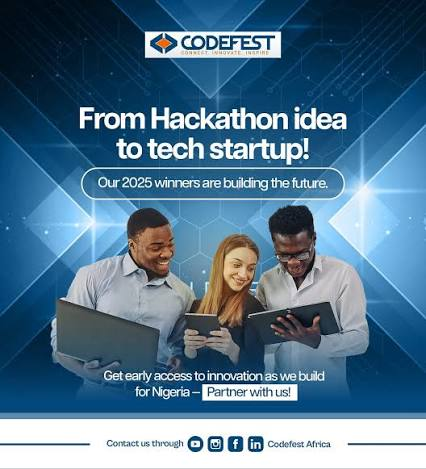
Codefest Africa, the organisation behind a 2025 hackathon that drew more than 5,000 participants, is working to turn one-off competitions into a year-round pipeline connecting businesses with innovators. The goal is to stop promising ideas from losing momentum once an event ends.
The plan will be showcased at Lagos Innovate 2026, an initiative powered by the group and hosted by Lagos State University (LASU), with Technext serving as the event's media partner. Event details are published on the official Lagos Innovate website.
Its Innovation Expo and Awards, scheduled for November 19, will bring together companies, government institutions, universities, investors, technology communities and innovators. Participants are expected to present solutions and explore collaborations.
Why hackathons alone fall short
Founded in 2017, Codefest Africa began with coding initiatives, bootcamps and technology competitions. It later added STEM education for younger learners, along with hackathons that bring developers, designers and researchers together to tackle real-world problems.
According to the organisation, its 2025 hackathon featured 92 teams — a milestone it said was highlighted in Nigeria's National Artificial Intelligence Strategy impact report, a reference that ties its work to the country's national AI agenda.
Even so, the group argues that competitions alone cannot sustain innovation. Teams disperse once an event closes, and promising solutions often stall before they reach real users.
Codefest Africa also identified a gap between training and opportunity: graduates trained to build technology frequently end up doing administrative work instead. Closing that gap, it said, is what its next phase is meant to accomplish.
How the new model would work
Under the proposal, companies would publish challenges as they arise rather than waiting for a scheduled competition. Innovators could then identify those problems, collaborate and develop solutions, with promising projects moving toward testing and real-world application.
The organisation described the approach as a more consistent link between businesses seeking solutions and people with the technical skills to build them. It did not disclose a launch date for the platform or say how it would be funded — two open questions ahead of the Innovation Expo.
Codefest Africa framed the ambition as going beyond successful events to a pipeline in which talent consistently meets real-world needs.
What Lagos Innovate adds
For the group, the event serves as a test of the collaboration it hopes to encourage: businesses presenting challenges, innovators building answers, and institutions creating room for ideas to grow.
Technext, in its role as media partner, is tasked with extending coverage beyond the venue and spotlighting emerging ideas, innovators and the communities behind them.
Delivering the model will take more than one organisation, the group stressed. Businesses, institutions, universities and technology communities would all need to contribute challenges, people or resources.
Companies and institutions are being invited to submit challenges that innovators can work on, as the organisation pursues a system in which innovation continues beyond individual events. How widely that invitation is taken up will provide an early measure of the cross-sector involvement the group says the model requires.

