Senate Delays CLARITY Act Vote Until September as Pre-Recess Negotiations Stall
Key Takeaways
- •Senate Majority Leader John Thune announced the CLARITY Act will be taken up in September after Democrats blocked a timing agreement needed to advance the bill before the August recess.
- •The legislation aims to establish a framework dividing digital asset oversight between the SEC and CFTC, resolving a long-standing jurisdictional gray area in cryptocurrency regulation.
- •Democratic senators are demanding stronger ethics provisions targeting federal officials with financial ties to crypto companies, including a proposal requiring divestment of stakes exceeding $1 million and 10% ownership.
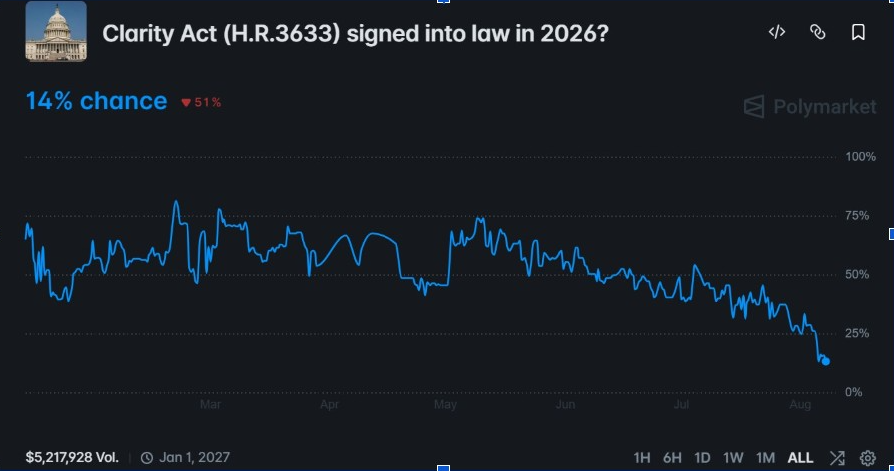
- •Polymarket traders have lowered the probability of the bill becoming law in 2026 to 14%, reflecting a 51% decline and a sharp drop from above 70% in early May.
- •Even if the Senate passes the bill in September, the House would need to approve any amended version before the legislation could proceed to the president's desk.
The CLARITY Act will not receive a Senate vote before lawmakers depart Washington for the August recess. Senate Majority Leader John Thune announced that the chamber intends to take up the cryptocurrency market structure bill in September, after Democrats blocked a timing agreement required to advance pre-recess business.
The Digital Asset Market Clarity Act, designated H.R. 3633, aims to divide cryptocurrency oversight between federal regulators by establishing a framework that determines when a digital asset is treated as a security under SEC jurisdiction and when it is regulated as a commodity under CFTC authority. The bill represents the most significant congressional attempt to resolve a jurisdictional gray area that has persisted since crypto markets emerged, leaving firms uncertain about which agency's rules apply to their products. Advancing the legislation on the Senate floor requires 60 votes, meaning bipartisan cooperation is essential.
Senate Schedule Shifts as Democrats Decline Time Agreement
Republican leaders had hoped to include the CLARITY Act in the Senate's final schedule before the recess. That effort failed when Democrats declined to approve a time agreement covering the chamber's remaining business.
Thune stated that Democrats opposed holding a CLARITY Act vote prior to the recess, but noted that Republican leadership plans to position the bill near the top of the agenda when the Senate reconvenes. Thune could still file cloture to initiate the process of bringing the legislation to a floor vote, though the Senate is not expected to complete that procedure before the recess begins.
The delay provides additional time for negotiations ahead of a potential September vote. Eleanor Terrett reported on the developments.
Ethics Provisions Remain a Central Point of Contention
Democratic senators continue to push for stronger ethics restrictions applicable to federal officials with financial ties to digital asset companies. Their proposal specifically targets President Donald Trump and cryptocurrency businesses connected to his family. In July, several Democratic senators rejected an earlier version of the bill over these ethics concerns, as covered in The Market Periodical's prior reporting.
A bipartisan counterproposal under discussion would require certain federal officials to divest substantial ownership stakes in affected companies. The provision would reportedly apply when an official holds more than $1 million in value and at least 10% of a company. Senators have not yet announced a finalized agreement on that language. Senate Republicans released an updated version of the bill in late July.
Republican support also faces pressure from other policy areas. Senator Josh Hawley has indicated he could oppose the measure if changes addressing community bank concerns are not incorporated.
Polymarket Odds Decline Sharply
Prediction market participants have significantly lowered their expectations for the CLARITY Act becoming law in 2026. According to the Polymarket contract, the probability of passage now stands at 14%, reflecting a 51% decline. Trading volume on the contract is near $5.22 million.
The probability had been above 70% in early May before declining steadily through June, July, and early August. The most pronounced recent drop coincided with the narrowing of the Senate's August schedule and the shift of the planned vote to September. Prediction market contracts can shift rapidly in response to developments such as a scheduled vote, a negotiated agreement, or a breakdown in talks.
September Vote Would Still Require Bipartisan Cooperation
The August recess affords bill sponsors additional time to negotiate with uncommitted senators. September will test whether lawmakers can resolve outstanding ethics language, banking-related concerns, and other provisions before leadership schedules a floor vote. Earlier reporting indicated the Senate might release final bill text in early July.
A Senate vote would not complete the legislative process by itself. If the Senate approves a version differing from the House-passed measure, the House would need to accept those changes. The legislation would then proceed to the president's desk only if both chambers pass identical text.
The CLARITY Act's path mirrors that of the earlier GENIUS Act, which followed a difficult Senate trajectory after failing its first cloture vote. Lawmakers ultimately revived and passed that measure following further negotiations. The CLARITY Act now enters a comparable phase of vote counting and policy discussions when Congress returns.

