U.S. Spot Bitcoin ETFs Draw Nearly $800 Million as Coldcard Exploit Sparks Custody Debate
Key Takeaways
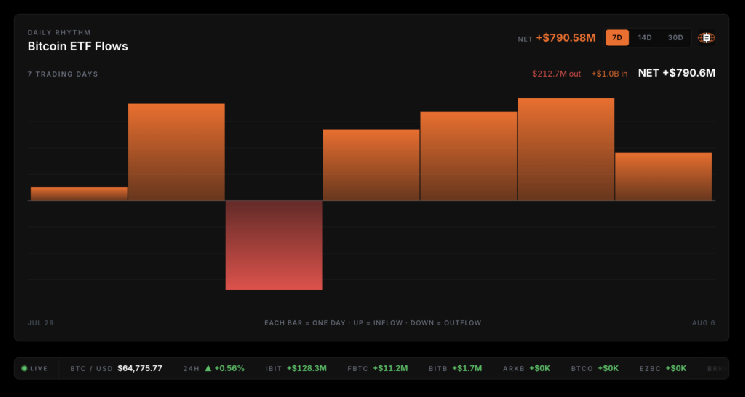
- •U.S. spot Bitcoin ETFs attracted $790.6 million in net inflows over seven trading days, with gross inflows exceeding $1 billion and $212.7 million in outflows.
- •A firmware exploit affecting certain Coldcard hardware wallets emerged during the same period, reigniting industry-wide discussions about self-custody and operational security practices.
- •BlackRock's IBIT dominated ETF inflows with $757.5 million in rolling net inflows and extended its streak to four consecutive inflow days.
- •A single negative session on July 31 was more than offset by four consecutive days of gains from August 3 through August 6.
- •Institutional demand for Bitcoin ETFs remained resilient despite security concerns dominating headlines, indicating investors continued allocating capital through regulated products during the period.
U.S. Spot Bitcoin ETFs Draw Nearly $800 Million as Coldcard Exploit Sparks Custody Debate
A firmware exploit affecting certain Coldcard hardware wallets emerged last week as one of the year's most significant Bitcoin security stories, reigniting industry-wide discussions about self-custody and operational security.
Simultaneously, U.S. spot Bitcoin ETFs were quietly posting one of their strongest weeks in recent months. Over the same seven trading days, these funds attracted $790.6 million in net inflows, according to the Bitcoin For Corporations ETF Dashboard. Gross inflows exceeded $1.0 billion, while $212.7 million exited the funds.
Since their January 2024 launch, U.S. spot Bitcoin ETFs have become one of the most closely watched barometers of institutional interest in digital assets, with weekly flow data scrutinized for signals about the direction and conviction of large-scale capital allocation.
The two developments are not necessarily connected. ETF flow data reveals where capital moved, not why investors allocated to Bitcoin. However, during a week dominated by security headlines, institutional capital continued flowing into regulated Bitcoin investment products.
One Outflow Day Did Not Alter the Trend
The seven-day flow chart was straightforward, with a single notable setback. On July 31, U.S. spot Bitcoin ETFs recorded $212.7 million in net outflows — the only negative session during the period.
Buyers returned almost immediately. The following four trading sessions posted consecutive gains:
- Aug. 3: +$170.1M
- Aug. 4: +$207.8M
- Aug. 5: +$241.6M
- Aug. 6: +$99.4M
By week's end, the positive sessions had more than offset the single day of outflows. The seven-day view shows that capital ultimately moved into Bitcoin-related ETF products.
BlackRock's IBIT Dominated Inflows
BlackRock's IBIT continued its pattern of leading ETF inflows, consistent with much of the spot Bitcoin ETF era. BlackRock, the world's largest asset manager with over $10 trillion in assets under management, launched IBIT to broad institutional interest, and the fund has consistently captured the largest share of spot Bitcoin ETF flows.
Over the seven-day period:
- IBIT attracted $757.5 million in rolling net inflows.
- It extended its streak to four consecutive inflow days.
- On the latest trading day alone, it added $128.3 million.
Other issuers also saw participation. Fidelity's FBTC added $11.2 million on the latest session, while Bitwise's BITB added $1.7 million. A handful of funds experienced modest outflows, but none came close to offsetting IBIT's strength. The breadth of inflows across multiple issuers, rather than concentration in a single fund, kept total ETF demand firmly positive for the week.
What ETF Flow Data Reveals — and What It Does Not
ETF flows provide one of the clearest windows into institutional Bitcoin participation, showing precisely where capital moved. They do not, however, explain investor motivation.
From a single week's data, it is not possible to determine whether buyers viewed the Coldcard exploit as inconsequential, saw it as a buying opportunity, or were simply executing pre-existing long-term allocation strategies.
What is observable is that institutional demand remained resilient during a week when Bitcoin security concerns dominated industry headlines. A security incident involving one specific custody solution is distinct from the broader investment thesis for Bitcoin, and ETF investors appeared comfortable continuing to allocate capital through regulated products.
Context: Multiple Paths to Bitcoin Exposure
Bitcoin can now be accessed through several channels. Some investors choose self-custody, a practice long championed within Bitcoin's culture as essential to the asset's core value proposition of eliminating trusted intermediaries. Others hold Bitcoin through public companies. Many institutions gain exposure through regulated ETFs, where custody is handled by qualified institutional custodians subject to regulatory oversight. Each approach carries its own tradeoffs, operational considerations, and risk profile.
Hardware wallet exploits, while relatively rare, have historically prompted fresh reviews of custody practices across the ecosystem — from individual users auditing their own setups to institutions reassessing their qualified custodian relationships.
Events such as the Coldcard exploit naturally draw greater scrutiny to custody practices. ETF flow data, meanwhile, offers a measurable lens into whether institutional demand is shifting beneath the headlines. This week, the data indicated that demand held steady.
This article first appeared on Bitcoin Magazine and was written by Nick Ward.

