Clarity Act Gets Last-Minute Revision Before Sept. 15 Senate Vote, With 60 Votes Still in Doubt
Key Takeaways
- •Senate Republicans released a revised 'last, best and final' text of the CLARITY Act containing 126 Democrat-requested changes, though disagreements remain over ethics provisions, stablecoin rewards, and developer protections.
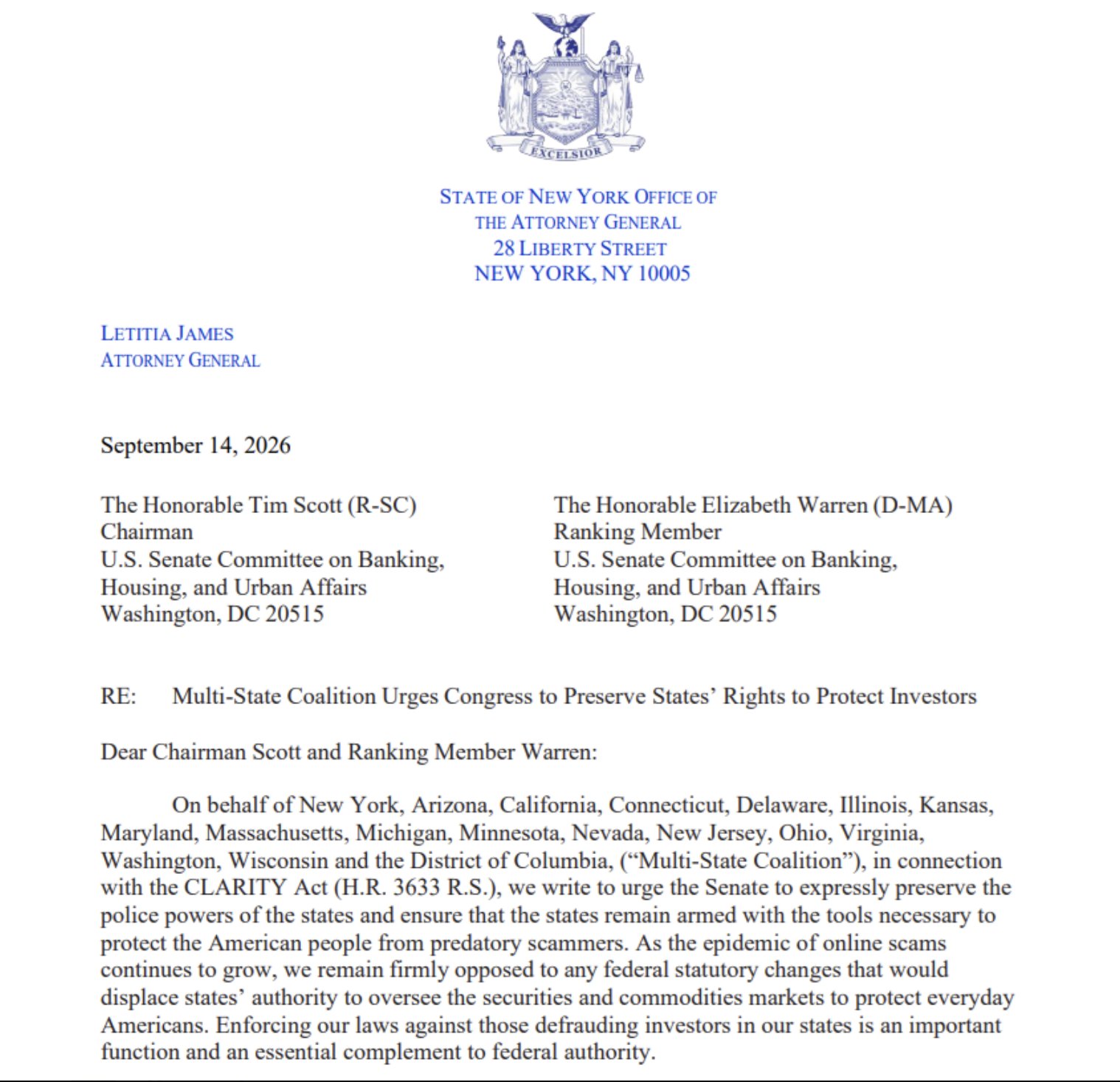
- •A bipartisan group of 18 state attorneys general, led by New York's Letitia James, urged Congress to reject the bill, arguing its federal preemption provisions could limit states' ability to investigate crypto fraud and protect investors.
- •Eight banking trade groups demanded tighter restrictions on stablecoin rewards, criticizing a 'circuit breaker' provision they argue would take effect only after a major shift of deposits from banks into stablecoins.
- •Sen. Ruben Gallego said the bill's latest ethics proposal leaves much to be desired, and Senate Democrats met on the evening of September 14 to formulate a counterproposal ahead of the vote.
- •A failed cloture vote would not kill the legislation, since Senate leaders can continue negotiating and schedule another attempt, with the outcome indicating how far both sides remain from the 60-vote threshold.
The Digital Asset Market Clarity Act entered its final hours before a pivotal Senate procedural vote scheduled for Tuesday, September 15, with key negotiations still unresolved. Eight banking trade groups are pressing for tighter restrictions on stablecoin rewards, Senate Democrats are preparing a counterproposal to the Republican draft, and industry leaders — including Coinbase CEO Brian Armstrong — have expressed optimism that the bill can secure the 60 votes needed to advance.
Final Text, Unresolved Disputes
The pressure surrounding the vote intensified after Senate Republicans released what they described as their "last, best and final" text. That version incorporated 126 changes requested by Democrats, but disputes persisted over ethics provisions, stablecoin rewards and developer protections.
Under Senate rules, 60 votes are required to invoke cloture — the mechanism for ending debate and moving legislation toward floor consideration — meaning Tuesday's vote tests whether negotiations can close, not whether the bill becomes law. Industry executives remained publicly optimistic, but lawmakers had not secured that threshold as of Monday night.
State Attorneys General Urge Congress to Reject the Bill
A bipartisan group of 18 U.S. state attorneys general, led by New York Attorney General Letitia James, is urging Congress to reject the Digital Asset Market Clarity Act. The attorneys general argue that the bill's federal preemption provisions could limit states' ability to investigate cryptocurrency fraud and protect investors — a dispute at the center of the broader debate over establishing federal crypto market rules without weakening state-level investor protections. Federal preemption, the principle that federal law displaces conflicting state rules, determines which level of government writes and enforces the rules market participants must follow.
The Senate is scheduled to hold its procedural vote on the legislation on Tuesday, September 15.
Commenting on the state of play, Eleanor Terret of Crypto In America wrote on X: "it appears that a growing number of Senate Democrats who have been open to supporting the Clarity Act remain unhappy with where the ethics provisions stand."
Banking Groups Press for Stricter Stablecoin Rules
As the attorneys general's arguments drew attention, crypto expert Omid Malekan noted on X that the current debate over stablecoin yields echoes the battle over money market funds in the 1970s. That historical parallel runs deep: money market funds won deposits by paying market-driven yields while Regulation Q capped the interest banks could pay on deposits, and the standoff only ended when Congress voted in 1980 to phase out those caps.
Eight banking trade groups have criticized the "circuit breaker" added to the latest CLARITY Act text, arguing that the provision would take effect only after a major flight of capital from bank deposits into stablecoins. In a letter to Senate leaders, the groups called for further tightening of the bill's stablecoin rewards provisions and flagged loopholes that could permit interest-like payments on stablecoin balances.
The groups' core demand remains unchanged: tighter restrictions on stablecoin rewards.
Nate Geraci, president of Novius Dius Wealth Management, said on X: "The only reason Clarity Act hasn't passed yet is b/c crypto disrupts the traditional banking model. It's really that simple. We can talk ethics, BRCA, etc."
"But it all boils down to crypto reducing the need for banks as intermediaries & disrupting net interest income model. And the politicians who are incentivized to support that model," he added.
Democrats Prepare Counterproposal
After reviewing the revised text on September 14, Sen. Ruben Gallego (D-Ariz.) told reporters that the latest crypto ethics proposal in the CLARITY Act "leaves a lot to be desired," adding that he plans to submit a counterproposal soon.
A group of Senate Democrats met on the evening of September 14 to discuss strategy and formulate a response to the Republican revision released the day before — less than 24 hours before the bill faced its first major test on the Senate floor. Republicans had already characterized the latest version as their "last, best and final" offer.
Eleanor Terret reported on X, citing industry sources, that the Democratic counterproposal is expected to address most, if not all, of the targeted changes Republicans made to the bill. It remains unclear whether Republicans will make further concessions ahead of the vote. The objective is to reach the 60 votes needed for the CLARITY Act to pass.
The 60-Vote Threshold
Patrick Witt, the White House crypto advisor, said he feels "very good" about the initial Senate vote on the crypto regulatory bill, noting that the legislation would regulate the crypto industry at the federal level for the first time.
"Whether or not we get 60 votes is going to be a political calculation, not a policy calculation because this truly is a bipartisan bill that is worthy of support," Witt said.
Coinbase CEO Brian Armstrong said he is "pretty optimistic" that the CLARITY Act will secure more than 60 votes in the Senate on September 15. He noted that thousands of hours of bipartisan work have gone into the legislation and described the upcoming vote as a "massive moment" for U.S. leadership in crypto and finance.
Under Senate practice, a failed cloture vote would not kill the bill: leaders can continue negotiating and schedule another attempt, so Tuesday's result would measure how far both sides remain from the 60-vote threshold.
This article is for informational purposes only and does not constitute legal, financial or investment advice. Legislative proposals can change during negotiations and may not become law in their current form.
Source: The Market Periodical

