Circle Shares Fall Despite New York Trust Charter for USDC Oversight
Key Takeaways
- •Circle secured a New York limited-purpose trust charter to supervise its USDC reserves and offer digital asset custody services.
- •The New York charter follows a recent federal trust approval from the Office of the Comptroller of the Currency, establishing dual oversight for Circle.
- •Shares of Circle fell roughly 7% as Bernstein lowered its price target by 25% from $190 to $140.
- •Circle is scheduled to report its second-quarter 2026 financial results on August 5.
- •USDC maintained a market capitalization exceeding $71.8 billion following the regulatory announcement.
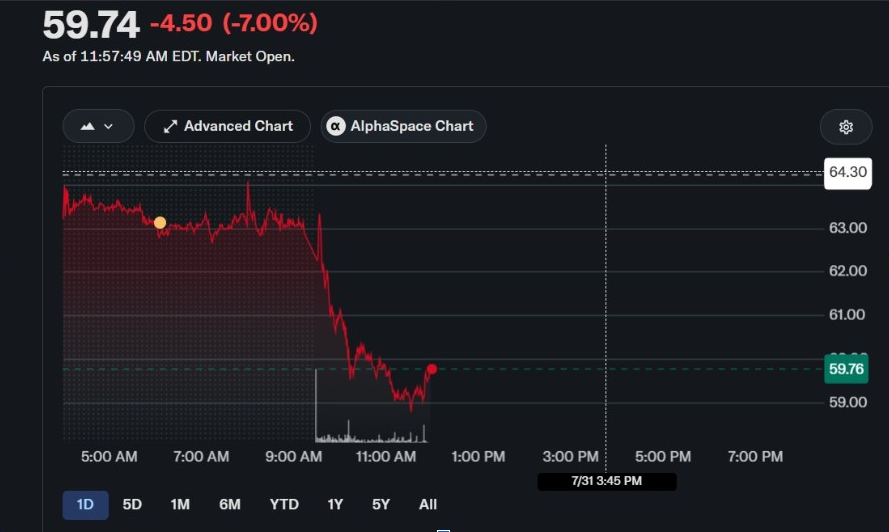
Circle stock fell about 7% on Friday even after reports that the company secured a New York limited-purpose trust charter to expand oversight of USDC reserves.
Circle won an NYDFS trust charter that allows Circle Internet Trust Company LLC to provide fiduciary, custody and asset services under New York banking law. The company said the structure would place oversight of USDC reserves within its New York trust framework. Circle's New York charter complements its earlier approval from the Office of the Comptroller of the Currency, creating both state and federal oversight for USDC-related services. The dual-charter approach comes as U.S. stablecoin regulation advances through Congress, with the Senate passing the GENIUS Act in June 2025 to establish a federal framework for payment stablecoins.
USDC had a market capitalization above $71.8 billion when Circle announced the NYDFS trust charter on Friday.
By 11:57 a.m. EDT, CRCL was trading near $59.74, down about $4.50 from the previous close. The stock opened under pressure and extended losses through the morning session, falling from above $63 to an intraday low near $59 before recovering slightly to around $59.76. Trading volume increased during the decline as shares broke below $61. The chart showed earlier trading near $63 before sellers accelerated the move lower after 9:30 a.m. EDT, with the price dropping below $62 and then $61 in quick succession. Buyers attempted a rebound near $59, but the stock remained near session lows as midday trading approached. The chart also indicated nearby resistance around $64.30, while CRCL first faced the $60 level and then the earlier trading area near $62.
The reported approval would allow Circle Internet Trust Company LLC to provide specified custody, fiduciary and virtual-currency services under New York Banking Law. Circle will operate the entity as Circle New York Trust. The company also plans to place USDC reserve oversight within the trust structure.
Circle said the entity will provide digital asset custody services to institutional customers, and it expects USDC issuance to move into the New York operation over time. Circle previously operated in New York under a BitLicense, which it received in 2015. The new charter adds trust-company supervision and broadens the company's regulated financial service capabilities.
Other digital asset firms already operate under similar New York trust structures. Coinbase, BitGo, Paxos and MoonPay have received limited-purpose trust charters from the state regulator. These approvals allow firms to conduct specified financial activities under direct supervision. Circle's approval places its USDC reserve operations within a framework New York applies to regulated trust companies. NYDFS will also examine governance, compliance, controls and reserve management.
The NYDFS approval follows the Office of the Comptroller of the Currency's federal authorization of Circle National Trust, which Circle received earlier in July. The National Trust Bank can provide custody and fiduciary services, but it cannot accept consumer deposits or issue traditional loans like a commercial bank.
Circle plans to use the federal entity for custody and as a collateral trustee. The New York trust company will support regulated USDC issuance and reserve oversight. Together, the two approvals give Circle separate state and federal channels for its stablecoin and institutional services. The company has linked both approvals to its broader plan for regulated digital financial infrastructure.
USDC remains the second-largest stablecoin, with a market value above $71.8 billion. The token also saw strong transaction activity in June, when Circle reported $1.2 trillion in monthly USDC volume, compared with $573 billion for USDT. Higher regulated usage could support reserve income, custody demand and institutional access, although financial results remain central for shareholders.
Circle will report second-quarter 2026 results on August 5. Investors are expected to focus on revenue, reserve income, operating costs and USDC circulation. Interest rates affect Circle because the company earns income from the assets backing USDC, and changes in stablecoin supply and market activity can influence quarterly performance.
Bernstein cut its Circle stock price target by 25%, reducing it from $190 to $140 before the earnings report. The revision added another concern during Friday's session. The lower target still sits above the current share price, but the cut altered expectations as traders also assessed competition from new stablecoins, including PayPal's PYUSD and other regulated entrants, and possible pressure on Circle's market share.

