Circle Minted 10 Billion ARC Tokens: What Changed for Arc, and What Did Not
Key Takeaways
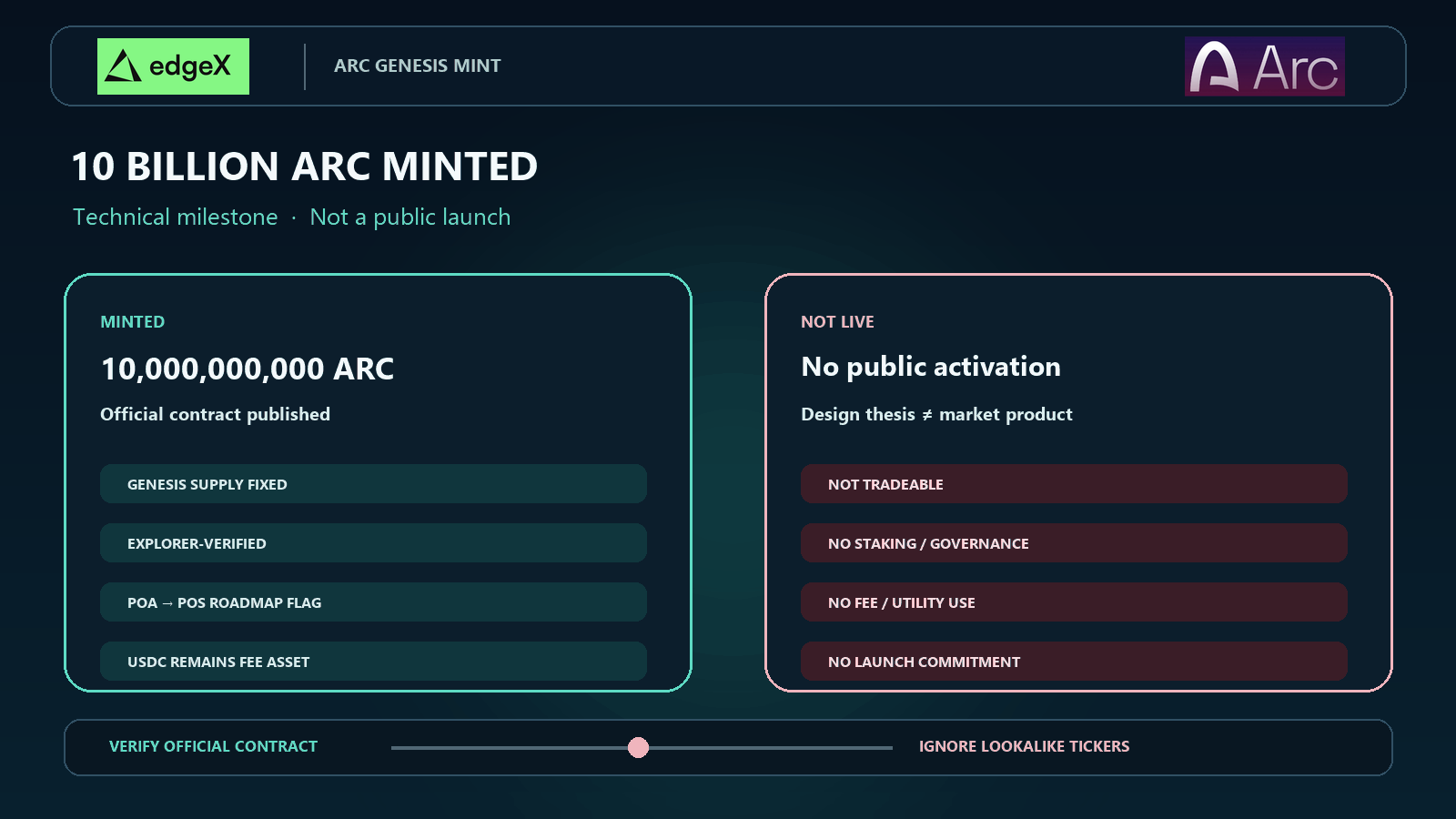
- •Circle minted the complete 10 billion ARC supply and published a verified official contract on Arc mainnet, which it describes as the first network-token mint by a publicly traded company for a new blockchain.
- •The mint does not commit Circle to a public token launch, and ARC is not live for trading, staking, governance, fees, or any utility.
- •The mint is framed as a technical milestone on a possible transition from Proof of Authority to Proof of Stake, with the network exploring a Proof-of-Stake model in 2027.
- •Arc's live fee and settlement rail remains USDC, and the chain supports real trading without ARC, including edgeX's 150+ perpetual contracts across stocks, commodities, crypto, and FX beginning with JPY pairs.
- •Readers are advised to verify the official contract address through Arc's own channels, as high-profile mints often attract fake claim pages and lookalike tickers.
Quick Answer
Two things happened around Arc's mainnet launch. One is getting most of the attention. The other is the one traders can use today.
Circle minted 10 billion ARC tokens and published an official contract. At the same time, Arc made clear that the mint is not a public-launch commitment and that ARC is not live for trading, staking, governance, fees, or utility. The current fee and settlement rail remains USDC.
That means the mint answers a narrow question: does an official ARC token contract exist on Arc? It does. It does not answer whether the public can use ARC today. For market participants, the more immediate fact is that Arc is already hosting live perpetual markets. edgeX is live on Arc with 150+ contracts across stocks, commodities, crypto, and FX.
https://x.com/edgeX_exchange/status/2100181275684618541
The Mint Is Real. The Token Is Not Live.
What Circle and Arc announced
Arc's X announcement puts the facts in a short sequence: ARC has been minted; Circle presents itself as the first publicly traded company to mint a network token for a new blockchain; the mint is a technical milestone tied to a possible move from Proof of Authority toward Proof of Stake; and the mint does not commit Circle to a public launch. The same post publishes the official contract and repeats that ARC is not live for public use, trading, staking, governance, fees, or utility.
https://x.com/arc/status/2100287180878844250
Arc's mainnet launch blog uses the same framing. Circle says it completed the genesis mint in the United States, created the
full initial supply of 10 billion tokens, and describes ARC as designed to serve as a coordination mechanism for security, utility, and governance, while network fees remain payable in USDC. The blog again states that the mint is not a commitment to publicly launch ARC, but a technical milestone as the network explores a Proof-of-Stake path in 2027.
That disclosure matters. Many networks mint a token and let the market fill in the blanks. Arc and Circle minted while telling readers not to fill those blanks in.
What the explorer confirms
The official contract is on the Arc explorer at `0xA12Cd81d0f9988E3d60c4B6a0D52D368Ef3c788d`. The token page shows a total supply of 10,000,000,000 ARC, a small holder set, and a verified contract. That confirms one thing only: an official ARC contract exists on Arc Mainnet.
It does not confirm market readiness. A verified contract can sit dormant. A fixed supply can remain outside public circulation. A high-profile mint is also exactly when lookalike tickers and fake claim pages tend to appear. The safe path is simple. Start from Arc's own link, confirm the contract address, and treat every other ticker as unverified.
| Question | Current answer | Why it matters |
|---|---|---|
| Was ARC minted? | Yes | The contract and 10B supply are real |
| Is there an official contract? | Yes | Readers can verify the address on Arc explorer |
| Is ARC publicly launched? | No commitment stated | Mint ≠ launch |
| Can the public trade, stake, or use ARC today? | No | Official materials say it is not live |
| Does Arc still run as Proof of Authority? | Yes | Broader PoS participation remains future work |
| Are network fees paid in USDC? | Yes | Live activity does not depend on ARC activation |
Live Markets Are a Separate Story
The mint can dominate the timeline without defining what Arc is useful for today. Arc launched as a USDC-native settlement environment. Gas is paid in USDC. Finality is designed to be fast and deterministic. Applications can settle without waiting for a network token to turn on.
That is the practical split. ARC is a prepared coordination asset. USDC is the live economic rail. Traders should not confuse the two.
edgeX sits on the live side of that split. As a day-one market layer on Arc, edgeX offers 150+ perpetual markets across equities, commodities, and crypto, plus continuous FX perpetuals beginning with JPY. Margin and settlement stay in native USDC, which matches Arc's fee design and removes the usual need to hold a separate gas asset across the trade lifecycle. In short: the token mint is a roadmap event; the markets are already a product event.
More detail on that market design is in edgeX's note on Arc mainnet perpetual markets. The useful takeaway for this article is narrower. Arc did not need ARC to be publicly active in order to host real trading. The settlement layer and the market layer can move first.
Why Mint Before Activation
A technical milestone on the PoA to PoS path
Arc opened with a permissioned validator set and USDC gas. That prioritizes day-one clarity for payments, markets, and institutional workflows. A native coordination token is not required for that first phase. It becomes more relevant if the network later wants broader participation in security and economic governance through Proof of Stake.
The mint is infrastructure preparation. Creating the supply, publishing the contract, and linking the event to a possible 2027 Proof-of-Stake exploration keeps a coordination-asset path open without turning that path into a live incentive market. Circle is separating chain readiness from token activation.
That sequencing also blocks a common mistake. Many chains use one token for gas, staking, and governance from day one, so readers assume every mint is an immediate product launch. Arc breaks that pattern. USDC carries fees now. ARC remains a designed coordination layer until official activation says otherwise.
Why the public-company framing matters
Circle's claim that it is the first publicly traded company to mint a network token for a new blockchain is a corporate milestone, not a trading signal. It matters because a listed issuer usually attaches more caution and more explicit "subject to change" language to network-token events.
Readers should treat that caution as part of the disclosure, not as fine print to skip. The same announcement that marks the mint also walls off the inferences that usually drive speculative cycles: no public-launch commitment, no live utility, no current staking or governance activation. If those walls move later, the move should come from official channels.
How ARC Is Designed to Work If Activated
The ARC whitepaper page and the earlier whitepaper introduction describe ARC as a native coordination asset, not as a replacement for stablecoin settlement. The design separates three layers: Arc as the execution environment, stablecoins as the transactional medium, and ARC as the coordination mechanism that could align security, governance, fee mechanics, and broader participation over time.
Coordination asset, not current gas token
Under the published design, ARC is meant to connect reinforcing functions rather than serve as day-to-day spending money. Economic governance would let participants help shape parameters such as fees, inflation, and burn logic. Fee mechanics would connect stablecoin-based network activity to ARC through conversion into rewards and a burn path. Broader network participation would support a future Proof-of-Stake model in which validators and stakers can earn from inflation-funded issuance and protocol fees. Platform utility would expand with the stack, including potential fee reductions and access mechanics as services grow.
That is a coherent design. It is still a design. Official materials continue to say ARC has not been launched for public use and that potential functionality remains subject to change.
| Designed function | What the design says | Current status |
|---|---|---|
| Staking and security participation | Support future PoS through staking/delegation; rewards from fees and inflation | Not active |
| Fee conversion and burn | Convert stablecoin-based fees into ARC; route value to stakers and burn | Not active |
| Economic governance | Vote on parameters such as fees, inflation, and burn logic | Not active |
| Platform utility | Broader utility across services, with potential fee reductions and access benefits | Not active |
| One network token | Single coordination asset for the stack | Minted; not publicly launched |
Read utility claims as conditionals
The clean way to read the whitepaper is to turn every utility bullet into an if-statement. Staker rewards from fees and inflation matter if Proof of Stake and reward modules activate as designed. Service discounts matter if holder utility is enabled across platform features. Fee conversion and burn matter if those mechanics ship onchain. Governance matter if voting is turned on and scoped as published.
That habit prevents two mistakes. The first is dismissing the mint as empty theater. A published contract, fixed initial supply, and explicit roadmap linkage are real preparatory steps. The second is treating design language as a live product catalog. Until activation is announced, ARC's utility stack is architecture, not currently available yield, voting power, or service access.
What to Watch Next
The next evidence will not come from social noise around the mint. It will come from official decisions and visible network changes.
Watch for a public-launch decision stated as a decision. Watch for staking, delegation, or governance modules described as live, with documentation that matches the contracts. Watch for fee-conversion and burn mechanics that can be observed onchain. Watch for clear distribution and eligibility rules if any public availability path appears. Watch whether Arc's validator model actually moves from Proof of Authority toward broader Proof-of-Stake participation on the exploratory timeline Circle has flagged.
Also watch the scam surface. A mint paired with an explicit "not live" disclaimer is fertile ground for fake claim sites and lookalike tickers. Start from Arc or Circle properties, confirm the contract address, and ignore the rest until those properties say otherwise.
And keep the live-market layer in view. Arc mainnet is up. USDC is the fee asset. Perpetual markets are already trading on Arc through edgeX. ARC may become central later. It is not the dependency that makes Arc usable now.
Investor Summary
Circle's ARC genesis mint is a controlled infrastructure event attached to Arc's mainnet launch. Ten billion tokens were created. An official contract was published. Circle framed the mint as a technical milestone on a possible path from Proof of Authority to Proof of Stake, while stating that the event does not commit it to a public token launch. ARC remains inactive for trading, staking, governance, fees, and utility.
The whitepaper maps a future coordination role: security participation, economic governance, fee conversion and burn, and expanding platform utility, while stablecoins remain the transactional layer. That map is useful. It is not activation. The sharper question for market participants is simpler. Arc is already live as a USDC settlement environment with real markets on top of it. ARC's public role, if any, still depends on later official decisions.
Final Takeaway
The genesis mint closes one uncertainty and opens a stricter one. ARC exists on Arc as an official, supply-defined token contract. It does not exist as a public market instrument or a live coordination system. Readers who keep those statements separate will understand the event. Readers who collapse them into "the token launched" will misread both the disclosure and the roadmap.
For now, the disciplined read is straightforward. Verify the contract. Treat the whitepaper as design, not activation. Ignore lookalikes. Judge Arc's present usefulness by USDC settlement and live markets, and judge ARC by future official decisions rather than by the mint alone.
Trade Perpetual Markets on edgeX With Arc Settlement
While ARC remains inactive as a public token, Arc already supports live USDC-margined trading. edgeX is live on Arc with 150+ perpetual contracts across stocks, commodities, crypto, and FX. The market set includes continuous FX perpetuals beginning with JPY, built for an always-on settlement environment where gas, margin, and settlement can stay in USDC.
That is the practical complement to the mint story. Arc provides the USDC-native settlement layer. edgeX provides the order-book market layer on top of it: one account, one collateral pool, and perpetual markets that remain available when traditional equity and commodity sessions are closed. Circle Ventures is an investor in edgeX, and the teams previously worked together on native USDC issuance and CCTP integration for EDGE Chain. Launching on Arc extends that work into production.
Explore edgeX for the platform and available perpetual markets, or open the JPY perpetual on Arc directly. Planned next steps include expanding major FX pairs by liquidity and demand, adding USDC-based FX spot markets, and later considering non-USD stablecoins as margin once those conditions are in place. Product details can still change.
Perpetual contracts are built for active traders, not passive holders. Leverage, funding, oracle design, liquidity, and liquidation can all affect outcomes. Review the product terms and risk controls before trading.
Frequently Asked Questions
Did Circle launch the ARC token?
No. Circle minted ARC and published an official contract, but official materials say the mint is not a commitment to a public launch and that ARC is not live, tradeable, or available for public use.
Is ARC the gas token on Arc today?
No. Current Arc design keeps network fees payable in USDC. ARC is described as a coordination asset for possible later security, governance, and utility roles.
Can traders use Arc without ARC being active?
Yes. Arc's live fee and settlement rail is USDC. Market activity on Arc, including edgeX perpetual markets, does not require ARC to be publicly launched.
Does the mint confirm staking or airdrop eligibility?
No. Official announcements state that staking, governance, fees, and utility are not active. No airdrop, snapshot, or claim program should be assumed without a later official publication.
How should readers verify the official contract?
Start from Arc's own announcement or token materials, then confirm the explorer address `0xA12Cd81d0f9988E3d60c4B6a0D52D368Ef3c788d`. Do not trust lookalike tickers or forwarded claim links.

