Chip and AI Stocks Slump, Dragging Nasdaq Indices Lower as Sandisk Falls 10.16%
Key Takeaways
- •Semiconductor and AI stocks fell broadly on Monday, August 24, dragging the Nasdaq indices and the broader US equity market lower.
- •The Nasdaq 100 declined 1.30%, the Nasdaq Composite fell 0.90%, and the S&P 500 slipped 0.37%.
- •Sandisk led the declines with a 10.16% drop; it is the NAND flash memory maker spun off from Western Digital in February 2025.
- •The Nasdaq 100 fell more than three times as much as the S&P 500, showing the pressure was concentrated in technology rather than spread evenly across the market.
- •Greg Michalowski's technical analysis found the Nasdaq 100 the most bearish, the Nasdaq Composite shifting modestly bearish, and the S&P 500 more neutral.
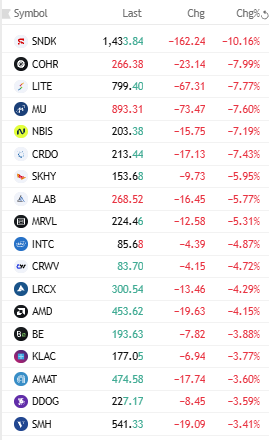
Semiconductor and artificial intelligence stocks came under heavy selling pressure on Monday, August 24, dragging the technology-heavy Nasdaq indices lower and weighing on the broader US equity market.
Chip and AI names sit at the center of the AI infrastructure buildout, and because that theme has driven much of the technology sector's strength in recent years, broad pullbacks in the group tend to translate quickly into index-level pressure.
Among the AI and semiconductor names on the author's watchlist, Sandisk was leading the declines, down 10.16%. Sandisk is the NAND flash memory maker spun off from Western Digital in February 2025, and memory companies are historically volatile because their profitability swings with memory-price cycles. The weakness was broad-based across the chip sector rather than concentrated in a single name — the type of move usually gauged against sector benchmarks such as the PHLX Semiconductor Index (SOX) — which amplified the pressure on the technology-focused benchmarks.
The selling left the major indices materially lower on the day:
- Nasdaq 100: -1.30%
- Nasdaq Composite: -0.90%
- S&P 500: -0.37%
The divergence across the three benchmarks reflects their composition. The Nasdaq 100 tracks the 100 largest non-financial companies listed on the Nasdaq exchange and carries a heavy weighting in technology names, which is why it bore the brunt of the decline. The Nasdaq Composite, which encompasses the companies listed on the Nasdaq exchange, posted a smaller loss, while the S&P 500 — a broad gauge of 500 large-cap US equities spanning multiple sectors — held up comparatively better. The gap is itself informative: with the Nasdaq 100 falling more than three times as much as the S&P 500, the pressure was concentrated in technology rather than spread evenly across the market.
In the accompanying video, Greg Michalowski takes a technical look at each of the three indices, applying the same analytical toolkit to define the bias, the risks, and the targets — three elements every trader should be aware of.
The technical picture differs from index to index. The Nasdaq 100 is the most bearish of the three, reflecting the heavier selling in AI and chip stocks. The Nasdaq Composite is shifting modestly bearish, while the S&P 500 remains more neutral from a technical perspective.
The analysis also breaks down the key price levels that would keep sellers in control, as well as the levels that would need to be reclaimed to give buyers more confidence. For those tracking the chip and AI trade, those levels — along with whether the selling stays broad across the sector or narrows to individual names — are the practical signposts to watch from here.
Source: investinglive

