China's Shipbuilding Boom: Order Books Stretch Well Into 2030 as Technical Breakthroughs Mount
Key Takeaways
- •China's shipbuilding industry has ranked first globally in completed output, new orders, and order backlog for 16 consecutive years, with first-half 2026 shares of 62.2 percent, 82.3 percent, and 71.2 percent respectively.
- •China is the only country capable of building aircraft carriers, large cruise ships, and large LNG carriers.
- •Jiangnan Shipyard's self-developed BrilliancE II LNG containment system obtained US Coast Guard and American Bureau of Shipping certifications, breaking foreign monopoly in gas-carrier markets.
- •Adora Flora City, China's second domestically built large cruise ship, is scheduled for delivery in November with construction time cut by 8 months and efficiency raised 20 percent.
- •Chinese research institutes have achieved full localization of high-power podded propulsors and domestic substitution of printed circuit heat exchangers, ending long-standing foreign monopolies.
The outline of China's 15th Five-Year Plan (2026-30) calls for building a modern industrial system, consolidating the foundation of the real economy, and accelerating high-level technological self-reliance to lead the development of what Beijing terms new quality productive forces. These goals have provided clear direction for industrial transformation and upgrading across sectors while injecting momentum into high-quality development.
Against this backdrop, the Global Times has launched a new column, "Chinese Industry Close-up," which examines concrete examples of industrial transformation and upgrading in the creation of a new development pattern, showcasing China's innovation-driven, high-quality development. This installment focuses on the country's shipbuilding boom.
In a shipbuilding area in East China, a vast industrial panorama is taking shape, painted in steel and lit by the flash of welders' sparks — a microcosm of a Chinese shipbuilding industry that has long held the world's top spot in three core indicators. Those indicators — completed output, new orders, and order backlog — are the standard yardsticks used to rank national shipbuilding industries, with China competing at the top against East Asian rivals South Korea and Japan.
What lies behind China's global leadership in shipbuilding? To find out, a Global Times reporter recently visited Jiangnan Shipyard (Group) Co, Shanghai Waigaoqiao Shipbuilding Co, and several marine research institutes under the China State Shipbuilding Corporation (CSSC).
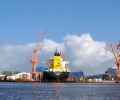
At every shipyard on the itinerary, towering gantry cranes pierced the clouds, block fabrication workshops roared with machinery amid flying sparks, giant hulls took shape in dry docks, and trucks shuttled materials without pause. Each yard held orders extending at least to 2030. Order books of this length reflect the multi-year production cycles inherent to shipbuilding, where large vessels are typically built to order with delivery slots negotiated years ahead of construction.
"We currently hold orders for over 100 ships, totaling more than 23 million deadweight tons, with some delivery dates scheduled as far out as 2031," said Ou Chuanjie, Party secretary and chairman of CSSC Qingdao Beihai Shipbuilding Co. The shipyard leads the world both in deliveries of very large ore carriers and in the order backlog for large bulk carriers.
As the world's largest shipbuilding group, CSSC has posted steady growth in key economic indicators this year, with profit margins reaching their best level since the group's restructuring.
The trend mirrors the broader performance of China's shipbuilding sector. Data released by the Ministry of Industry and Information Technology on July 23 showed that in the first half of 2026, China's completed shipbuilding volume, new orders, and order backlog accounted for 62.2 percent, 82.3 percent, and 71.2 percent of the global share respectively — a leading position across all three major indicators.
Across several days of interviews, phrases such as "world's No.1," "far ahead," "the only one in the world," and "breaking technology monopolies" came up repeatedly. Behind those words stand giant vessels taking shape and breakthroughs in key technologies — the true source of confidence and strength in Chinese shipbuilding. The emphasis on breaking foreign monopolies reflects a broader pattern across China's industrial policy, where import substitution in high-value components has been a central aim of the self-reliance agenda.
Zheng Shuangyan of Jiangnan Shipyard told the Global Times that the yard's self-developed BrilliancE II aluminum B-type containment system has secured US Coast Guard and American Bureau of Shipping certifications — a passport for access to global energy shipping. Such certifications from international regulators and classification societies are a precondition for vessels to trade in the global LNG carrier market, which has historically been served by a small group of Korean and European yards.
"Keeping LNG at -163 C poses huge challenges, especially severe welding deformation for aluminum alloys. Jiangnan Shipyard built a dedicated production line with friction-stir welding to address the issue. The breakthrough ends foreign monopoly and elevates China from a follower to a leader in high-value gas-carrier markets," Zheng said.
Taking the 'crown jewel'
No discussion of China's shipbuilding rise is complete without the "crown jewel" CSSC has claimed: large cruise ships. A single large cruise ship has more than 25 million components and over 100 onboard systems, far exceeding the complexity of ordinary merchant vessels. The design drawings alone contain more than 1 terabyte of 3D model data for the entire ship. Before China's entry, large cruise-ship construction had been dominated by European shipbuilders, chiefly in Italy, Germany, and Finland.
Wei Shengsheng of Waigaoqiao Shipbuilding highlighted key vibration and noise-reduction achievements for cruise ships. "Unlike ordinary passenger vessels, where cabin noise easily travels, cruise-ship designs ensure noise such as karaoke sounds stay inside cabins. To achieve this, engineers need to curb equipment-sourced vibration, block cross-deck vibration transfer, and optimize air-vent and interior-panel sound insulation," Wei told the Global Times.
Large cruise ships, Wei said, demonstrate a country's overall shipbuilding strength. Adora Magic City delivered China's first domestically built cruise ship, ending Western dominance, while the upcoming Adora Flora City, scheduled for delivery in November, demonstrates China's ability to build large cruise ships systematically. The new vessel features larger tonnage and more cabins, yet its construction time is cut by 8 months, efficiency is raised 20 percent, and design revisions are reduced by 85 percent. This shift from one-off development to serial construction proves China has acquired a proven, replicable cruise shipbuilding system, Wei said.
When Adora Magic City was under construction, many key components and interior materials had to be imported because domestic supporting industries were not yet mature. For Adora Flora City, local enterprises have had opportunities to carry out small-batch trial applications of their products, Wei noted.
"Just as domestically made large aircraft are gradually entering the global market, future domestically built large cruise ships will become another shining business card for China. China-built cruise ships, with their unique competitive strengths, will offer brand-new options for the world," Wei said.
China is now the only country capable of building aircraft carriers, large cruise ships, and large LNG carriers, and its shipbuilding industry has ranked first globally in the three core indicators for 16 consecutive years — a leadership position that reflects accumulated systemic strength.
'Magic tools'
Key technical support also comes from research institutes, whose cutting-edge equipment holds the secrets that enable giant vessels to sail far.
Zheng Jian of the 704 Research Institute told the Global Times that China has achieved full localization of high-power podded propulsors after 20 years of R&D. Engineers ran thousands of simulations and model tests to tackle low-noise and hydrodynamic hurdles, and rising demand from cruise and research vessels is fueling further technical upgrades. Meanwhile, the CSSC 725 Research Institute has achieved domestic substitution for the printed circuit heat exchanger (PCHE), a vital component for ship power and clean-energy systems, breaking a long-standing foreign monopoly.
If technological breakthroughs are the first step, harsh marine conditions are the ultimate test of reliability.
The Xiamen marine environmental test station, located on Dalipuyu Island in East China's Fujian Province, is one of China's earliest seawater test stations. Almost all ship materials and equipment must pass rigorous marine environment assessments there. The station features seawater test fields, tidal test fields, and atmospheric exposure test fields, covering nearly all real-world conditions.
"Here, materials undergo regular outdoor sun-exposure tests. Glass-framed equipment adjusts test racks automatically to follow the sun, collecting real-world weather-resistance data," said Wang Jingjing of the State Key Laboratory of Marine Corrosion and Protection.
The floating-raft testing area checks parts below a ship's waterline. Preventing marine organisms from attaching to hulls is a major challenge: seaweed and tubeworms increase water drag and slow ships down. Some test samples have been monitored for 15 years, building a strong technical base for China's deep-sea vessels.
Source: Global Times
