China's Economy Loses Momentum as Weak Domestic Demand and Property Crisis Weigh on Growth
Key Takeaways
- •Industrial production rose 4.5% year on year in July, but retail sales increased only 0.6%, both below market expectations.
- •Urban unemployment increased from 5% to 5.2% in July, pointing to a weaker labor market.
- •Fixed-asset investment fell 6.7% in the January–July period, and property investment dropped 19.2% to a record decline.
- •Passenger car sales fell 21% in July, underscoring continued weakness in consumer spending.
- •China’s foreign-exchange reserves rose by USD 74.7 billion in the second quarter of 2026, while the yuan appreciated for a sixth straight quarter.
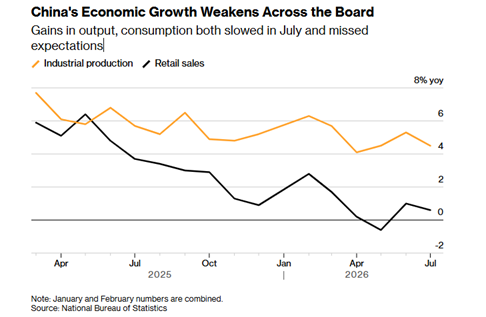
China's economy lost momentum in July, as soft retail sales, falling investment and a deepening property market downturn weighed on domestic demand.
Strong exports are providing growing support for growth, but they are also pushing the yuan higher, prompting the authorities to manage the pace of the currency's appreciation.
Weaker economic data and rising deflationary risks are building expectations of further government stimulus to help China reach its 2026 growth target.
Activity slows at the start of the second half
China's economy lost noticeable momentum at the beginning of the second half of 2026. July data showed weaker industrial activity and consumption, while falling investment and the prolonged property market crisis remain increasingly serious problems. At the same time, China is leaning more heavily on exports to support economic growth, raising the importance of exchange-rate policy and of official efforts to prevent an excessive appreciation of the yuan.
Industrial production rose 4.5% year on year in July, while retail sales increased by just 0.6%. Both readings came in below market expectations and confirmed that domestic demand remains one of the weakest parts of the Chinese economy. The labour market also deteriorated: the urban unemployment rate climbed from 5% to 5.2%, which could further limit households' willingness to increase spending.
Investment and the property market deepen the problems
Investment data look even more concerning. Fixed-asset investment fell 6.7% year on year in the January–July period, following a 5.7% decline in the first half of the year. Conditions remain particularly difficult in the property market, which for several years has been one of the main sources of weakness in the Chinese economy.
Investment in the sector fell by as much as 19.2%, marking a new record decline. At the same time, the pace of falling new-home prices accelerated again, making it harder to restore confidence among both developers and households. The prolonged weakness of the property market is reducing companies' willingness to invest and is also weighing on household wealth and consumer sentiment.
Consumption remains a weak point of the economy
Consumption also remains subdued. The passenger car market provides a clear example, with sales falling by 21% in July. This matters for the broader economy because the automotive sector accounts for around 8% of total retail sales of goods.
Car manufacturers are also facing high raw-material costs and intense price competition, which are putting pressure on profitability and limiting their ability to increase investment. Weak car sales are another sign that households remain cautious and are reluctant to raise spending significantly.
Economic activity in July was also negatively affected by unusually severe weather conditions. Heavy rainfall, strong winds and flooding led to temporary closures of factories and ports, power supply disruptions and evacuations. The impact of these factors should be temporary, but much of the weakness in the Chinese economy is more persistent in nature. The property crisis, households' low propensity to consume and subdued investment activity cannot be explained by adverse weather alone, which is why policymakers are likely to keep focusing on measures that can stabilise demand without leaning too heavily on one sector.
Exports are becoming an increasingly important engine of growth
One consequence of weak domestic demand is China's growing dependence on exports as a source of economic growth. Overseas sales remain one of the main drivers of activity at a time when consumption and investment are not strong enough to generate more balanced growth.
However, such a growth structure also makes China more vulnerable to changes in external demand, trade tensions and exchange-rate fluctuations. The more important exports become, the greater the significance of the authorities' policy towards the yuan, especially as a stronger currency can affect how much support exporters provide to the broader economy.
Deflationary pressure increases the risk of a further slowdown
Prices are another source of concern. In July, both consumer and producer inflation slowed more sharply than the market had expected, once again increasing concerns about mounting deflationary pressure.
Persistently weak price growth can become a problem in itself. If households expect prices to fall further, they may postpone purchases, while companies may delay investment in anticipation of weaker demand and lower prices. As a result, subdued price dynamics could further reinforce the weakness of domestic demand and make the near-term policy response more important for keeping activity from cooling further.
Strong exports support the yuan and increase foreign-exchange reserves
The growing importance of exports is also reflected in the foreign-exchange market. China's foreign-exchange reserves, measured in the balance of payments, increased by USD 74.7 billion in the second quarter of 2026. This was the largest quarterly increase since the first quarter of 2014.
At the same time, the yuan appreciated for a sixth consecutive quarter, while the onshore exchange rate moved close to its strongest level since 2023. Strong exports were one of the main sources of foreign-currency inflows, generating a substantial supply of dollars in the Chinese market.
The People's Bank of China is slowing the pace of yuan appreciation
Chinese authorities absorbed part of the foreign-currency inflows, limiting the pace of the yuan's appreciation. The People's Bank of China continued to set the official reference rate at a weaker level than the market had expected, although the fixing itself reached its strongest level in more than three years. This suggests that the authorities are not trying to stop the yuan from strengthening altogether, but rather to control the pace of its appreciation.
This is particularly important at a time when exports remain one of the main engines of growth. An excessively rapid appreciation of the yuan could weaken the price competitiveness of Chinese goods in international markets and further weigh on the economy while domestic demand remains subdued.
Weak domestic demand remains China's biggest challenge
China's biggest challenge remains the imbalance between a relatively resilient export sector and weak domestic demand. Consumption, investment and the property market are still not strong enough to provide a solid foundation for more balanced growth.
While the deterioration in activity caused by adverse weather may fade relatively quickly, addressing the economy's structural problems will require more decisive action. Without a clear rebound in consumption and investment, China's economy will remain dependent on exports and state support, while achieving this year's growth target will become increasingly difficult.
Opinions are the authors' and not necessarily those of OANDA Business Information \u0026 Services, Inc. or any of its affiliates, subsidiaries, officers or directors. The publication is for informational and educational purposes only.
Source: OANDA MarketPulse — China's economy is losing momentum - weak domestic demand and the property crisis

