China's Net New Yuan Loans Fell 340 Billion Yuan in July 2026, Only Third Contraction Since 2000
Key Takeaways
- •Net new yuan loans fell by 340 billion yuan in July 2026, marking the sharpest monthly contraction on record.
- •The July decline was driven by households, whose loans shrank by 460.3 billion yuan, while business loans fell by 130 billion yuan.
- •Total new lending in the first seven months of 2026 reached 10.38 trillion yuan, about 2.5 trillion yuan less than a year earlier.
- •Outstanding yuan loans rose 5.1% year over year in July, which was a record low and below consensus forecasts.
- •The People’s Bank of China said it would take practical, effective measures and maintain an appropriately loose monetary policy stance.
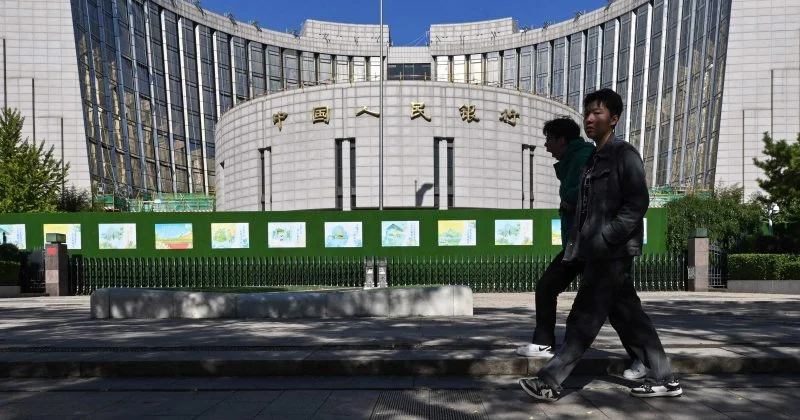
China's credit growth turned negative in July 2026, producing the sharpest monthly contraction on record. Net new yuan loans fell by 340 billion yuan, or roughly $50.4 billion, marking a milestone that has occurred only three times since 2000 — the previous instances came in July 2005 and once in 2025.
For an economy the size of China's, that is a short list, and the fact that July 2026 is the second negative reading in a single calendar year, following April's contraction, makes the signal harder to dismiss as seasonal noise. The monthly yuan-loan release is one of the most closely watched barometers of Chinese domestic demand, because bank credit remains the dominant financing channel for households and firms in the world's second-largest economy, far more so than bond or equity markets.
Households led the retreat
The household sector drove the decline. Loans to consumers and homeowners shrank by 460.3 billion yuan in July, reversing the expansion recorded in June. Mortgage appetite, already weak throughout 2025, showed no sign of recovery.
Corporate borrowing moved in the same direction. Business loans contracted by 130 billion yuan, indicating that companies are paying down existing credit rather than taking on new debt to fund expansion.
Cumulative lending down roughly 2.5 trillion yuan
Zoomed out to the first seven months of the year, the picture darkens further. Total new loans from January through July 2026 came in at 10.38 trillion yuan, compared with 12.87 trillion yuan over the same stretch last year — a gap of roughly 2.5 trillion yuan in lending that simply did not happen.
Outstanding yuan loans grew just 5.1% year-over-year in July, a record low that came in below consensus forecasts.
PBOC promises "practical, effective measures"
The People's Bank of China acknowledged the weakness and said it would deploy "practical, effective measures" while maintaining an "appropriately loose" monetary policy stance. Analysts expect the PBOC to hold back from aggressive rate cuts or large reserve-requirement reductions in the near term. The loose framing itself continues a shift made in late 2024, when Beijing dropped the "prudent" label that had described its monetary stance for more than a decade.
Part of July's drop is attributable to the calendar. The June quarter-end typically pulls borrowing forward as banks hustle to meet lending targets, leaving July looking deflated by comparison. But that seasonal explanation only goes so far when the year-over-year cumulative gap has grown to 2.5 trillion yuan.
The next signposts are fixed by the calendar rather than by discretion: China's benchmark Loan Prime Rate is published on the 20th of each month, and the broader "total social financing" gauge, which captures bond and other non-bank funding alongside bank loans, is released with each monthly credit report.
The real estate shadow
Household deleveraging in China is inseparable from the property market. Mortgages represent the single largest category of consumer debt, and with home prices in many cities still under pressure, prospective buyers are in no hurry to add leverage. Cheaper credit can lower the cost of a mortgage, but it cannot by itself make hesitant households commit to decades of debt — one reason attention also falls on government housing-support measures alongside central-bank decisions.
Source: CryptoBriefing

