CFTC Issues Renewed Warning on Prediction Market Self-Certifications
Key Takeaways
- •The CFTC said prediction market operators must provide specific terms and compliance analysis for each event contract permutation submitted through self-certification.
- •The agency characterized the issue as improper use of the self-certification process rather than a ban on prediction market products.
- •The July 24 advisory is the CFTC’s second warning in 2026 about overly generalized event contract submissions.
- •Public comments are due July 27 on proposed amendments creating a three-step framework for public interest determinations involving certain event contracts.
- •Insufficiently detailed filings could increase regulatory scrutiny and affect contract listing stability or availability.
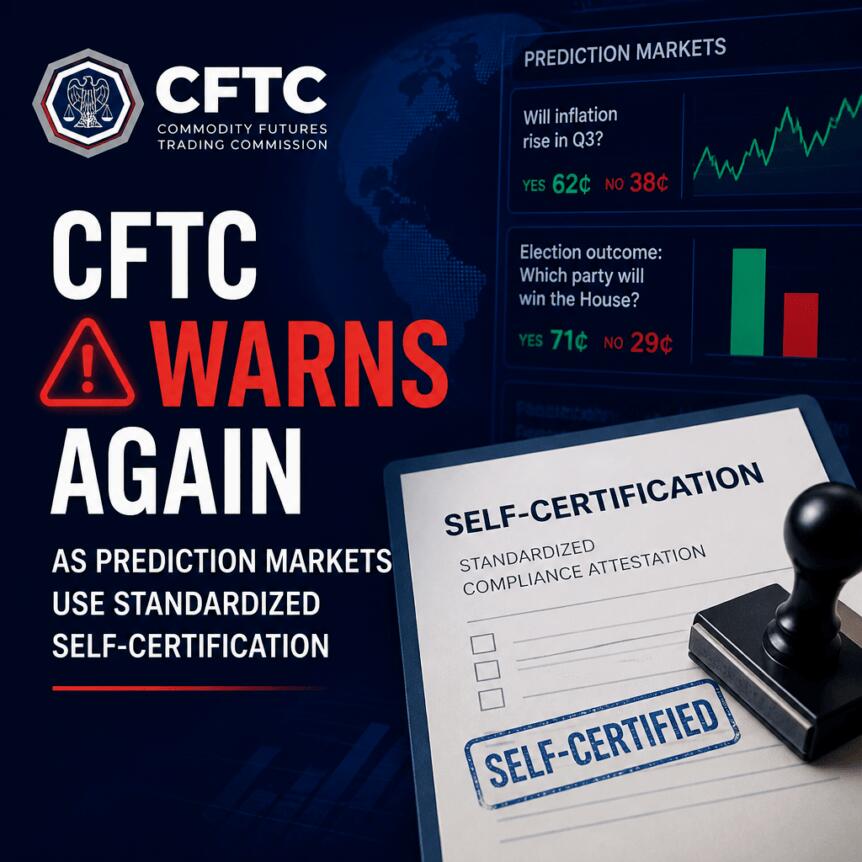
The U.S. Commodity Futures Trading Commission (CFTC) has renewed its warning to prediction market operators, telling platforms to comply with agency rules when self-certifying event contracts that may cover broad sets of possible outcomes. The regulator said some operators have submitted “self-certified” listings without providing the specific contract terms and compliance analysis required for each proposed permutation.
In an advisory released on July 24 and published as part of a Friday notice, the CFTC reiterated that, despite continuing policy discussions and proposed rulemaking, operators may still self-certify certain event contracts as compliant with the Commodity Exchange Act (CEA) and CFTC regulations. However, the agency said those filings must be made within the statutory self-certification framework and must contain the information required under that process.
CFTC objects to template-style event contract filings
The CFTC said broad, template-based self-certifications for event contracts are not acceptable for products listed under its jurisdiction. Platforms are expected to provide the terms and conditions for each proposed permutation, together with concise explanations connected to the product, the relevant commodity, and applicable compliance requirements.
According to the agency’s July 24 announcement, CFTC staff have observed multiple instances in which event contracts were self-certified without the full details the regulator says are necessary to assess compliance. The agency specifically criticized submissions that fail to include the terms and conditions of each proposed permutation and do not provide a concise explanation and analysis of how the product’s terms and conditions relate to compliance obligations.
The advisory presents the issue as a problem with execution of the self-certification process, not as a blanket ban on prediction market products. The CFTC emphasized that operators can self-certify certain event contracts without first seeking affirmative commission approval, but only if they follow the process established by law and CFTC regulations.
In the regulator’s view, broad, template-style certifications should not be submitted. The CFTC’s concern is that generalized documentation makes it more difficult to evaluate whether each individual contract listing complies with the CEA and applicable CFTC requirements, particularly when a product category covers a wide range of events and possible contract permutations.
Second warning in 2026
The July 24 advisory marks the second time in 2026 that the CFTC has raised this issue. The agency referred to a similar warning issued on March 12, which also addressed overly generalized submissions. By repeating the guidance, the CFTC is signaling that it expects operators to correct the practice and that continued reliance on template-style filings may be treated as a recurring compliance failure.
The issue is significant for prediction market operators because self-certification is commonly viewed as a faster route to listing products than seeking affirmative approval from the commission. That route can be important for event-contract venues that need to list standardized products on defined timelines, but the CFTC’s warning makes clear that speed does not reduce the obligation to document how each contract complies with existing rules. If the CFTC continues to determine that filings lack required detail, platforms could face increased regulatory scrutiny. That scrutiny could result in delays, requests for additional information, or more direct enforcement consequences, especially for contracts tied to broad event categories.
Public comment deadline approaches
The advisory was issued shortly before the CFTC’s July 27 deadline for public comments on proposed rule amendments related to how the agency conducts public interest determinations for certain event contracts.
Those proposed amendments are intended to clarify how the CFTC determines whether specific event contracts are contrary to the public interest under the CEA. The agency has described the proposal as a three-step analytical framework for evaluating contracts based on their involvement in certain enumerated activities, including terrorism, assassination, or gaming, so that only appropriate contracts are listed for trading.
The timing places the self-certification warning alongside a broader regulatory process that could affect how event contracts are reviewed. For prediction market businesses, the next phase of CFTC rulemaking may influence how public interest risks are assessed even if self-certification remains available in some circumstances.
As a result, operators face two parallel regulatory expectations: they must submit sufficiently detailed self-certifications under current requirements, while also preparing for possible changes to the CFTC’s standards for public interest determinations.
Operators may need permutation-specific documentation
The practical effect of the CFTC’s message is that event contract filings must reflect the complexity of the products being listed. When an event contract can take many forms, or when it is structured to cover numerous permutations, the CFTC expects the supporting documentation to be specific to those variations.
The agency’s criticism focused on certifications that do not provide, for each proposed permutation, the terms and conditions and a concise compliance explanation tailored to the product’s conditions, the underlying commodity, and applicable compliance considerations.
That position may affect platforms that use a scaled product-development approach, in which only a limited number of parameters change across listings. Under the CFTC’s advisory, such a template-based method may be viewed as insufficient when the certification is expected to demonstrate compliance for each unique configuration.
For market participants, including traders and liquidity providers, the quality of regulatory filings may not immediately change how contracts trade day to day. However, it can affect listing stability and regulatory risk. If a contract certification is challenged, the availability of that product could be disrupted, and users may experience changes in trading access or contract availability.
Legal practitioners have also noted that the pending amendments could reshape the regulatory environment for prediction markets. Earlier coverage cited law firm Ropes & Gray as saying the CFTC’s proposed changes could “rewrite the rulebook” for prediction market contracts, reflecting the potential significance of the public interest determination framework if adopted.
What comes next
With comments on the proposed public interest determinations framework due July 27, prediction market operators are likely to monitor further CFTC action closely. Future developments could clarify what the agency considers acceptable event contract listings and how self-certification filings must be documented.
The central issue is whether operators revise their certification practices to avoid broad template-style submissions, and how the CFTC applies its three-step public interest framework if the proposed amendments advance.

