Who's a Socialist (or Economic Fascist)? Federal Government Ownership Under Trump Examined
Key Takeaways
- •The Cato Institute cataloged instances in which the U.S. Federal government acquired equity positions in private-sector firms, finding this practice became increasingly routine during the Trump administration.
- •Prior to the Trump era, federal ownership stakes in private companies were primarily limited to acute crises, such as the Troubled Asset Relief Program interventions in major banks and automakers during 2008–2009.
- •Under a strict economic definition where socialism involves collective ownership of the means of production, the expansion of government equity stakes qualifies as socialistic in character.
- •The Trump administration's approach of acquiring ownership stakes while preserving the corporate form of affected entities places it in a hybrid zone that scholars sometimes label state capitalism.
- •The Cato Institute characterizes this trajectory as a notable departure from the free-market principles traditionally associated with Republican administrations, though it does not predict whether the shift will be lasting.
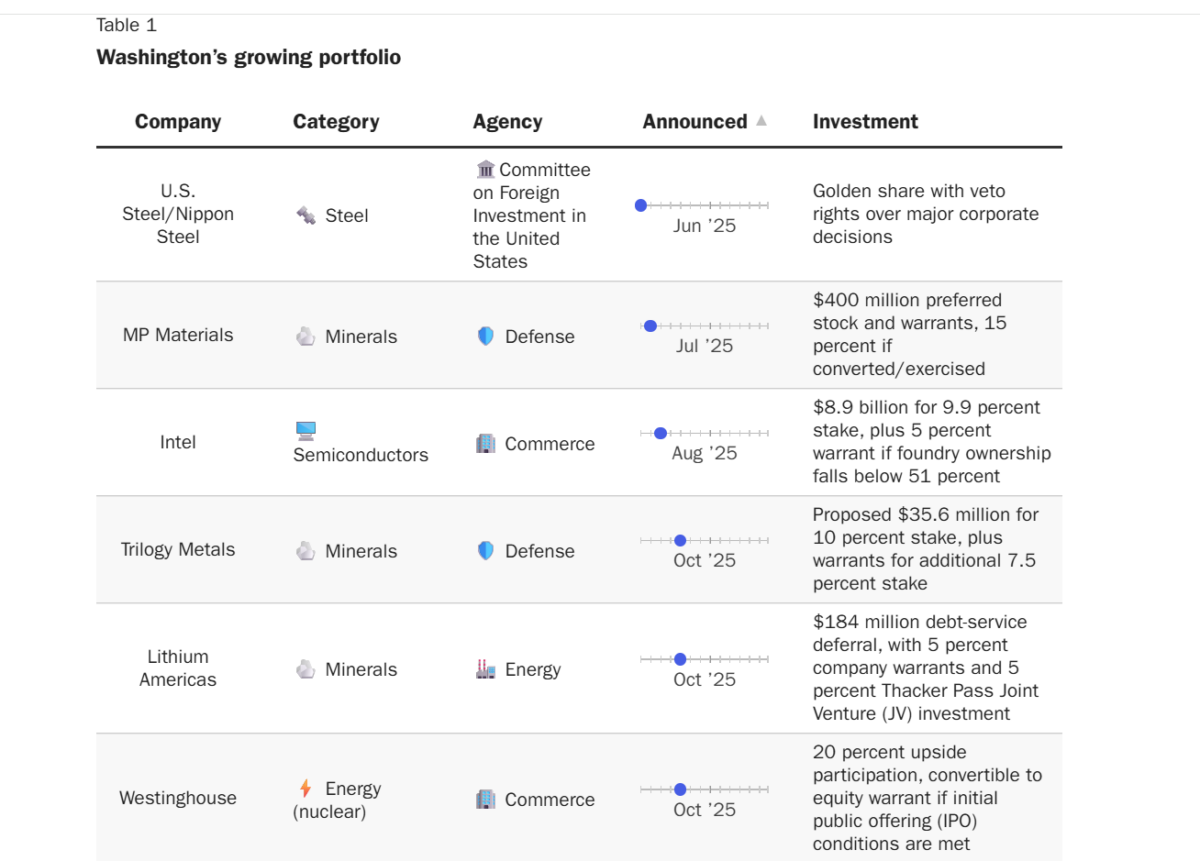
The term "socialist" is frequently invoked in American political discourse, but its precise economic meaning is often overlooked. Drawing on academic study of the subject—specifically a semester-length course titled simply "Socialism," taught by the late Harvard scholar Adam Ulam—a straightforward economic definition can be offered:
Socialism is an economic system in which the means of production and distribution are owned or controlled collectively.
Under this definition, the question of who qualifies as a socialist becomes a matter of examining actual government ownership and control of economic assets. A tabulation compiled by the Cato Institute, a libertarian think tank, documents the extent of U.S. Federal government ownership stakes in private companies—and how those stakes expanded significantly during the Trump administration.
The Cato analysis, authored by DeHaven (2026), catalogs instances in which the Federal government acquired equity positions or ownership stakes in private-sector firms. According to this data, such government ownership became increasingly routine under President Donald Trump, rather than under administrations more commonly associated with interventionist economic policy. This is notable because the United States has a documented history of acquiring temporary equity stakes in private firms during acute crises—most prominently through the Troubled Asset Relief Program (TARP) during the 2008–2009 financial crisis, when the Federal government took ownership positions in major banks and automakers including General Motors and Chrysler—but the Cato findings suggest a shift toward such stakes as a more routine policy tool rather than an emergency measure.
By the definition above, this expansion of collective (i.e., governmental) ownership of the means of production would qualify as socialistic in character. Alternatively, the pattern may be described through the lens of a related concept:
Economic fascism is a system where the state exerts strong control over private enterprise, directing economic activity to serve national interests while maintaining the appearance of private ownership.
Under either framework—socialism, defined by collective ownership, or economic fascism, defined by state direction of nominally private enterprise—the Trump Administration's record of expanding Federal government ownership stakes places it among the more aggressively interventionist presidencies in modern U.S. history, according to the Cato Institute's findings.
The distinction between the two concepts is nuanced: socialism involves direct collective ownership of productive assets, while economic fascism preserves the formal structure of private property but subordinates enterprise decisions to state objectives. The Trump administration's approach—acquiring ownership stakes while maintaining the corporate form of the affected entities—could be characterized as occupying a space between the two, depending on the degree of operational control exercised by the government. Scholars of political economy have sometimes labeled such hybrid arrangements "state capitalism," a category applied to economies as varied as China's and Norway's, where sovereign wealth funds hold significant commercial stakes.
The Cato Institute, historically a critic of government intervention in markets, has framed this trend as a departure from the free-market principles typically associated with Republican administrations. Whether this approach represents a lasting realignment in U.S. economic governance or a temporary departure will depend on subsequent policy choices—an open question the Cato analysis implicitly raises by documenting the trajectory without predicting its endpoint.

