Casey's Quietly Became America's Fifth-Largest Pizza Chain—and Gen Z Can't Stop Posting About It
Key Takeaways
- •Casey's ranks as the fifth-largest pizza chain in the U.S. by prepared food and dispensed beverage sales, behind Domino's, Pizza Hut, Little Caesars, and Papa Johns, according to Bank of America Research.
- •Nearly half of Casey's nearly 3,000 stores are in towns of 5,000 people or fewer, and about half of its stores have no national pizza competitor nearby.
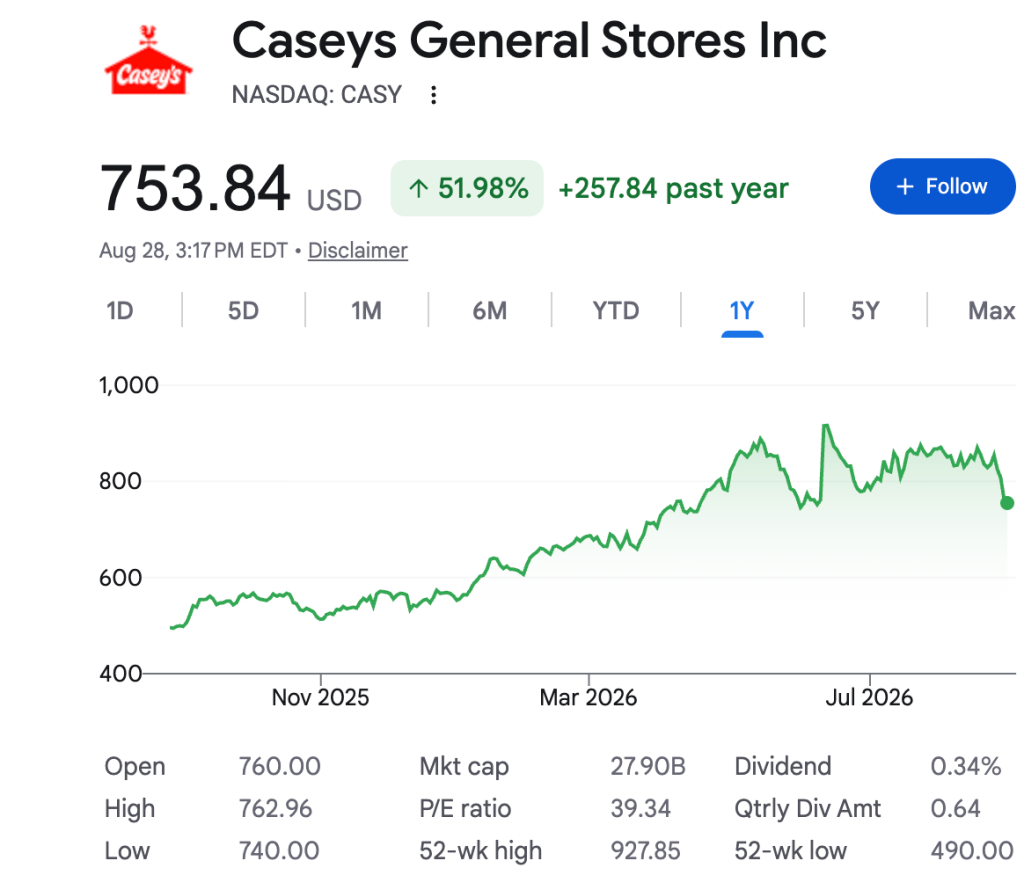
- •Casey's shares are up more than 50% in the past 12 months, giving the company a market capitalization of $28 billion.
- •The company's prepared food and beverages carried an estimated 58% gross margin in fiscal 2025, more than double its overall margin of roughly 23.5%.
- •Casey's roughly $1.1 billion acquisition of Fikes Wholesale closed in late 2024, adding nearly 200 CEFCO stores that anchor its expansion into Texas.
Drive through Iowa, Missouri, or Illinois, and you'll pass a Casey's roughly every few exits. Midwesterners know the red-roofed convenience store and gas station as a place to buy diesel, a bag of ice, a lottery ticket—and, increasingly, a hot pizza. Perhaps one of its distinctive creations, like the taco pizza or the breakfast pizza.
Casey's is closing in on 3,000 stores, nearly half of them in towns of 5,000 people or fewer and about two-thirds in towns under 20,000. The Fortune 500 company's stock price is surging as America wakes up to the stealth pizza empire sitting under its nose: shares are up more than 50% in the past 12 months, for a market capitalization of $28 billion. Part of the store-count growth has come through acquisition—the company's roughly $1.1 billion purchase of Fikes Wholesale, the Texas-based CEFCO convenience store chain, closed in late 2024 and added nearly 200 stores in Casey's newest expansion market.
Bank of America Research recently ran the numbers and concluded that Casey's pizza business ranks as the fifth-largest pizza chain in the entire U.S. when measured by prepared food and dispensed beverage sales—behind national players like Domino's, Pizza Hut, Little Caesars, and Papa Johns, brands that spend heavily on national advertising and delivery logistics. Tom Brennan, Casey's chief merchandising officer, confirmed to Fortune that the company is the fifth-largest pizza chain and the fourth-largest liquor license holder in the U.S., not to mention the third-largest convenience store chain.
"You don't hear the other big pizza players talk about Casey's," he said, "but at the same time, it's evident from our growth … we're taking share as we continue to grow."
Ask Brennan whether "stealth" is a fair description, and he laughs a little at an out-of-touch, coastal way of thinking. "Certainly stealthy for, I think, a lot of the U.S.," he said—but ask anyone in its 19 states, and they'll know Casey's.
That is starting to change online. TikTok and YouTube have built a small, oddly durable genre around "gas-station pizza"—creators bracing for something left under a heat lamp, then finding themselves wowed by something genuinely good. Casey's turns up constantly in the genre, praised for its scratch-made dough and on-site pizza ovens, and Brennan said he welcomes the attention. For a company that historically spent little on national marketing, the organic social attention amounts to a form of advertising its bigger rivals have to buy.
Casey's social team found that its penetration with Gen Z has climbed 600 basis points over the past three years based on engagement. "What underpins all of this is just this incredible fandom and brand love that we've generated," he said. It comes down to something an algorithm can't fake, he added—an authenticity prized in the age of AI backlash and analog fever. "It's really built on decades of delivering high-quality pizza and food, a great experience."
Brennan described Casey's as the "gathering spot" for its communities, and it keeps adding new offerings, like Sauced Wings, which began as a pilot in January 2025 and have now grown to almost 900 stores, with a gradual rollout across the chain over the next two years.
A moat across small-town America
Casey's traces its origin to 1968, when Donald Lamberti opened a converted service station in Boone, Iowa. Brennan said he has talked with Lamberti about his strategy, describing it as, "Hey, this will probably work in the next small town." He recounted a gradual, slow-and-steady, and now explosive growth path: "Literally, they just went from small town to small town, building Casey's." Over time, this became what Wall Street calls a "defensible moat," because most other brands simply aren't looking "to develop sites in towns that small." In an industry where the big delivery chains concentrate on dense suburban and urban markets, those tiny towns are effectively private territory.
The company is still making the same bet that small is beautiful: build where the population is too small for anyone else to bother, and eventually you're outcompeting Big Pizza on turf it never thought to conquer. Pizza joined the menu in 1984, and breakfast pizza arrived about two decades later—what Brennan calls an "iconic" mix of sausage gravy, egg, and cheese.
This strategy also means Casey's is fighting a different war than its pizza competitors—if they can even be called competitors. The roughly $31 billion quick-service pizza category turned negative in 2025, per Technomic, after barely growing the year before. The Wall Street Journal reported in January 2026 that America appeared to be "falling out of love with pizza." Brennan said Casey's is watching the trend closely, but the company takes a different view.
"About half of our stores don't have a national pizza competitor within what we consider a competitive rating," he said. And when Casey's does arrive in a nearby town, "we're bringing something that hasn't been really on offer there. And it's resonating."
Brennan added that Casey's works to keep pizza and other key items priced slightly below the prevailing market rate. Citing inflation data, he noted that over the past three years, food-away-from-home prices are up about 14%, while Casey's prepared food and dispensed beverage business is up only 5%. "We can leverage the other parts of the business to make the total P&L work while we invest, essentially, to grow food," he said.
BofA noted the unglamorous math behind the model: prepared food and beverages carried an estimated 58% gross margin in fiscal 2025, more than double Casey's overall margin of roughly 23.5%. That spread explains why convenience-store operators across the industry have been pushing further into fresh food—it is the highest-margin real estate in the store. Brennan calls the Casey's model "three legs of the stool," with food, convenience, and merchandise propping up one another. Pizza is the "crown jewel" of the food business, he said, but to him Casey's is a "category of one," with "the magic of the brand [being] when we have all three legs of the stool working together."
The math points to Casey's next frontier: Texas. Iowa has about 3 million people and 550 Casey's stores, he noted, while Texas has roughly 30 million people and room to run. "We see that as Casey's country," Brennan said, pointing to the small towns along the Interstate-35 corridor that don't have anything like what Casey's offers. The Fikes acquisition gives the company an existing store base and infrastructure there to build from.
Asked whether gas-station food is having a moment, Brennan said Casey's is a Midwestern example of something that has been bubbling for decades in certain U.S. regions and spreading to others. He spent three years at 7-Eleven in the Mid-Atlantic a little over a decade ago, he recalled, and remembers how gas-station culture there became a rising tide lifting all boats. His stores had the highest food sales in the U.S. enterprise—not because of any underlying difference from other 7-Elevens, but "because Wawa and Sheetz had legitimized eating at a gas station."
Brennan also serves on the retail board of the National Association of Convenience Stores, and said the "collegiality" among brands is unique to convenience retail. "We certainly are supportive of each other," he said. "We're definitely in competition, but at the same time, the more good operators we have who really deliver delicious food in our channel, it lifts everybody up."
Asked about his favorite Casey's pizza, he said the breakfast pizza with bacon is hard to argue with, but a new item has caught his attention: the four-cheese pizza, featuring a blend of provolone, mozzarella, and cheddar—finished with a special "post-bake shake" of cheese seasoning. "It is a game-changer."
This story was originally featured on Fortune.com.

