Cardano (ADA) Falls After Dijkstra Upgrade Timeline as Whale Selling Continues
Key Takeaways
- •Cardano's first Dijkstra phase, scheduled for the fourth quarter of 2026, would upgrade the network to protocol version 12, introducing Ouroboros Linear Leios, Nested Transactions, and Script Context capabilities in PlutusV4.
- •A second phase projected for the second quarter of 2027 would activate the Ouroboros Peras consensus mechanism, which is designed to accelerate transaction confirmations and reduce settlement times.
- •The announced dates are development targets rather than guaranteed deployment schedules, with each phase requiring extensive testnet testing and approval from DReps, stake pool operators, and the Constitutional Committee.
- •Santiment data shows that wallets holding between 1 million and 100 million ADA have sold roughly 200 million tokens since August 11, pointing to ongoing distribution by large holders.
- •CoinGlass figures show a long-to-short ratio of 0.92 and negative funding rates, while ADA's Relative Strength Index near 34 places the token in oversold territory.
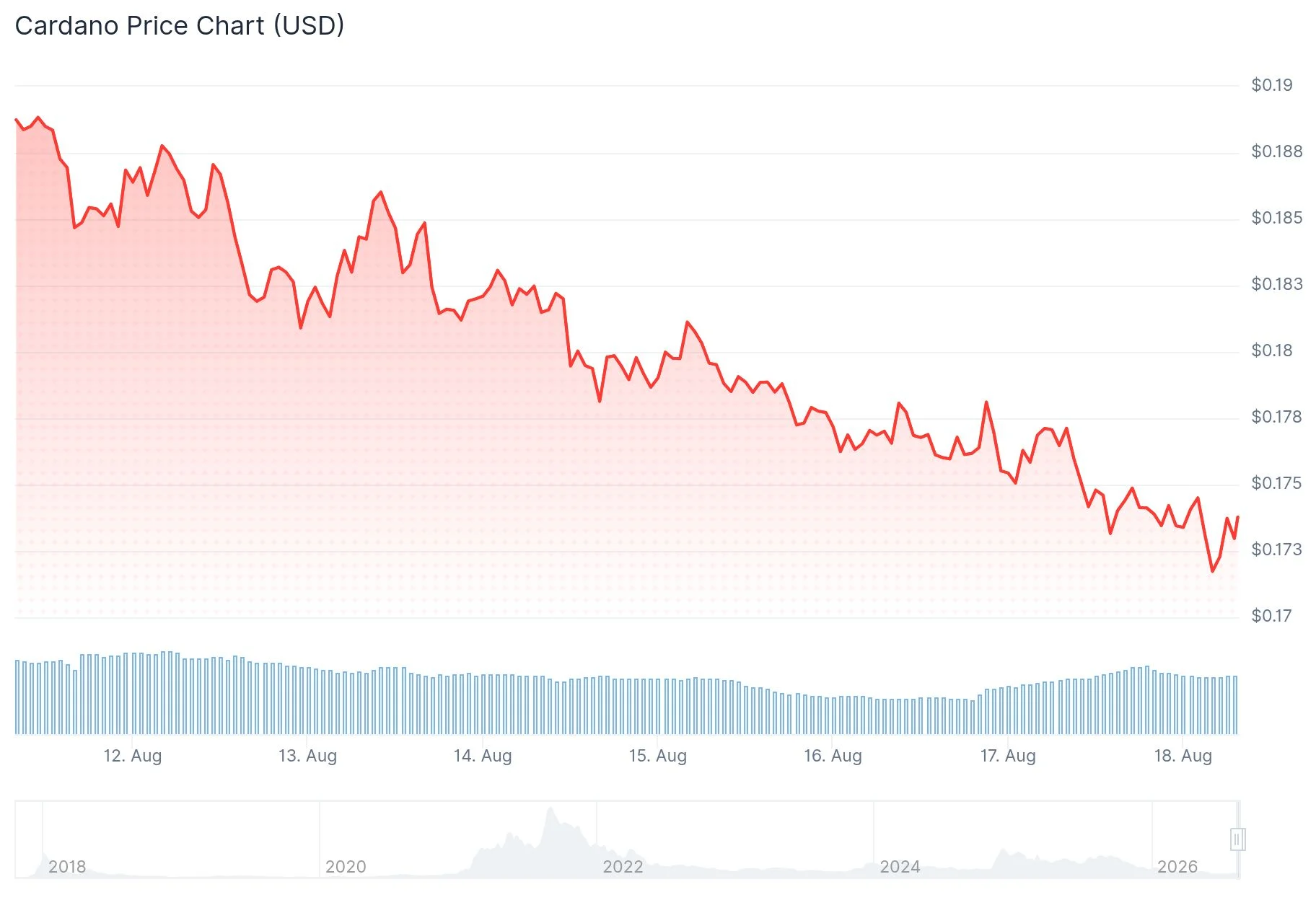
Cardano is trading near $0.175 after falling 1.03% following the network’s announcement of a two-phase Dijkstra hard fork development timeline. The roadmap outlines major protocol upgrades planned for late 2026 and the second quarter of 2027, adding a longer-term development backdrop even as near-term trading remains pressured.
The first phase is scheduled for the fourth quarter of 2026 and would bring Cardano to protocol version 12. That stage is expected to implement Ouroboros Linear Leios, introduce Nested Transactions, and add Script Context capabilities in PlutusV4. It would also establish the foundational block structures for Ouroboros Peras.
The second phase is projected for Q2 2027, when another hard fork would activate Ouroboros Peras. The consensus mechanism is intended to improve transaction confirmation speeds and could reduce settlement times across the blockchain.
The timeline represents development targets rather than guaranteed mainnet deployment dates. Each phase must still undergo extensive testing on the Preview and Pre-production networks before being released to the main blockchain.
Decentralized governance approval required
Implementation also depends on approval through Cardano’s decentralized governance process. Delegated Representatives (DReps), stake pool operators, and the Constitutional Committee must all participate in the approval process before any protocol changes can be executed.
Market analyst Sjuul from AltCryptoGems said on X that ADA is “still pushing lower, just as we expected,” pointing to a bearish break in market structure. The analyst also said altcoin rallies remain short-lived and driven by capital rotation rather than sustained upside.
$ADA still pushing lower, just as we expected. It was easy to spot with that bearish market structure break. Still a heavy rotation in play with altcoins. Pumps are short-lived, and money is simply rotating from one name to another. pic.twitter.com/3FZEeJLtBm — Sjuul | AltCryptoGems (@AltCryptoGems) August 17, 2026
Blockchain analytics from Santiment show that addresses holding between 1 million and 100 million ADA tokens have sold about 200 million coins since August 11. Smaller whale cohorts have acquired some of that supply, but the overall pattern still points to significant distribution.
Futures markets reflect cautious positioning
Derivatives data also suggests a negative backdrop. CoinGlass data shows the long-to-short ratio at 0.92 on Monday, below the neutral level of 1.0. Funding rates have also turned negative, indicating that short position holders are paying long traders.
Spot ADA trading volume rose 89.88% to $388.36 million. Derivatives volume increased 151.19% to $15.56 million. At the same time, open interest fell 1.76% to $451.31 million, indicating the liquidation of leveraged positions.
The Relative Strength Index is around 34, putting ADA in oversold territory. Immediate resistance is at the 50-day EMA near $0.179, while the 100-day EMA is at $0.194.
ADA is trading below a concentrated cluster of exponential moving averages, and the MACD indicator remains negative. If ADA closes below $0.173 on the daily timeframe, it would likely retest support near $0.150.
The Chaikin Money Flow indicator has risen to 0.19, suggesting modest positive capital inflows at current price levels.

