Cardano Could Dip to $0.156 as ADA Faces Sixth Consecutive Weekly Loss
Key Takeaways
- •Cardano is trading near $0.171 after a nearly 4% weekly drop and is heading toward its sixth consecutive weekly decline, deepening a correction that has cut more than 30% of its value since early October.
- •ADA's long-to-short ratio of 0.86, close to its lowest level in over a month, combined with a negative funding rate of -0.0015%, indicates that bearish positioning dominates the derivatives market.
- •CryptoQuant data show large whale orders, elevated trading activity, and sell-side dominance in both ADA spot and futures markets.
- •ADA trades below all major daily EMAs at $0.203, $0.208, and $0.229, while an RSI of roughly 29 signals oversold conditions and a negative MACD points to persistent bearish pressure.
- •The key downside support is $0.156, whose successful defense could enable consolidation, whereas resistance starts at $0.183 and a heavier barrier cluster spans $0.203 to $0.229.
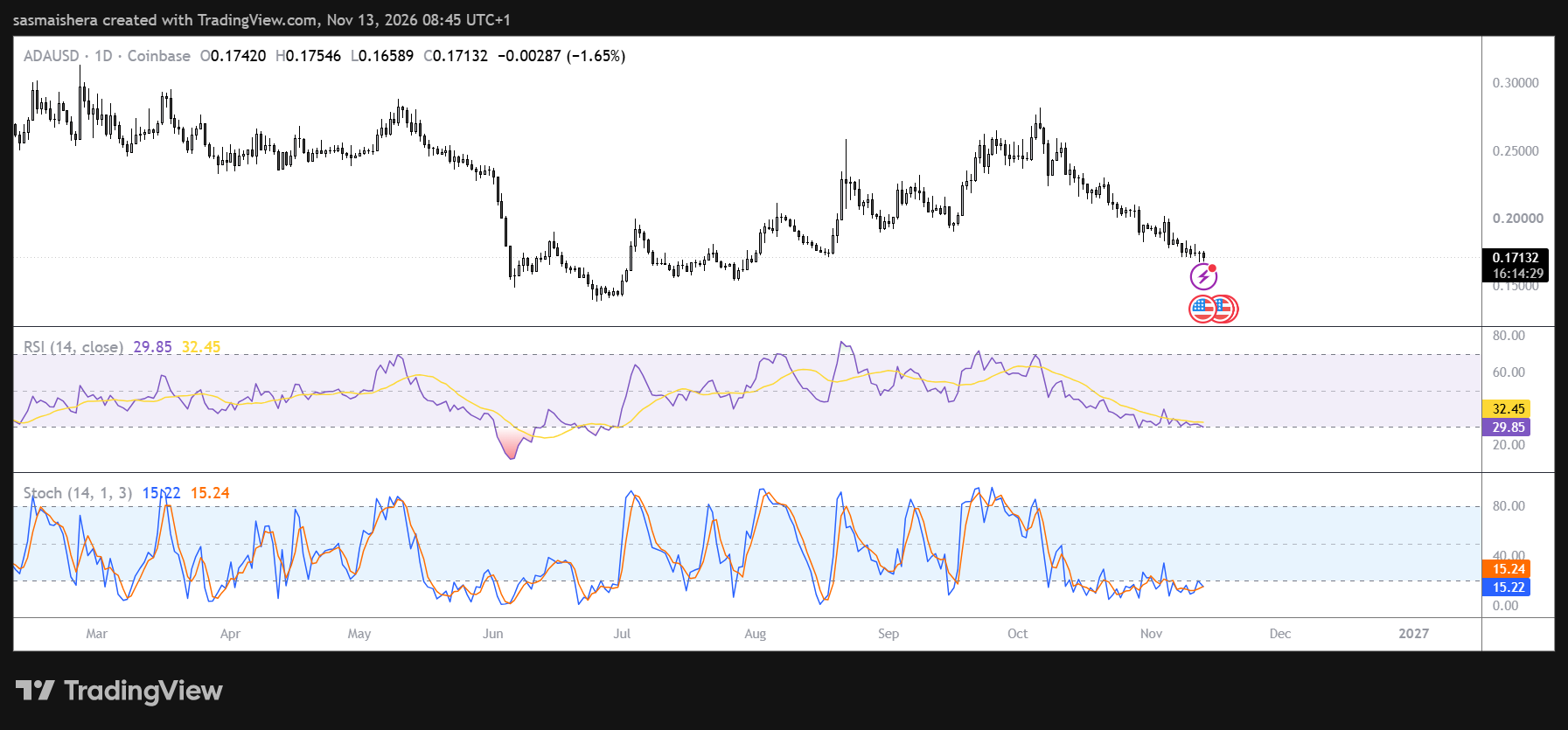
Cardano (ADA) extended its decline on Friday, trading around $0.171 as weakening derivatives activity and bearish on-chain signals added to concerns about further losses. The cryptocurrency has fallen nearly 4% this week and is heading toward its sixth consecutive weekly decline, deepening a correction that has erased more than 30% of its value since early October.
Derivatives traders have grown increasingly defensive, with Cardano's long-to-short ratio falling toward its lowest level in more than a month and funding rates turning negative. Metrics like these are closely tracked because they show not only how leveraged traders are positioned, but also what they are paying to maintain those positions — a real-time gauge of market sentiment that spot volume alone does not capture.
Derivatives Data Point to Bearish Positioning
Cardano's derivatives market continues to reflect weakening investor confidence as traders position themselves for further downside. According to CoinGlass, ADA's long-to-short ratio stands at 0.86, approaching its lowest level in more than a month. A ratio below 1 indicates that short positions outnumber long positions under the metric being measured, suggesting that bearish positioning has become more prominent.
Funding rates provide additional evidence of deteriorating sentiment. Cardano's funding rate turned negative on Thursday and stood at -0.0015% on Friday. Under a negative funding regime, perpetual futures contracts trade below the index price and short-position holders pay periodic fees to long-position holders, a mechanism exchanges use to keep contract prices aligned with spot markets. The combination of defensive positioning and negative funding suggests that traders remain reluctant to anticipate a sustained price recovery.
On-Chain Indicators Show Sell-Side Dominance
Cardano's on-chain and trading indicators also suggest that market conditions remain unfavorable. According to CryptoQuant's summary data, both ADA spot and futures markets are experiencing large whale orders alongside elevated trading activity. The data likewise indicates sell-side dominance across both markets.
CryptoQuant's indicators suggest that large market participants remain active while aggressive selling continues to outweigh buying activity.
ADA Remains Below Major Moving Averages
Cardano's technical outlook remains bearish as the cryptocurrency continues trading below its major daily Exponential Moving Averages (EMAs). Unlike simple moving averages, EMAs weight recent prices more heavily, which makes them quicker to reflect changes in trend direction. At the time of writing on Friday, ADA trades around $0.171, significantly below its 50-day EMA at $0.203. The 100-day EMA stands near $0.208, while the 200-day EMA is positioned around $0.229. Trading below all three moving averages suggests that sellers retain control of the short-, medium-, and longer-term price trends.
Momentum indicators provide little evidence of an immediate bullish reversal. The daily Relative Strength Index (RSI) has fallen to approximately 29, placing Cardano in oversold territory, a label conventionally applied to readings below 30 that can nonetheless persist for extended stretches during established downtrends. Meanwhile, the Moving Average Convergence Divergence (MACD) remains in negative territory, with its histogram showing limited momentum. This suggests that bearish pressure persists even though the pace of selling may be stabilizing.
Taken together, these indicators suggest that Cardano's broader downtrend remains intact despite the possibility of a short-term rebound.
Support at $0.156 in Focus
With the weekly candle approaching its close, the sixth consecutive weekly decline remains in view, and the sign of the funding rate, the direction of the long-to-short ratio, and how the market behaves around the levels below offer measurable checkpoints for tracking whether current positioning begins to shift.
Cardano's next important downside support stands at $0.156. This horizontal level could attract buying interest as traders assess whether the cryptocurrency's recent correction has become excessive. A successful defense of $0.156 could allow ADA to consolidate and potentially attempt a temporary recovery. However, a decisive breakdown below this support would weaken the technical outlook further.
Despite the bearish technical structure, Cardano could attempt a recovery if buyers successfully defend the $0.156 support level. The first important resistance stands at $0.183, where a sustained breakout would suggest that short-term buying momentum is improving.
Beyond that level, ADA would still face a significant resistance cluster between $0.203 and $0.229, where its major daily EMAs are concentrated. The 50-day EMA at $0.203 represents the first major dynamic barrier. Beyond this level, the 100-day EMA near $0.208 and the 200-day EMA around $0.229 could limit further gains. A recovery above these moving averages would provide stronger evidence that Cardano's bearish structure is beginning to improve.
Additional resistance levels stand at $0.236, $0.245, and $0.296.

