California Law Bars Public Officials From Issuing Meme Coins
Key Takeaways
- •California's new law bars public officials from issuing meme coins but does not prohibit them from owning or discussing cryptocurrency.
- •The ban covers elected representatives, senior government appointees, and others exercising official state authority, though the precise definition of 'public official' and penalties are not yet confirmed.
- •Legislative momentum followed early 2025 cases in which tokens tied to political figures saw dramatic price swings that disadvantaged retail buyers.
- •The federal CLARITY Act fell short of the votes needed in the Senate, leaving state laws like California's to address gaps in crypto oversight.
- •The restriction does not apply to private citizens, celebrities, companies, or tokens already in circulation, and it cannot bind officials in other states.
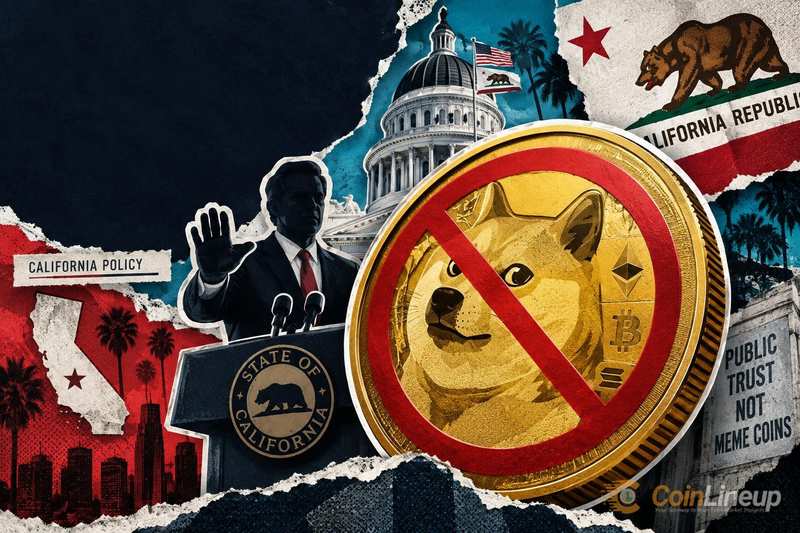
California Governor Gavin Newsom has signed into law a measure that bars state public officials from issuing meme coins, placing California among the first U.S. states to directly restrict elected and appointed officials from launching personal cryptocurrency tokens.
What the Ban Covers
The statute targets a specific act: public officials issuing meme coins. A meme coin is a cryptocurrency typically built around a person's name, image, or social media following rather than underlying technology or utility. That distinction matters, because the law does not prohibit officials from owning or discussing cryptocurrency — only from launching tokens tied to their public profiles.
Newsom, who has served as California's governor since 2019, signed the measure. With roughly 40 million residents and a state economy larger than that of most countries, California's regulatory moves on digital assets tend to draw national attention, giving the new law weight beyond the state's borders.
Who Is Affected and What Is Prohibited
The ban applies to public officials, a category that generally includes elected representatives, senior government appointees, and other individuals exercising official state authority. The core prohibition concerns issuance — the act of creating and launching a token for public trading or distribution.
The specific enforcement mechanism, penalties, and the precise definition of "public official" in the bill text are not confirmed in available reporting on the law. Readers can consult the California Legislative Information site for the bill text once it is published there, and those details will determine how broadly the ban reaches in practice. The gap matters because the boundary between a politician personally launching a token and a campaign using cryptocurrency fundraising tools may require further regulatory guidance to clarify.
The broader push to regulate politically connected crypto tokens gained momentum after several high-profile cases in early 2025, when tokens tied to political figures saw dramatic price swings that disadvantaged retail buyers. California's law is a direct state-level response to that pattern. On the federal side, the CLARITY Act fell short of the votes needed in the Senate, leaving gaps in federal crypto oversight that state laws like this one are beginning to fill.
Impact on Crypto Markets
Personality-led tokens, sometimes called "political meme coins," carry a specific risk: their value is tied to a person's popularity rather than project fundamentals. When that person's fortunes shift, token holders often bear the loss. That dynamic is the conflict-of-interest concern California lawmakers chose to legislate against. The state's law removes at least one category of that supply from state officials.
The practical effect for investors is narrower token issuance from California's political class. The law does not restrict private citizens, celebrities, or companies, and it does not apply to tokens already in circulation before it took effect.
Because the measure is a state rule rather than a federal one, it cannot prevent officials in other from issuing tokens, and it does not change how federal securities law treats meme coins. The Securities and Exchange Commission has separately been examining how digital asset experiments should be governed at the national level — a process still underway.
For anyone holding or considering crypto assets tied to a public figure, California's move signals a growing view among lawmakers that political meme coins present a conflict-of-interest problem worth legislating rather than merely debating, and similar bills may emerge in other states. The markers to watch from here are practical: publication of the bill text and its definitions, whether other states pursue comparable measures, and how federal oversight evolves in the wake of the CLARITY Act's shortfall in the Senate.
Disclaimer: This article is for informational purposes only and does not constitute financial or investment advice. Cryptocurrency and digital asset markets carry significant risk. Always do your own research before making decisions.

