California Bans Memecoins by Public Officials in Law Signed by Governor Newsom
Key Takeaways
- •Assembly Bill 2409 prohibits public officials at any government level from issuing memecoins in California.
- •Starting in January 2027, exchanges will be barred from listing memecoins issued by or affiliated with public officials.
- •California prosecutors, including the state attorney general and local attorneys, may bring civil actions to enforce the law.
- •Newsom’s statement cited claims that nearly one million people lost more than $3 billion on the TRUMP token while President Trump earned approximately $636 million.
- •The federal CLARITY Act failed to advance in the Senate after negotiations over crypto ethics rules broke down.
California Governor Gavin Newsom, a Democrat, has signed Assembly Bill 2409 into law, banning public officials from issuing memecoins in the nation's most populous state. Memecoins are cryptocurrencies typically built around internet jokes, online communities, or public figures, with values driven largely by sentiment rather than underlying utility—the category that includes the TRUMP token at the center of this dispute. The governor approved the measure on Sunday as part of a series of crypto-focused bills signed the same day. Among them was Senate Bill 1208, which addresses crypto-related money laundering and the seizure of proceeds from crypto crime. Several other pieces of legislation were also signed.
Newsom Criticizes Trump Crypto Ventures
The legislation also reads as a pointed response to President Trump and his crypto ventures. In the statement announcing the signings, Newsom specifically mentioned Trump, noting that California is doing the opposite of what he did. The statement cited the TRUMP memecoin, claiming that almost a million people have lost more than $3 billion on the token, while the president made around $636 million in profit.
“While the scam that is Donald Trump continues to hurt American families, California is fighting to make our economy work for people, not the powerful. No official should profit off their office,” Newsom said.
In addition to barring public officials from issuing memecoins, the law prohibits exchanges from listing memecoins issued by, or in partnership with, a public official at any level of government, beginning in January 2027. Because the restriction targets listings and not just issuance, its practical effect extends to the trading platforms themselves. The provision will affect the TRUMP memecoin. Enforcement authority rests with the state attorney general, the district attorney, the county attorney, and the city attorney, each of whom may bring civil action under the legislation.
California has previously legislated on officials' involvement in digital assets. In 2019, the state passed a law requiring public officials to disclose digital asset holdings that could create a conflict of interest, a step that frames the new ban as a continuation of the state's effort to govern how officeholders interact with crypto.
Lummis Criticizes Democrats Over CLARITY Act
The new California law aligns with the broader position of Democrats, who have been calling for a ban on political officeholders profiting from crypto. The issue has been at the forefront since Trump issued a memecoin before his swearing-in as president, and several Democratic lawmakers in Congress have called for an investigation into the TRUMP memecoin.
The issue was also central to negotiations over the CLARITY Act—a federal bill intended to set a regulatory framework for digital asset markets—with Democrats demanding stricter ethics rules to prevent Trump and his family from profiting from crypto. The breakdown of those negotiations ultimately led to the CLARITY Act failing to clear a procedural vote in the Senate, where most legislation needs 60 votes to advance.
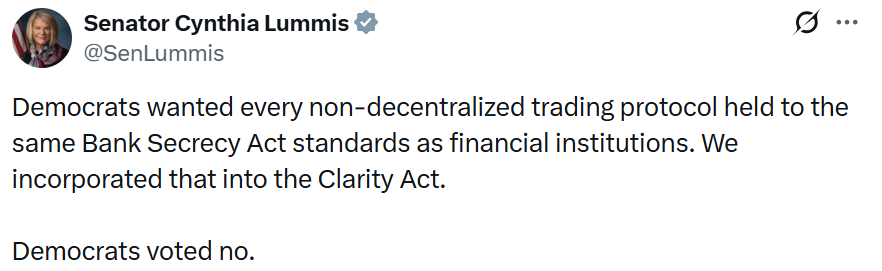
Republican Senator Cynthia Lummis has since criticized Democrats for voting against the bill. In a series of posts on X since September 17, she has highlighted several Democratic demands that were incorporated into the proposed legislation. Lummis claimed the CLARITY Act mandated a government study on crypto mixers to protect consumers, and that Democrats voted against it. She also pointed to other amendments made to the bill at the request of Democrats. Whether other states follow California's lead, and whether the CLARITY Act returns to the Senate floor, are among the open questions as the state ban's January 2027 start date approaches.
This article is for informational purposes only. Political claims and disputed interpretations are attributed to the officials and sources making them.
This story was first reported by The Market Periodical.

