Bitcoin Falls Below $83,000 as U.S. Treasury Yields Reach 17-Year High
Key Takeaways
- •Bitcoin fell 1.5% to $83,416 on Monday as investors reduced exposure to risk assets during a global bond-market selloff.
- •The 10-year U.S. Treasury yield rose above 5% for the first time since 2007, while Japanese government bond yields reached three-decade highs.
- •Markets assigned a 70.3% probability to a 0.25% Federal Reserve rate increase in October, with the August PCE inflation report due Wednesday and September employment data scheduled for Friday.
- •Despite the decline, Bitcoin has gained more than 40% this quarter, which would be its strongest third-quarter performance since 2017.
- •Analysts flagged $82,000-$82,500 as critical support, with a potential move toward $100,000 if the level holds and a possible return to the $60,000-$80,000 range if it breaks.
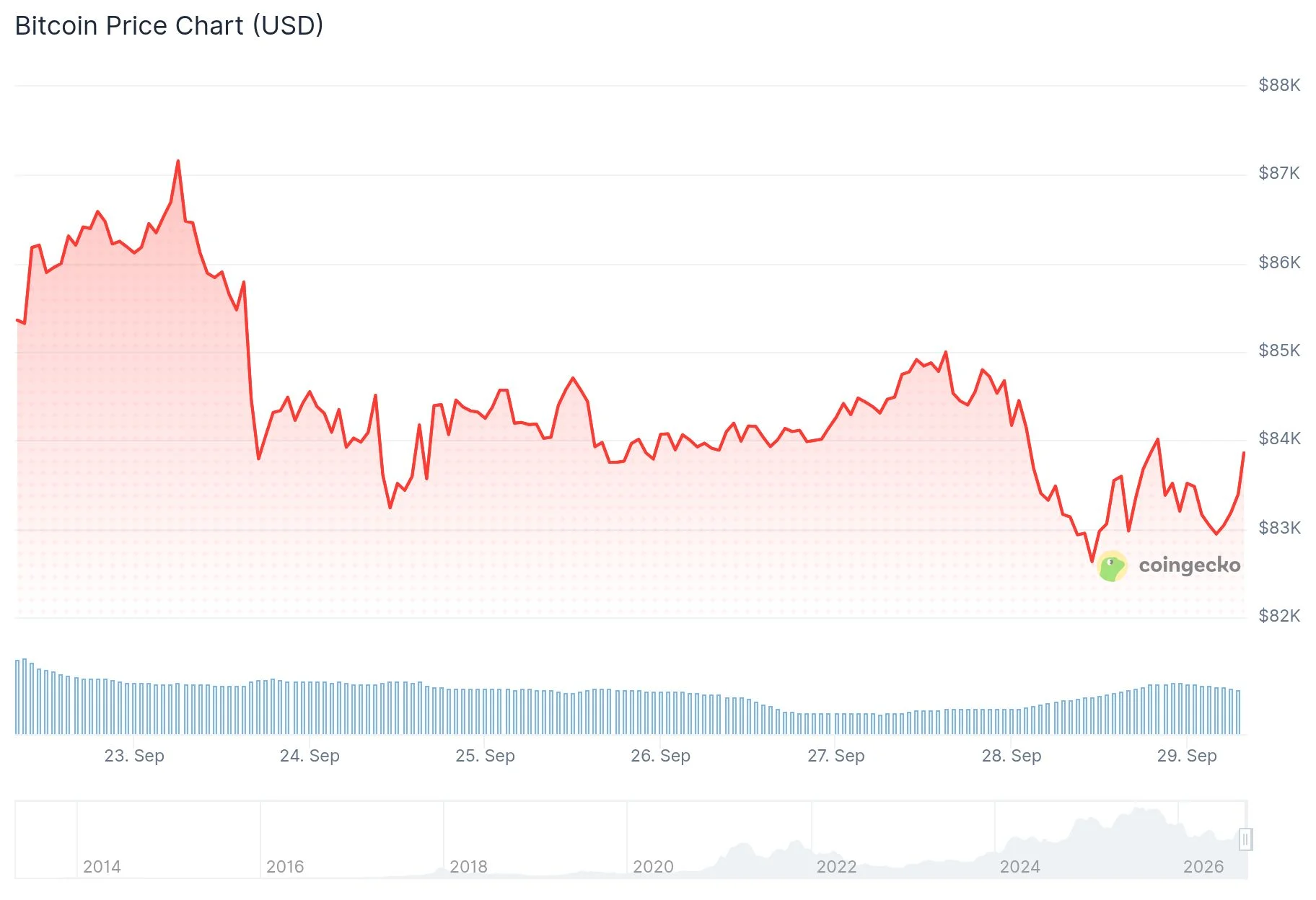
Bitcoin fell 1.5% on Monday to $83,416 as a global bond-market selloff intensified and investors reduced exposure to risk-sensitive assets. The decline followed a strong two-week advance driven by expectations of more favorable cryptocurrency regulations in the United States.
The broader crypto market also moved lower. Ethereum, Cardano, XRP, Dogecoin, and Solana each surrendered part of their recent gains.
The selloff coincided with a sharp rise in sovereign debt yields across developed markets. The benchmark 10-year U.S. Treasury yield climbed above 5% for the first time since 2007, reaching its highest level in 17 years. Japanese government bond yields also reached three-decade highs. Higher government bond yields can make sovereign securities more attractive relative to higher-risk assets as digital currencies.
The U.S. Federal Reserve and the Bank of Japan both raised interest rates in September and indicated that additional tightening might be necessary.
Middle East tensions add to oil and inflation concerns
Rising crude oil prices linked to U.S.-Iran tensions have added to inflationary pressures throughout the year. Over the weekend, President Trump declined to rule out additional military operations against Iran after rejecting Tehran’s proposed ceasefire agreement.
Crude oil prices moved toward $95 per barrel, rising 3% on Monday. Hamad Hussain, a commodities economist at Capital Economics, told Reuters that concerns about supply disruptions remained dominant despite increased tanker traffic through the Strait of Hormuz.
BREAKING: U.S. official says President Trump is ready to ease sanctions on Iran and unfreeze assets in exchange for progress on its nuclear program. Oil is crashing on the news, down -3.60% in just the last 30 minutes. pic.twitter.com/TEUmiHyBVG — Bull Theory (@BullTheoryio) September 28, 2026
Ongoing clashes involving Yemen’s Houthi militants and Saudi Arabia provided additional upward momentum for oil prices.
Analyst Ali Charts said Bitcoin had completed a double-bottom formation and was retesting neckline support at $82,000. His analysis indicated that holding that level could precede a potential move toward $100,000.
BITCOIN: BULLISH RETEST!? $BTC appears to have broken out of a double bottom pattern and is now moving back toward the $82,000 neckline. If this level holds as support, the retest could offer a buying opportunity before the rally resumes toward the pattern’s $100,000 target. pic.twitter.com/SXE7VeA9SN — Ali Charts (@alicharts) September 28, 2026
Despite Monday’s decline, Bitcoin has gained more than 40% in the third quarter. That would make it Bitcoin’s strongest third-quarter performance since 2017 and substantially above its average third-quarter gain of 8.6% since 2013.
Bitcoin’s weekly close had reached $84,450, its highest since late January, before the price fell to a one-week low near $82,557. Limited order-book depth contributed to the volatility, with approximately $30 million in sell orders concentrated around $85,700 on Monday. Order books that thin mean even relatively modest order flow can move prices further than it would in deeper markets.
October rate-hike odds rise ahead of economic data
Financial markets were assigning a 70.3% probability to a 0.25% Federal Reserve rate increase in October, up from 57.7% one week earlier. The August personal consumption expenditures (PCE) inflation report, the Fed’s preferred inflation measure, is scheduled for release Wednesday. Expectations call for year-over-year growth of 3.6%. The PCE report and Friday’s employment figures are among the data the Federal Reserve weighs most heavily in its policy decisions, giving this week’s releases an outsized role in shaping the tightening expectations already priced into those October odds.
69% Chance of another Rate Hike in October… Bond Market is screaming, again. pic.twitter.com/vdWzJYjfzd — Manz (@ManzTrades) September 28, 2026
The September employment situation report is scheduled for Friday. August payroll growth significantly exceeded forecasts at 162,000, while consensus estimates for September stood at 83,000.
Trader Rekt Capital identified $82,500 as a critical level for Bitcoin to defend. He compared the current setup with the 2022 bear-market recovery, when Bitcoin formed a base above a comparable support level before beginning its subsequent rally.
Rekt Capital said that holding $82,500 would validate an inverse head-and-shoulders formation on the weekly chart. He added that a failure to maintain the level could send Bitcoin back into the $60,000-to-$80,000 range.
Above the current market price, Bitcoin’s 2026 yearly opening level is $88,700, while the average purchase price for spot Bitcoin exchange-traded fund investors is approximately $86,000. The spot ETF market only opened to U.S. investors in January 2024, making the aggregate cost basis of that group a comparatively new reference point. Below the market, corporate Bitcoin treasury holders have an average cost basis near $80,500. Read alongside the technical levels above, those cost-basis markers frame the price zones traders are watching as Wednesday’s inflation data and Friday’s employment report land.
Source: https://blockonomi.com/bitcoin-btc-dips-below-83k-as-treasury-yields-hit-17-year-peak/

