Two U.S. Businesses Sue Trump Administration Over New Section 301 Tariffs
Key Takeaways
- •Two small U.S. retailers filed a lawsuit challenging tariffs the Trump administration imposed on 60 economies under Section 301 of the 1974 Trade Act.
- •The new duties of up to 12.5 percent took effect the same day the administration's prior 150-day 10 percent global tariff expired.
- •The complaint alleges the USTR acted arbitrarily by imposing near-uniform tariffs across materially different economies without a reasoned explanation.
- •The Liberty Justice Center previously challenged Trump's emergency tariffs, which the Supreme Court struck down in February.
- •Trump defended his tariff policies at the White House, claiming they have attracted $19.2 trillion in investment to the United States.
WASHINGTON — Two small U.S. businesses filed a lawsuit Friday challenging new tariffs on dozens of U.S. trading partners that President Donald Trump's administration announced a day earlier over concerns related to forced labor, according to a litigation firm.
The Liberty Justice Center said it brought the case in the U.S. Court of International Trade, the specialized federal court that adjudicates trade and customs disputes, on behalf of Burlap & Barrel, a New York-based online retailer, and Collective Horology, a California-based retailer. The lawsuit followed an announcement by the U.S. Trade Representative (USTR) of new tariffs of up to 12.5 percent on South Korea and other economies.
The latest duties were introduced after the USTR conducted investigations into 60 economies under Section 301 of the 1974 Trade Act. Section 301, which grants the executive branch authority to respond to foreign trade practices deemed unfair, has historically been applied to specific trading partners on a targeted basis — most prominently against China beginning in 2018. Its use here across 60 economies simultaneously marks a notably broad application of the statute. The probes examined whether those economies had taken adequate steps to prohibit imports made with forced labor.
The tariffs took effect Friday, the same day the administration's 150-day 10 percent global tariff expired.
According to the complaint, the USTR acted "arbitrarily and capriciously" by imposing near-uniform tariffs across 60 materially different economies "without a reasoned, record-based explanation" of how the duties would address the practices identified by the trade agency.
The lawsuit also alleges that the USTR did not explain how taxing the products at issue would lead foreign governments to change their import policies.
The Liberty Justice Center said the new tariffs apply to lawful imports that have no demonstrated connection to forced labor, including goods brought into the United States by American small businesses with transparent and responsible supply chains.
"Forced labor is morally indefensible, but an important objective does not give the government permission to ignore the law," Sara Albrecht, chairman and CEO of the Liberty Justice Center, said.
"The administration allowed one global tariff to expire and immediately replaced it with another under a different statute. Changing the statute doesn't change the law. Every tariff authority has limits, and every administration must respect them."
The Liberty Justice Center is the same organization that challenged the Trump administration's emergency tariffs, which were struck down by the Supreme Court in February. That ruling narrowed the executive's ability to impose tariffs under emergency powers, and the current lawsuit tests the boundaries of a separate legal authority — Section 301 — continuing a broader judicial examination of how far presidential tariff powers extend.
Asked by a reporter whether the new U.S. tariffs could withstand legal scrutiny, Trump said that "these tariffs have been up for a long time" and that they have been "approved for years."
"I thought the decision by the Supreme Court was not a good one," Trump said, referring to the ruling against his emergency tariffs. "But we have many forms of tariffs."
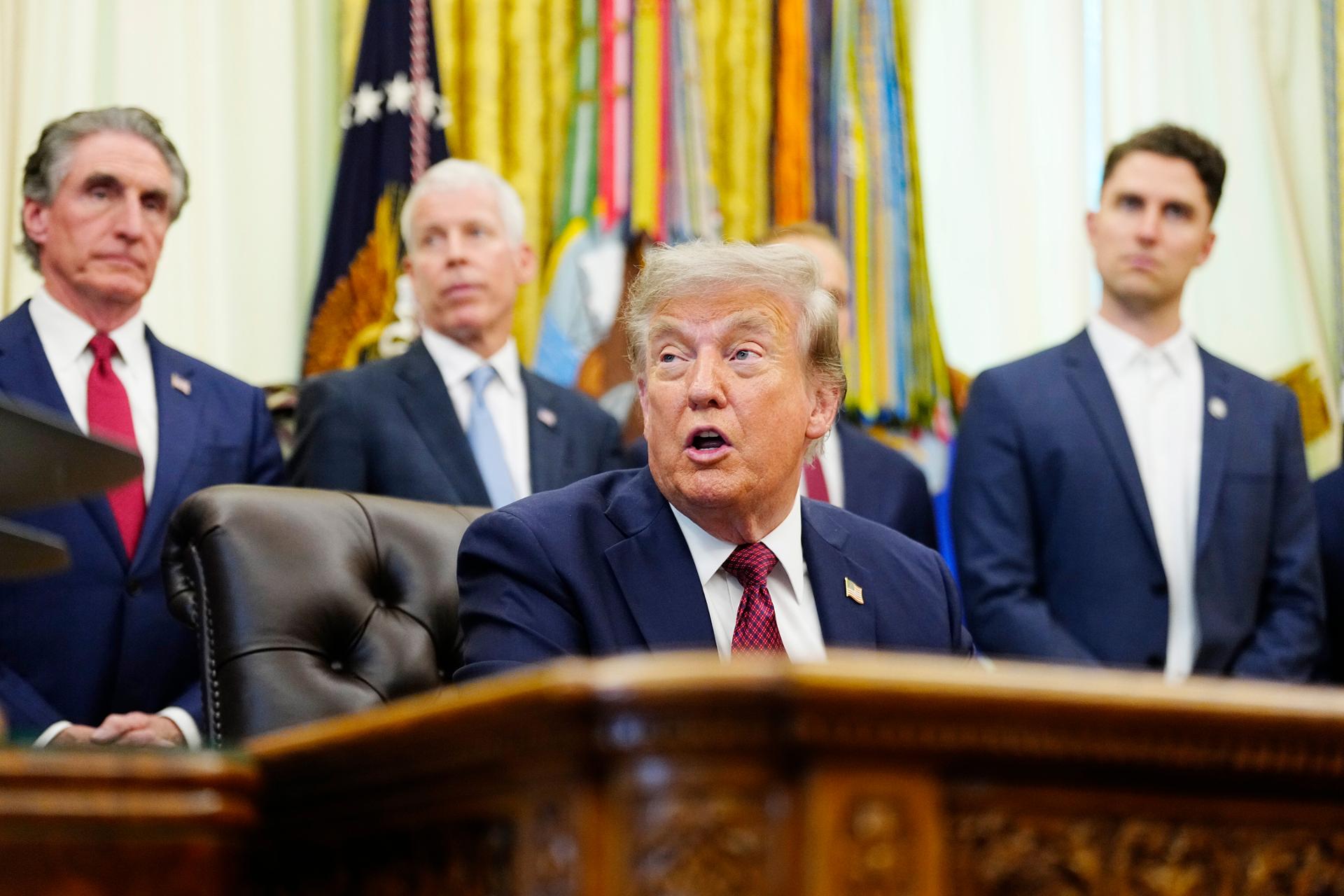
Trump defended his tariff policy during the press availability at the White House, saying it had helped draw investment into the United States.
"Largely because of tariffs, we have $19.2 trillion being invested in our country," he said. "And without tariffs, we would be in big trouble."

