BNB Chain Unveils New Layer-1 Blockchain as BNB Breaks Multi-Year Support
Key Takeaways
- •BNB broke below an ascending trendline that had acted as support since 2024, completing the neckline break of a large head-and-shoulders reversal pattern.
- •Analyst Crypto Patel projected downside targets of $300 and $207, flagged $700-$760 as resistance for any recovery, and said a move above $811 would void the bearish setup, with the chart implying a potential correction of roughly 63% from the neckline area.
- •At the time of the analysis, BNB traded at $553 after opening the session at $559.51 and reaching a low of $537.41, marking a weekly decline.
- •BNB Chain's litepaper describes a new Layer-1 blockchain targeting 200-millisecond block times and about 20-millisecond transaction preconfirmations, compared with BSC's reported 450-millisecond block interval.
- •The upcoming chain will use BNB as its sole native token for fees, staking, and governance, with public testing scheduled for the first quarter of 2027 and a mainnet launch planned for the second half of that year.
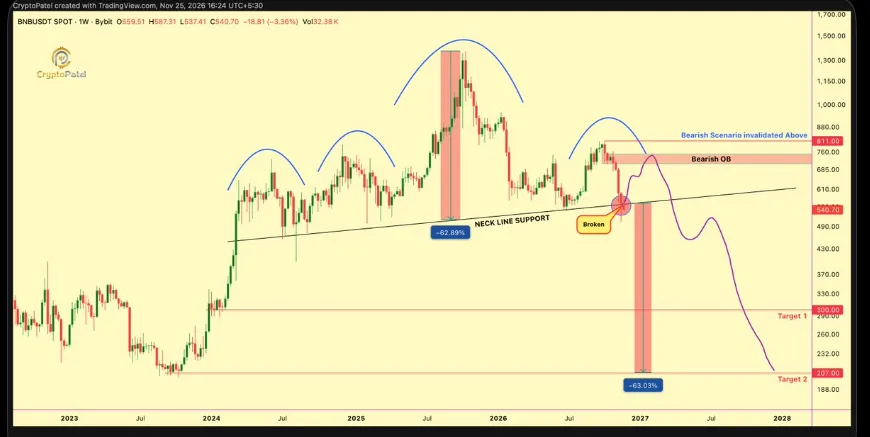
Binance Coin (BNB) has dropped below a support trendline that has held since 2024, raising concerns over further price declines, even as BNB Chain released the litepaper for a new Layer-1 blockchain designed for high-frequency trading, fast payments, and autonomous AI agents. Crypto analyst Crypto Patel has identified downside targets at $300 and $207, with a possible recovery toward $760 before another decline.
Analyst Maps Downside Targets After Multi-Year Support Break
Crypto Patel shared a weekly chart on X showing BNB breaking below the neckline of a large head-and-shoulders pattern. The ascending trendline had served as support for nearly three years, with BNB recovering from this area several times. Head-and-shoulders formations are among the most closely watched reversal patterns in technical analysis, with the neckline break serving as the reference point from which traders typically measure projected downside moves.
BNB was trading at $553 when the analyst posted the chart, recording a weekly decline. The cryptocurrency had opened the session at $559.51 before reaching a low of $537.41.
Despite the loss of support, Patel has not ruled out a temporary price recovery. He identified an area between $700 and $760 where BNB could encounter resistance, while a move above $811 would invalidate his bearish outlook.
His price prediction places the first downside target at $300, with further weakness potentially bringing the $207 level into focus. The chart projects a potential correction of roughly 63% from the neckline area. For now, the setup offers clearly defined reference points: a resistance zone that could cap any recovery, a specific level above which the bearish reading would be voided, and staged downside targets should the breakdown extend.
BNB Chain Reveals a Faster Layer-1
BNB Chain has released the technical details of a new blockchain that will run alongside BNB Smart Chain (BSC) in an official litepaper. The project focuses on payments, high-frequency transactions, and applications that require faster processing.
Under the proposed design, the blockchain aims to produce a new block every 200 milliseconds. BNB Chain also targets transaction preconfirmations of around 20 milliseconds, compared with BSC's reported block interval of 450 milliseconds. Latency at these scales speaks directly to the project's stated focus, since high-frequency trading and fast payment applications depend on how quickly transactions can be confirmed.
The developers plan to separate transaction ordering from execution, meaning validators can arrange new transactions without waiting for the execution of earlier ones to finish. The design also introduces SubBlocks, which give applications early information about the placement of transactions within a block. Such confirmations do not guarantee that a transaction will succeed.
Built-In Support for AI Agents and Flexible Fees
Users of the upcoming blockchain will have several options for approving transactions. BNB Chain plans to support passkeys, sponsored transaction fees, and the completion of multiple smart contract operations through a single transaction. Applications can cover network fees for users who do not hold BNB, and payment intermediaries can accept stablecoins from users while paying the actual network fees in BNB.
Another feature allows users to give AI agents access to specific account functions. Users can decide which operations an agent can perform and withdraw those permissions when necessary. Scoped, revocable permissions address a practical question for agent-based systems: how much control a user should delegate to software acting on their behalf.
BNB Chain also plans to introduce an optional shielded pool for private transfers involving BNB and approved BEP-20 tokens. Participants can disclose selected transaction information to authorized parties. However, some details will remain visible when users interact with public applications.
Launch Set for 2027 With BNB as the Sole Native Token
BNB Chain has confirmed that the upcoming blockchain will not have a separate native cryptocurrency. BNB will serve as the token for transaction fees, staking, and governance across both networks, with public testing scheduled for the first quarter of 2027 and a mainnet launch planned for the second half of the year. Until that testing begins, the litepaper's block-time and latency figures remain design goals rather than demonstrated results.
The consensus mechanism will support up to 64 validators, and daily elections will determine which validators participate in the network based on the amount of BNB they stake.
Developers working on BNB Smart Chain can keep their existing applications on the network, while those looking to use the new blockchain can introduce compatible applications without shutting down their existing services.
This article provides market information and does not constitute financial or investment advice.
This article was originally published by The Market Periodical.

