BNB Holds Near $707 as Binance Reopens Withdrawals in Phases
Key Takeaways
- •Binance restarted withdrawals in phases on Nov. 1, with Bitcoin first in a 06:00–09:00 UTC window, as part of its recovery from a $6.3 billion hack.
- •The first phase spans 15 networks, including Ethereum, BNB Smart Chain, Solana and Tron, and each asset-and-network route must pass security and stability reviews before going live.
- •Binance reported it has replaced about 95% of the affected assets, up from 90%, and will bear the financial losses, though reduced liquidity is slowing purchases of the remaining tokens.
- •The FBI urged THORNode operators and DeFi services to block transactions connected to the hack, and compliance depends on voluntary action because no central administrator processes public blockchain transfers.
- •BNB traded at $706.55, up 0.79%, remaining below the $710 level and the $731–$749 resistance zone defined by its 20-day and 50-day moving averages.
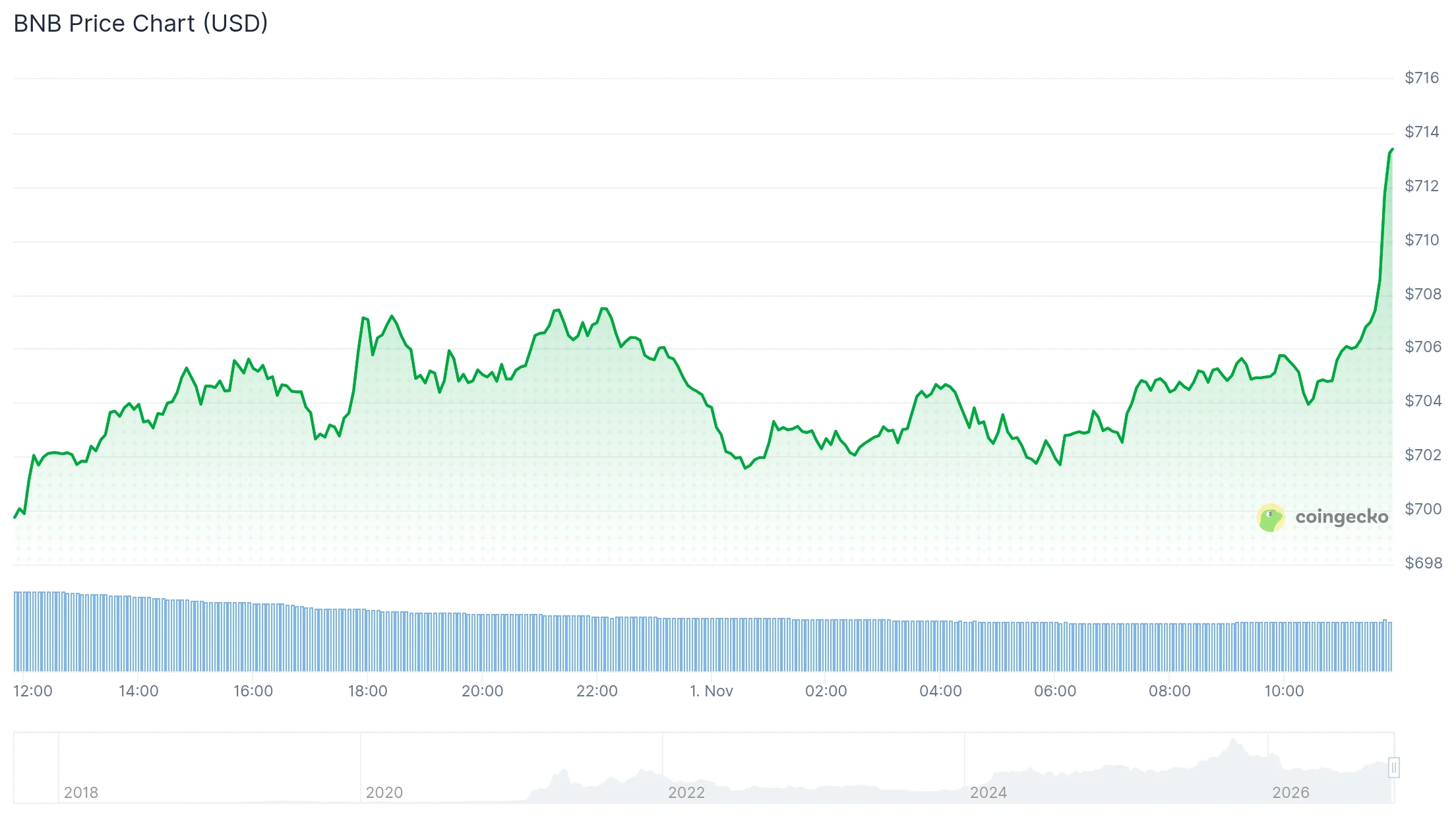
BNB traded near $707 on Nov. 1 as Binance began reopening withdrawals after a $6.3 billion hack. Bitcoin withdrawals were the first confirmed to resume, while other assets were scheduled to return gradually. Binance set the initial restart window for Sunday from 06:00 to 09:00 UTC. Withdrawal access is the function that lets customers move assets to external addresses, so its restoration is a direct marker of how far the exchange’s recovery from the breach has progressed.
The first phase covers selected assets across 15 networks, including Ethereum, BNB Smart Chain and Solana. Each asset-and-network route must pass security and stability checks before it becomes available. Binance warned that heavy traffic could result in temporary delays or longer processing times. Customers can check the withdrawal page for the availability of a specific asset and network, making that page the practical reference for when particular holdings become movable again.
Binance Reopens Withdrawals Across 15 Networks
Binance is restoring withdrawals by asset and network rather than reopening all services simultaneously. That structure reflects how multi-chain exchanges operate, since the same token can circulate on several blockchains and each route needs its own verification. In addition to Bitcoin, the announced first phase includes Ethereum, Solana, BNB Smart Chain, Tron, XRP Ledger, Zcash and Dogecoin. The remaining networks are TON, Polygon, Avalanche C-Chain, Arbitrum, Base, Optimism and Sui.
Stablecoin support differs by chain. The Ethereum and Solana routes include USDT and USDC, while the Tron route supports USDT alongside TRX.
Yi He, Binance’s co-founder, said wallets for other currencies remained subject to repeated security audits and checks of their protective systems. She identified market capitalization, locked funds and user numbers as priorities. Binance’s formal recovery notice also referred to withdrawal demand recorded during the previous week.
Binance is preparing to resume phase one of withdrawals on 2026-11-01 between 06:00 and 09:00 (UTC). The first batch open for withdrawal covers 15 currencies across the 15 networks shown in the chart. Wallets for other currencies are still undergoing repeated security audits and… pic.twitter.com/bZ1LCDYZ9c — Yi He (@heyibinance) November 1, 2026
Binance reported that it had replaced approximately 95% of the affected assets, up from 90% in its previous update. The exchange said lower liquidity was preventing it from buying the remaining tokens quickly and reiterated that it would absorb the financial losses from the breach. How quickly the remaining assets are replaced and additional routes clear the security checks will show how soon full withdrawal service returns.
Separately, the FBI urged THORNode operators and DeFi services to block transactions linked to the Binance hack. THORChain is a cross-chain liquidity protocol whose THORNode operators run the infrastructure that moves assets between blockchains. THORChain co-founder Chad Barraford said node operators hold no nonpublic information and that investigators can retrieve the public data without subpoenas. His response did not say whether operators would block the transactions. Because transfers on public blockchains are processed by distributed nodes rather than a central administrator, compliance with the request rests on operators’ voluntary action.
BNB Price Remains Below Key Resistance Levels
Market data showed BNB at $706.55, up 0.79%, with a daily range of $702.28 to $706.79. The token remained below $710, a nearby level identified in earlier market analysis. That analysis said a sustained move above $710 would be an initial sign of improving short-term strength.
An earlier technical review placed BNB’s 20-day moving average at $731.04 and its 50-day moving average at $749.09. The 200-day moving average stood at $655.18, leaving the price below the shorter-term averages but above the longer-term reference.
The same review identified resistance at $734.03 through the Ichimoku Kijun line. The $731 to $749 range therefore represented several resistance levels above the current market price. The modest daily advance had not cleared those levels or confirmed a lasting reversal.
An analyst projected a seven-day level of $668.06 and a target of $750 for November. Both figures are forecasts, not current market prices.
Source: https://blockonomi.com/bnb-price-holds-near-707-as-binance-withdrawals-resume-in-phases/

