BLS Preliminary Benchmark Revision Points to Lower Payroll Estimates; Goldman Sachs Expects Smaller Final Revision
Key Takeaways
- •The BLS preliminary benchmark revision released on August 28, 2026 indicates payroll employment was previously overstated.
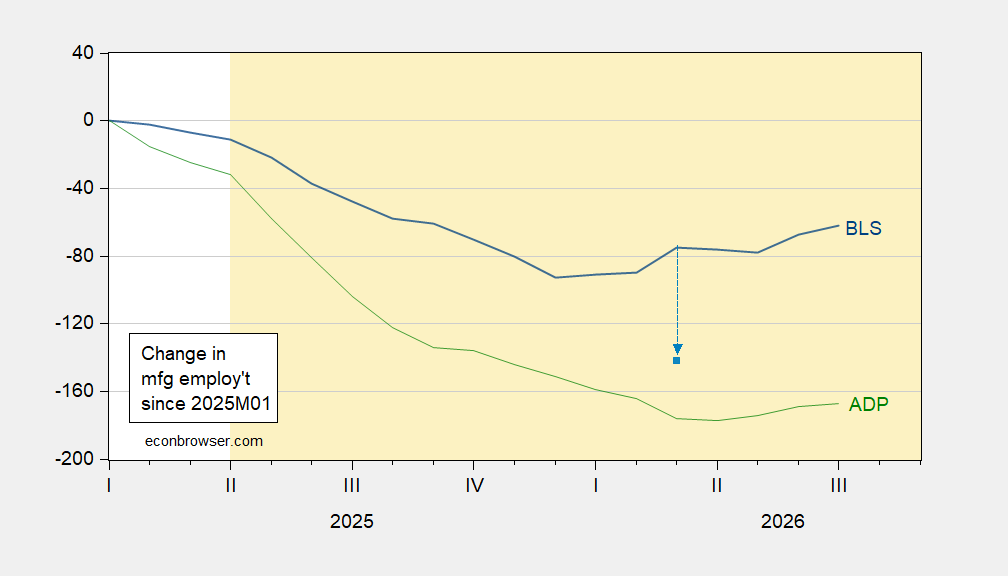
- •Econbrowser compared manufacturing employment since January 2025 using BLS payroll data, the preliminary benchmark revision, and ADP series data.
- •The analysis also compared private nonfarm payroll employment using BLS, ADP, and Bloomberg consensus forecast data as of August 28.
- •The post-Liberation Day period after the April 2, 2025 tariff announcement was highlighted in the charts.
- •Goldman Sachs said the preliminary downward revision may be smaller in the final benchmark update.
The US Bureau of Labor Statistics (BLS) released its preliminary benchmark revision of payroll employment estimates on August 28, 2026. The revision, based on Quarterly Census of Employment and Wages (QCEW) data, points to a downward adjustment to previously published employment figures (BLS preliminary benchmark release). The monthly payroll report is among the most closely watched US economic indicators — tracked by economists, businesses, and Federal Reserve policymakers, whose mandate includes maximum employment — so the benchmark process directly shapes confidence in the headline job numbers.
In an analysis published the same day, Econbrowser examined the revised picture for two employment series:
Manufacturing employment. Tracking the change in manufacturing employment since January 2025 (2025M01), the analysis compares the official BLS payroll series, the BLS preliminary benchmark revision, and the ADP employment series, with data drawn from BLS and ADP (via FRED) and the author's calculations. The chart uses orange shading to mark the post-'Liberation Day' period — the months following the April 2, 2025 announcement of sweeping tariffs by the Trump administration, which were promoted as a way to encourage domestic manufacturing. Factory employment has been a focal point of the tariff debate, and the analysis's title — "So Much for the Manufacturing Employment Renaissance" — frames the revised data against that renaissance narrative.
Private nonfarm payroll employment. A parallel comparison of the change in private nonfarm payroll employment since January 2025 uses the same three series plus the Bloomberg consensus forecast (as of August 28), again marking the post-Liberation Day period with orange shading. Sources for this comparison are BLS, ADP (via FRED), and Bloomberg as of 8/28, with the author's calculations.
Goldman Sachs' view. Goldman Sachs argues that the downward revision will likely be reduced in the final benchmark — a reminder that the preliminary figures are themselves an estimate that can move before the final revision lands.
Background on the benchmark process. Each year the BLS reconciles its Current Employment Statistics (CES) survey estimates — which are based on a sample of businesses — with the QCEW, a near-census of employment compiled from unemployment insurance tax records filed by employers. Because new and closing firms take time to show up in a fixed survey sample, payroll estimates can drift from actual employment, and the annual benchmark is the built-in correction; the QCEW arrives with a lag because it depends on employers' unemployment insurance filings. Preliminary benchmark estimates are typically published in late summer, and the final benchmark revision is incorporated into the data together with the January employment estimates released early the following year. Benchmark revisions can materially change the measured path of job growth over the benchmark period, which makes the January release the next checkpoint for how large the downward adjustment ultimately proves to be.
The ADP employment series, used in the analysis as an alternative private-sector measure, is derived from payroll data processed by ADP, one of the largest US payroll processors.
Original post: Econbrowser — So Much for the Manufacturing Employment Renaissance

