Can Bitcoin Offset the US $40 Trillion Debt? BlackRock's Digital Assets Head Weighs In
Key Takeaways
- •BlackRock digital assets head Robert Mitchnick said rising US debt and deficit levels are strengthening Bitcoin's investment case as investors seek scarce stores of value alongside gold.
- •US federal debt has surpassed $40 trillion, and annual interest costs on that debt now exceed $1 trillion, a figure higher than US defense spending.
- •BlackRock's spot Bitcoin ETF IBIT holds approximately 771,641 BTC worth nearly $61 billion and has become one of the fastest-growing funds in ETF history.
- •Bernstein forecasts Bitcoin reaching $125,000 by late 2026 in its base case, $300,000 by the end of 2029, and up to $500,000 under its bull case.
- •Even at $1 million per BTC, the US government's roughly 328,372 BTC in holdings would cover only about 0.82% of the $40.05 trillion national debt.
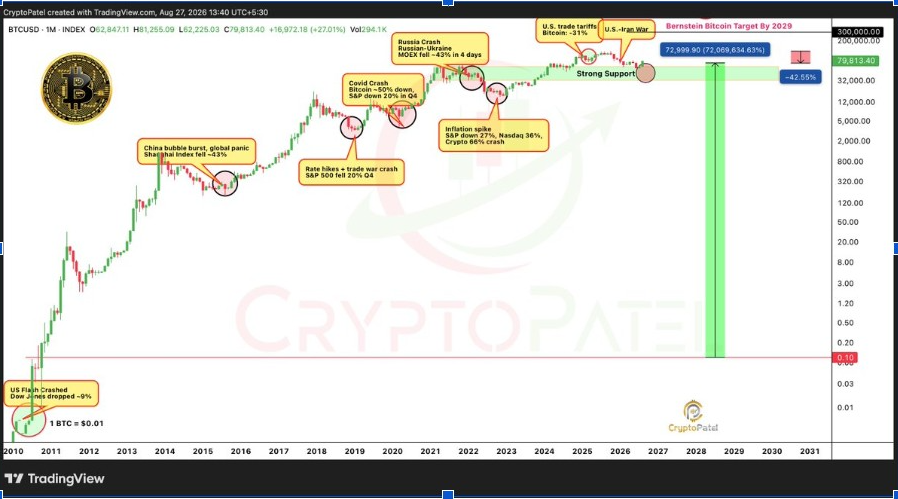
Bitcoin's recovery above $80,000 is renewing debate over whether the asset can serve as protection against growing fiscal pressure in the United States. Robert Mitchnick, head of digital assets at BlackRock, says debt concerns are becoming a stronger part of Bitcoin's investment case.
US federal debt has crossed $40 trillion, while continuing deficits shape investor views on long-term fiscal stability. Annual interest costs on that debt have climbed above $1 trillion, a level that now exceeds US defense spending and has pushed fiscal policy into mainstream market discussion. According to Mitchnick, these concerns are directing more attention toward Bitcoin and gold as alternative stores of value. Gold has also drawn demand in this environment, setting a series of record highs in 2025 while central banks have remained net buyers for several consecutive years, according to World Gold Council data.
BlackRock Sees Fiscal Pressure Driving Bitcoin Demand
Mitchnick said debt and deficit levels have become a major concern for markets as federal borrowing keeps rising. He argued that such conditions can support demand for assets with limited or scarce supply, such as Bitcoin, whose protocol hard-caps total issuance at 21 million coins, a limit that no government or central bank can alter.
"Debt and deficit levels are a major concern for markets," Mitchnick said, according to the report. He added that both Bitcoin and gold can benefit from those concerns.
His comments suggest regulation is becoming less central to Bitcoin's investment case than broader macroeconomic conditions. Bitcoin already operates within a clearer regulatory framework than many other parts of the digital asset market.
The CLARITY Act may still matter for exchanges, DeFi platforms, and other crypto businesses. However, Mitchnick said its effect on Bitcoin itself could be more limited.
IBIT Growth Expands Institutional Bitcoin Access
BlackRock's spot Bitcoin ETF, IBIT, continues to provide institutional and retail investors with regulated exposure to Bitcoin. The fund launched in January 2024 after the SEC approved spot Bitcoin ETFs and has since become one of the fastest-growing funds in ETF history. According to Bitcoin Treasuries, the fund holds about 771,641 BTC worth nearly $61 billion.
Mitchnick told Bloomberg that IBIT should continue growing as BlackRock expands investor access. He also pointed to custody and physical security concerns among some Bitcoin holders, noting that those risks can lead investors toward exchange-traded funds instead of self-custody. ETFs allow investors to gain Bitcoin exposure without directly managing private keys or digital wallets.
BlackRock's growing BTC holdings also reduce the amount of Bitcoin available across public markets. Even so, Bitcoin's price still depends on overall demand, liquidity, selling pressure, and wider financial conditions.
Bernstein Links BTC Price Outlook to the Debasement Trade
Against this backdrop, Wall Street analyst Bernstein has recently published its long-term BTC price forecast on the basis of growing US debt and concerns about currency debasement. The debasement trade describes positioning in scarce assets such as gold and Bitcoin as a guard against the loss of purchasing power that can follow heavy government borrowing. The firm expects Bitcoin to reach $125,000 by late 2026 under its base case.
The forecast rises to $150,000 by mid-2027 and $300,000 by the end of 2029. Bernstein's bull-case projection reaches $500,000 during the same 2029 period.
The firm also points to institutional demand, spot ETF inflows, and stronger holding behavior as supporting factors. Around 59% of circulating BTC reportedly remained unmoved during the recent market drawdown.
Bernstein views the latest Bitcoin decline as shallower than earlier bear markets. Previous cycles often produced losses of 75% to 90%, while the latest decline approached 50%.
Can Bitcoin Offset US Debt Risks?
As for whether Bitcoin could clear the US debt, the honest answer is that it cannot. The US government currently holds about 328,372 BTC, mostly obtained through criminal and civil asset seizures. In March 2025, the White House established a Strategic Bitcoin Reserve by executive order, capitalized with that forfeited bitcoin rather than new market purchases.
At $1 million per BTC, those holdings would be worth about $328.4 billion. That amount would cover only about 0.82% of the $40.05 trillion national debt load.
Even a federal reserve of one million BTC, an idea that has been persistently advocated, most prominently in the BITCOIN Act introduced by Senator Cynthia Lummis, would be worth $1 trillion at that price. A $1 trillion reserve would equal only about 2.5% of the current US debt total.
