BlackRock Options Positioning Shifts as JPMorgan and Morgan Stanley Raise Targets
Key Takeaways
- •BlackRock’s open put-call ratio moved from 1.00 on July 15 to 0.98 on July 24, indicating a slight shift toward upside positioning.
- •Chaikin Money Flow improved from about -0.28 to -0.13 over the same period, but it remained below zero, showing sellers were still in control.
- •Morgan Stanley raised its BlackRock price target to $1,488, while JPMorgan upgraded the stock to Overweight and lifted its target to $1,364.
- •BlackRock reported $15.34 trillion in assets under management, $7.08 billion in revenue and $191.7 billion in net inflows for the quarter.
- •BlackRock’s IBIT accounted for $202 million of a $225 million one-session outflow from U.S. spot Bitcoin ETFs in late July.
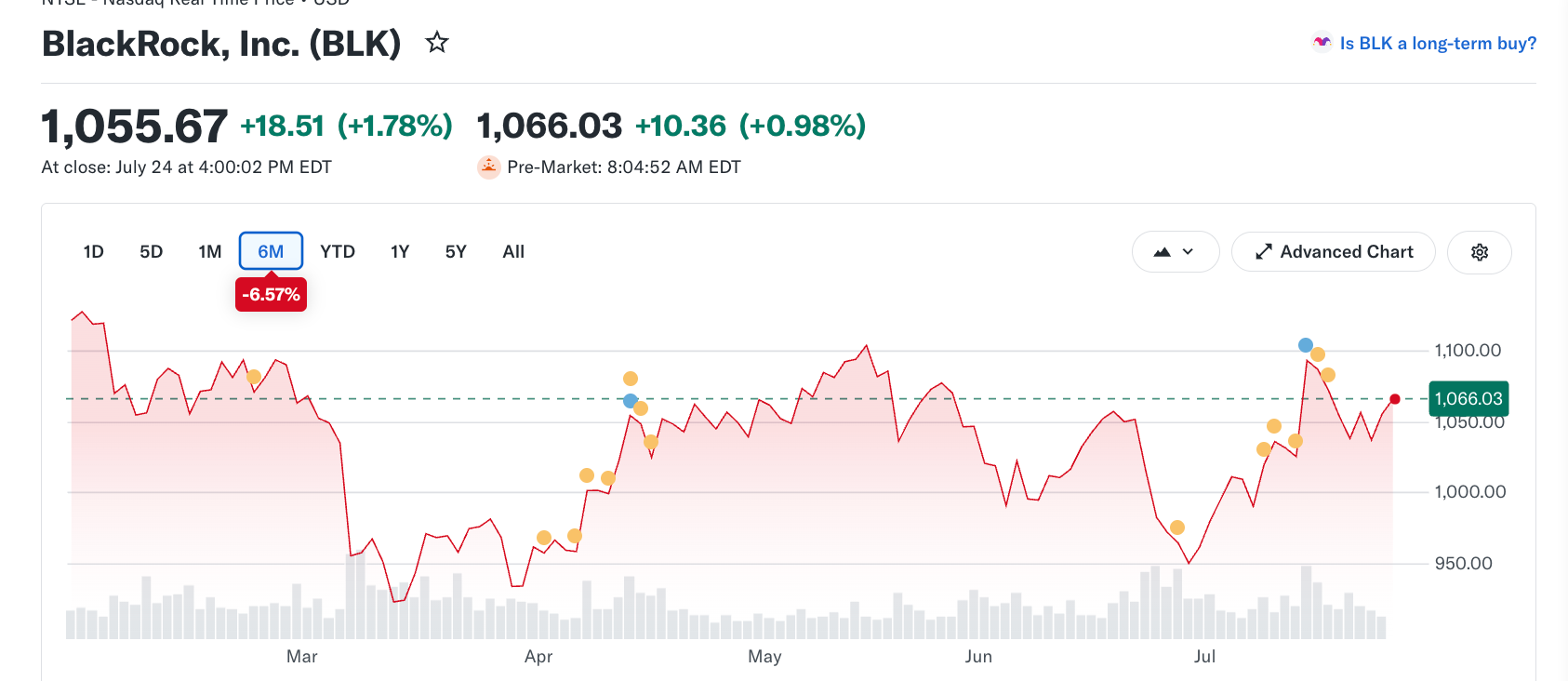
Traders have begun positioning for a rebound in BlackRock, the world’s largest asset manager, following its July earnings beat. The shift has occurred even as BlackRock’s share price has continued to decline, and weeks after two of the company’s largest competitors told clients to buy the stock.
JPMorgan and Morgan Stanley both raised their price targets on July 16. For the following eleven days, BlackRock’s stock price did not reflect those calls.
Open Options Bets Now Tilt Toward a Rise
The put-call ratio compares bets on a falling share price with bets on a rising one. A reading below 1.00 indicates that upside bets have the larger share.
For BlackRock stock, that measure stood at 1.00 on July 15, the day the company reported results, showing an even split. By July 24, it had moved down to 0.98, shifting the balance slightly toward a rise.
This reading counts only the positions traders still hold after the market closes. As a result, it reflects the exposure investors are prepared to carry overnight rather than trades opened and closed during the session.
Shorter-term traders have shown less conviction. When counting only the trades placed each day, the same ratio rose from roughly 0.70 to 0.83, meaning more downside bets were changing hands than before the earnings report.
The difference suggests traders are keeping recovery-oriented positions open while also paying for downside protection as they wait, because the share price has continued to slide.
BLK Shares Have Not Yet Followed the Options Positioning
Money flow presents the more cautious side of the setup. Chaikin Money Flow (CMF) is used to assess whether institutional buyers or sellers are dominating a stock. A reading below zero indicates seller control.
BlackRock stock was near -0.28 on July 15 and improved to -0.13 by July 24. The reading remained below zero, meaning sellers were still in control. However, the improvement suggests institutional activity may have started to respond to the JPMorgan and Morgan Stanley calls.
That selling pressure weakened while BlackRock’s share price fell between July 15 and July 24 and CMF moved higher. The gap between improving money flow and a declining share price is the disconnect the two rival banks had identified in advance.
JPMorgan and Morgan Stanley Made the Call First
JPMorgan and Morgan Stanley compete with BlackRock for client money through J.P. Morgan Asset Management and Morgan Stanley Investment Management. Even so, both firms told clients to buy shares of their competitor.
Morgan Stanley’s adjustment came in two steps. It cut its BlackRock target to $1,383 from $1,430 on July 14, one day before earnings, while maintaining an Overweight rating. It then raised the target by $105 to $1,488 on July 16, the highest target on Wall Street.
$BLK -Morgan Stanley lowers BlackRock target to $1383 from $1430 Overweight – $BTSG -KeyBanc raises BrightSpring Health target to $80 from $60 Overweight -Morgan Stanley raises target to $80 from $71 Overweight – $CABO -BNP Paribas upgrades Cable One to Neutral from… — stock setter (@MarcJacksonLA) July 14, 2026
$BLK -Morgan Stanley lowers BlackRock target to $1383 from $1430 Overweight – $BTSG -KeyBanc raises BrightSpring Health target to $80 from $60 Overweight -Morgan Stanley raises target to $80 from $71 Overweight – $CABO -BNP Paribas upgrades Cable One to Neutral from…
JPMorgan made a larger move on the same day, upgrading BlackRock from Neutral to Overweight and raising its price target by 17% to $1,364.
Two smaller firms also supported positive ratings. BMO Capital Markets, the investment banking arm of Bank of Montreal, reiterated a Buy rating with a $1,300 target on July 17. Keefe, Bruyette and Woods (KBW), a broker specializing in financial companies, initiated coverage a day earlier with the same $1,300 target.
None of those targets has been reduced since. Because BlackRock shares have declined during that period, the distance between the current share price and those targets has widened rather than narrowed. Analyst targets are not a guarantee of future performance, but the cluster of higher targets helps explain why options traders are watching whether fund flows and share-price momentum begin to align.
What the BlackRock Bets Are Based On
BlackRock reported $15.34 trillion in assets under management on July 15. Revenue rose 31% to $7.08 billion, and net inflows totaled $191.7 billion.
For asset managers, assets under management and net inflows are central operating measures because management fees are generally tied to client assets. That makes the mix of inflows important, not just the total.
One figure was weaker than the headline numbers. Large institutions contributed only about $2.34 billion of those inflows, meaning most of the growth came from ETFs and everyday investors. That matched the broader picture in which institutional money had largely stayed quiet. The recent improvement in CMF indicates that this measure has started to move higher.
BLACKROCK AUM $15.34T, EST. $15.19T || 2Q FIXED INCOME NET INFLOWS $92.10B || 2Q ADJ EPS $13.91, EST. $12.66 || 2Q REV. $7.08B, EST. $6.82B || 2Q NET INFLOWS $191.70B, EST. $175.92B || 2Q INSTITUTIONAL NET INFLOWS $2.34B || 2Q INSTITUTIONAL NET INFLOWS $2.34B || 2Q LONG-TERM… — First Squawk (@FirstSquawk) July 15, 2026
BLACKROCK AUM $15.34T, EST. $15.19T || 2Q FIXED INCOME NET INFLOWS $92.10B || 2Q ADJ EPS $13.91, EST. $12.66 || 2Q REV. $7.08B, EST. $6.82B || 2Q NET INFLOWS $191.70B, EST. $175.92B || 2Q INSTITUTIONAL NET INFLOWS $2.34B || 2Q INSTITUTIONAL NET INFLOWS $2.34B || 2Q LONG-TERM…
Two newer business areas are also part of the discussion. BlackRock has joined a DTCC pilot on tokenized collateral alongside JPMorgan and Goldman Sachs. The pilot covers Russell 1000 shares and Treasuries, with a formal launch scheduled for October.
BREAKING: JPMorgan, BlackRock, and Goldman Sachs join 50-firm DTCC pilot to tokenize Russell 1000 stocks and US Treasurys, per WSJ — unusual_whales (@unusual_whales) July 15, 2026
BREAKING: JPMorgan, BlackRock, and Goldman Sachs join 50-firm DTCC pilot to tokenize Russell 1000 stocks and US Treasurys, per WSJ
BlackRock is also leading a debt sale of more than $12 billion for a Meta-backed data center campus in El Paso, placing the company in the financing of AI-related infrastructure expansion.
BlackRock, $BLK , is leading a debt sale targeting at least $12 billion for its new El Paso data-center project backed by Meta, $META , Platforms, per WSJ — unusual_whales (@unusual_whales) July 20, 2026
BlackRock, $BLK , is leading a debt sale targeting at least $12 billion for its new El Paso data-center project backed by Meta, $META , Platforms, per WSJ
The share performance has not matched those developments. BlackRock stock was up only 7.44% over the prior month, driven by the earnings results, but remained lower for the year. Morgan Stanley, Goldman Sachs and Citigroup had each gained more than 20%.
One risk remains for the positive bank calls. BlackRock operates the largest spot Bitcoin ETF, with roughly 735,000 BTC. However, spot Bitcoin ETFs recorded $225 million in outflows in one session in late July, and IBIT accounted for $202 million of that total.
Bitcoin ETFs snap their inflow streak while Ethereum funds keep printing green US spot Bitcoin ETFs bled $225M on Thursday, ending a four-day run of inflows, with BlackRock's $IBIT accounting for $202M of the exit. Ethereum ETFs went the other way, pulling in $26M for a fifth… pic.twitter.com/RhP3cFXBU2 — BSCN (@BSCNews) July 24, 2026
Bitcoin ETFs snap their inflow streak while Ethereum funds keep printing green US spot Bitcoin ETFs bled $225M on Thursday, ending a four-day run of inflows, with BlackRock's $IBIT accounting for $202M of the exit. Ethereum ETFs went the other way, pulling in $26M for a fifth… pic.twitter.com/RhP3cFXBU2
Analysts have described that demand as wave-like rather than steady.
I feel like there's a spiritual parallel bt GLD and IBIT.. GLD got so popular so quickly that for ONE DAY in 2011 it was bigger than SPY, the biggest ETF in world. Then it went out of favor for years. IBIT, similarly reached $100b in assets for ONE DAY (a few hrs actually) and… pic.twitter.com/ACJEiyyIIW — Eric Balchunas (@EricBalchunas) July 17, 2026
I feel like there's a spiritual parallel bt GLD and IBIT.. GLD got so popular so quickly that for ONE DAY in 2011 it was bigger than SPY, the biggest ETF in world. Then it went out of favor for years. IBIT, similarly reached $100b in assets for ONE DAY (a few hrs actually) and… pic.twitter.com/ACJEiyyIIW
For the positive positioning to be reflected in the stock, money flow would need to move back above zero. Until then, traders and banks have price targets and positioning that remain ahead of the actual share-price trend.

