BlackRock Reaffirms Bullish Bitcoin Outlook as IBIT Attracts $143M in Daily Inflows
Key Takeaways
- •BlackRock kept its long-term Bitcoin investment thesis unchanged despite a more than 50% price decline from the October 2025 all-time high, attributing the drop to deleveraging, weaker capital flows, and reduced buying by digital asset treasuries.
- •U.S. spot Bitcoin ETFs recorded $189.31 million in total net inflows on August 18, with BlackRock's IBIT accounting for $143.57 million, roughly 76% of the total.
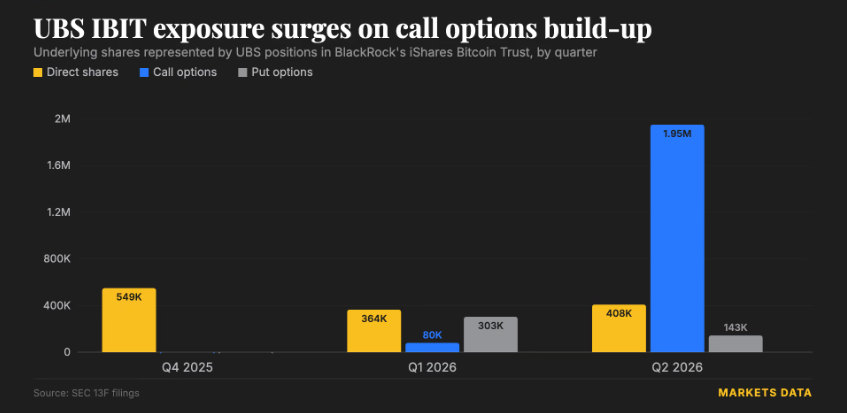
- •Recent filings showed institutional demand for IBIT: Tudor Investment raised its stake 18.9% to 688,529 shares, Jane Street held about $828 million in IBIT, and UBS expanded its underlying call position roughly 24-fold to 1.95 million shares.
- •BlackRock highlighted that AI-focused funds drew more than $46 billion in inflows while spot Bitcoin products saw over $5 billion in outflows after October 2025, indicating capital rotation from crypto into AI.
- •Tariff shocks triggered multiple liquidation waves that pushed Bitcoin below $60,000 in June 2026, when crypto futures open interest exceeded $90 billion, with about 80% held in offshore perpetual contracts outside the CME.
BlackRock has reaffirmed its long-term investment thesis for Bitcoin even after the cryptocurrency lost more than half of its value from its October 2025 all-time high, attributing the drawdown to deleveraging, weaker capital flows, and slower buying from digital asset treasuries. The firm's iShares Bitcoin Trust (IBIT), meanwhile, led U.S. spot Bitcoin ETF inflows on August 18 with $143.57 million.
BlackRock's Bitcoin Thesis Survives a 50% Drawdown
In its latest executive summary, BlackRock said its long-term investment thesis for Bitcoin remains unchanged despite a price decline of more than 50% from the October 2025 peak. The asset manager identified deleveraging, weaker capital flows, and reduced purchasing by digital asset treasuries as the primary drivers of the drop, while maintaining that Bitcoin still presents a strong long-term investment case.
At the time of the decline, crypto futures open interest exceeded $90 billion, with around 80% of it coming from perpetual futures traded outside the CME, according to the firm. Perpetuals are crypto-native derivative contracts with no expiry date, traded largely on offshore exchanges rather than the regulated, institution-focused CME — so the bulk of that leveraged positioning sat outside regulated U.S. venues. BlackRock also said tariff shocks triggered multiple waves of liquidations, pushing Bitcoin below $60,000 in June 2026.
BlackRock was among the early participants to bring Bitcoin ETFs to the U.S. market in January 2024, when SEC approval ended roughly a decade of rejections and opened a regulated, exchange-listed route to spot Bitcoin exposure. IBIT, BlackRock's entry in that cohort, has since grown into the largest U.S. spot Bitcoin ETF by assets. Spot Bitcoin exchange-traded products attracted approximately $60 billion in cumulative inflows between January 2024 and October 2025, before seeing major outflows of more than $5 billion in the period that followed.
Over the same stretch, BlackRock noted, AI-focused funds drew more than $46 billion in inflows — a pattern the firm pointed to as evidence of capital rotating from the crypto sector into AI. Selling by Strategy (MSTR), the largest publicly traded corporate holder of Bitcoin, other digital asset treasuries, and large holders added further pressure to the market, according to BlackRock.
The financial giant nonetheless continues to hold that a small allocation to Bitcoin within an overall portfolio remains the right diversification choice.
Institutional Demand for IBIT Remains Strong
The broader Bitcoin ETF sector has been going through a rough patch over the past few months, enduring weeks of outflows. Even so, IBIT continues to see demand from institutional players. Much of that positioning is visible through 13F filings — the quarterly SEC disclosures that show what institutional managers held as of quarter-end and are published up to 45 days later — making them a delayed but closely watched window into professional sentiment.
Tudor Investment recently increased its stake in IBIT by 18.9% to 688,529 shares, worth approximately $22.9 million as of June 30. The increase reverses a year-long selling trend that had reduced the position by 91% from its late-2024 peak.
Jane Street disclosed more than $1 billion in U.S. spot Bitcoin ETF holdings as of June 30, according to SEC filings. Around $828 million of that exposure was invested in BlackRock's IBIT.
UBS also significantly increased its exposure to IBIT options, raising its underlying call position from 80,000 shares to 1.95 million shares — a roughly 24-fold increase in a single quarter, per its latest 13F filing. The Swiss bank also grew its direct IBIT holdings by 12% while cutting its put protection by 50%.
IBIT Leads $189 Million of Daily ETF Inflows
On Tuesday, August 18, U.S. spot Bitcoin ETFs recorded $189.31 million in total net inflows, led by BlackRock's IBIT with $143.57 million — about 76% of the total. IBIT alone added 2,220 BTC, worth approximately $143.57 million, with trading volume reaching $1.1 billion.
Fidelity's FBTC took in $23.92 million, followed by ARKB with $19.73 million and BITB with $16.15 million. Grayscale's Bitcoin Mini ETF also saw $2.86 million in inflows.
VanEck's HODL was the only fund to record an outflow, with $16.92 million leaving the ETF. The remaining funds recorded no net flows.
Because spot ETFs publish creations and redemptions every trading day, this flow data has become one of the few real-time gauges of Bitcoin demand — which is why single-day prints like Tuesday's attract attention even during longer outflow stretches. Whether the inflow marks a turn or a one-session outlier will show up in the weekly and monthly aggregates compiled from these daily figures.
Source: The Market Periodical

