Strategy, BlackRock, and Coinbase Among Founders of New Bitcoin Security Consortium Targeting Post-Quantum Threats
Key Takeaways
- •Nine companies including BlackRock, Coinbase, and Strategy have founded the Bitcoin Security Consortium, collectively pledging $15 million over three years to fund Bitcoin security research and developers.
- •Post-quantum cryptography is the consortium's initial focus, addressing the theoretical risk that sufficiently powerful quantum computers could break Bitcoin's ECDSA digital signatures.
- •The consortium will not participate in protocol development or governance and will leave those responsibilities with the broader Bitcoin open-source community.
- •Galaxy separately announced a $5 million Bitcoin Quantum Readiness Initiative the same week, committing funds toward post-quantum cryptographic developer grants.
- •The consortium's launch aligns with NIST's finalized post-quantum cryptography standards from August 2024 and recent U.S. executive orders advancing quantum computing and post-quantum migration.
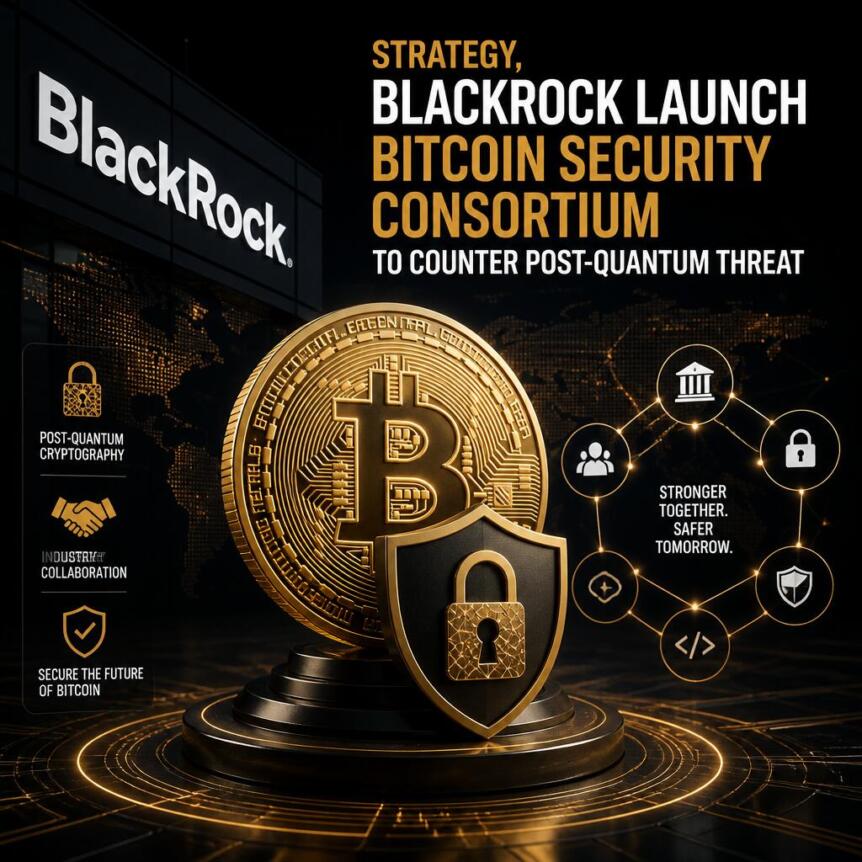
Nine companies — Strategy, BlackRock, Coinbase, Galaxy, Fidelity Digital Assets, Anchorage Digital, ARK Invest, Block, and Blockstream — have launched the Bitcoin Security Consortium, an initiative aimed at supporting the long-term security of the Bitcoin network. The founding members have collectively pledged $15 million over three years to fund developers and research focused on network security and post-quantum cryptography.
The consortium brings together a broad cross-section of the digital asset industry, including Bitcoin holders, cryptocurrency exchanges, custodians, infrastructure providers, payment companies, and asset managers. Among the founders are the world's largest asset manager (BlackRock, with over $10 trillion in assets under management), the largest U.S. cryptocurrency exchange by spot trading volume (Coinbase), and the largest publicly disclosed corporate holder of Bitcoin (Strategy, formerly MicroStrategy). Day-to-day operations will be coordinated by Mike Schmidt, Executive Director of Brink, a non-profit organization that funds Bitcoin open-source developers.
Post-Quantum Cryptography as First Priority
The consortium's initial focus will be post-quantum cryptography. Bitcoin's security model relies on the Elliptic Curve Digital Signature Algorithm (ECDSA) over the secp256k1 curve for transaction signatures. A sufficiently powerful quantum computer running Shor's algorithm could theoretically break this cryptographic scheme, exposing private keys derived from public keys. While the group acknowledged that the risk posed by quantum computers remains years away, it emphasized that preparing Bitcoin for these threats is a key priority for the community.
The effort also aligns with wider cryptography standardization progress. In August 2024, the U.S. National Institute of Standards and Technology (NIST) released its first finalized post-quantum cryptography standards — FIPS 203, FIPS 204, and FIPS 205 — giving protocol developers across industries a reference framework for migration.
Strategy CEO Phong Le underscored the strong incentive that long-term Bitcoin holders have to ensure the network's security:
"As long-term holders, we have every incentive to see Bitcoin remain secure for generations. Funding the people who do this work, and helping inform the conversation around it, is a natural way for us to contribute."
Robert Mitchnick, BlackRock's global head of digital assets, added:
"Bitcoin Core developers do incredibly important work, and we're pleased that our firm and the others in this group will now be making significant additional funding available to support Bitcoin's long-term security needs."
Scope and Limitations
According to Strategy's statement, the consortium will publish, update, and maintain information about Bitcoin's security and will continue to support and fund the network's developer community. It will also work to raise awareness about the Bitcoin network and its security.
However, the consortium will not participate in developing or governing the Bitcoin protocol, take positions on protocol changes, or speak on behalf of developers. Responsibility for the network's development will remain with the broader Bitcoin community — a stance consistent with Bitcoin's open-source model, in which protocol changes require rough consensus among a globally distributed set of volunteer and grant-funded contributors rather than approval from any industry body.
Broader Industry and Government Efforts
The consortium's launch comes amid growing institutional and governmental efforts to address the quantum computing threat. Earlier this week, Galaxy announced its own Bitcoin Quantum Readiness Initiative, committing $5 million toward developer grants to support post-quantum cryptographic tools. Galaxy also launched a research program and an advisory council focused on Bitcoin-specific quantum risks.
At the government level, U.S. President Donald Trump signed two executive orders — EO 14409 and EO 1441 — focused on advancing quantum computing capabilities and pushing for full post-quantum cryptography migration for high-value federal assets.
These initiatives by the consortium, Galaxy, and the U.S. government collectively signal that major stakeholders now recognize quantum computing as a credible long-term threat to Bitcoin's security architecture.
This article is provided for informational purposes only. It is not offered or intended to be used as legal, tax, investment, financial, or other advice.

