Bitcoin's Missing Retail Traders: What the Binance and ETF Data Show
Key Takeaways
- •CryptoQuant's retail-activity indicator showed no surge through either Bitcoin's October 2025 record near $126,000 or a drawdown of roughly 50% to about $60,000.
- •Hackers stole about $6.3 billion from Binance on October 29, the exchange covered 95% of the stolen assets when withdrawals reopened, and net customer withdrawals reached $4.72 billion.
- •Binance Bitcoin futures open interest fell to $8.7 billion, but because the roughly 5% dollar decline was smaller than the 6% price drop, the implied coin exposure was marginally higher rather than lower.
- •US spot Bitcoin ETFs posted net outflows of about $399 million on November 2, led by roughly $405 million leaving BlackRock's IBIT, which weakens the migration-to-ETFs explanation for this month.
- •The data supports only a narrower conclusion: Binance derivatives traders kept roughly the same coin exposure through the hack, and ETF holders were net sellers in the days before the futures low.
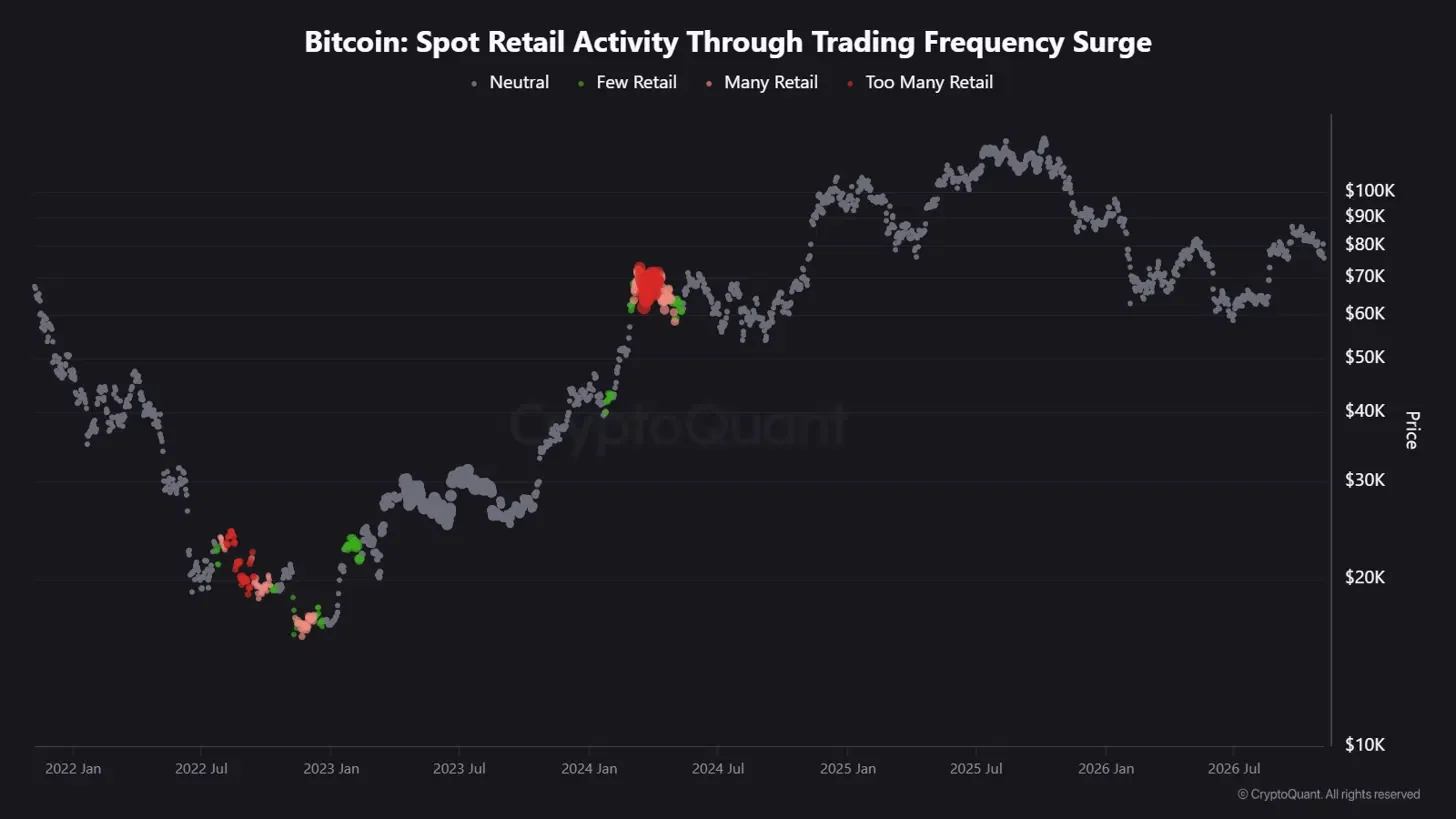
Two analyses published on CryptoQuant on November 6 raise a pointed question about Bitcoin's investor base: where did the retail traders go? One, from the analyst BaykusCharts, found that the platform's retail-activity indicator never flashed a surge around Bitcoin's October 2025 record near $126,000, nor around its roughly $60,000 lows this year, and suggested that part of that activity had moved into spot ETFs. The other, from Arab Chain, reported that Binance Bitcoin futures open interest had dropped to its lowest level in more than two months.
The figures framing the debate are stark. Binance lost about $6.3 billion to hackers on October 29. Binance BTC open interest fell to $8.7 billion. Measured in bitcoin, however, that exposure barely changed. US spot Bitcoin ETFs shed $399 million on November 2.
BaykusCharts argues that retail moved rather than left. Testing that argument requires three things the posts do not provide: a clear sense of what the retail gauge actually counts, the Binance figure expressed in coins rather than dollars, and ETF flow data covering the same days.
A Relative Gauge, Not a Headcount
CryptoQuant's own description of its Spot Retail Activity Through Trading Frequency Surge indicator explains the method. The gauge compares trading frequency with its one-year moving average and flags periods when trade counts jump well above that baseline. A neutral reading means activity stayed within its normal range — trading can continue at a steady pace under such a reading, and the number of people trading never enters the calculation.
Trade counts also reveal little about who is behind them. A fund can split a single order into hundreds of fills, while an individual can buy once and hold for a year. Yet exchange trade counts remain the industry's default proxy for retail behavior, because direct spot trading in Bitcoin has historically concentrated on crypto exchanges rather than brokerages — which is why a permanently quiet gauge reshapes how analysts read participation across the whole market. The finding still carries weight: through both a record high and a drawdown of roughly 50%, the frenzied trading bursts that marked earlier cycles never returned to crypto exchanges.
The Binance Shock Behind the Futures Low
Hackers drained about $6.3 billion from Binance, the world's largest crypto exchange by trading volume, on October 29, and the exchange suspended withdrawals. When withdrawals began reopening, Binance said it had covered 95% of the stolen assets, the South China Morning Post reported. Reuters put net customer withdrawals after the reopening at $4.72 billion.
That timing changes what the futures figure can say. A trader who no longer trusts an exchange can close positions there and reopen them elsewhere — a move that shrinks one venue's open interest while leaving the trader's Bitcoin exposure unchanged. Coins moved to private wallets also leave an exchange without being sold. A two-month low at Binance, recorded one week after the exchange was robbed, is first of all a reading on Binance.
Converted to Coins, Binance Futures Held Steady
Dollar open interest equals the BTC-equivalent size of open contracts multiplied by a price, so a falling price shrinks the total even if no position closes. An earlier CryptoQuant QuickTake, written in late October before the hack, provides a pre-hack reading for comparison.
The dollar figure fell by roughly 5%, slightly less than the 6% drop in price. The price move alone would have cut about $540 million from the late-October positions, but the actual decline was smaller. That leaves the coin count marginally higher, not lower. Because the November price sat below $76,000, the implied exposure is a minimum.
The comparison rests on rounded figures from two posts and assumes both measured the same contracts at comparable prices. Coin-margined contracts, which have a fixed dollar size and settle in BTC, are valued differently, so a total that mixes contract types cannot be adjusted with a single spot price. Binance publishes the coin quantity and dollar value of open interest as separate fields, though only for roughly the latest month, so a cleaner check is possible while that window covers the hack.
Open interest also nets two sides of every trade. The late-October post found shorts slightly ahead of longs, and a steady total can hide longs closing while fresh shorts open, or forced liquidations being replaced by new bets. It is a stock of contracts rather than a cash balance, so the roughly $450 million drop in dollar terms represents no withdrawal of money.
ETF Flows Point the Other Way This Month
BaykusCharts' migration case starts from a sound premise. Investors buying ETF shares trade through a brokerage — a channel open since the US spot Bitcoin funds debuted in January 2024 — so their activity never reaches a crypto exchange's trade counts. Over a full cycle, that shift could keep an exchange-based retail gauge quiet even while individual demand grows.
Fund flows show whether the shift applies now. Unlike assets under management, flows count shares created or redeemed, so price swings do not distort them. US spot Bitcoin ETFs opened November with net outflows of about $399 million on November 2, led by roughly $405 million leaving BlackRock's IBIT, according to Farside Investors data. A single session is not a trend, but in the week after the hack the funds were shedding money rather than absorbing it — which weakens migration as an explanation for this month's quiet.
Flows still cannot say who sold. In creation and redemption data, a financial adviser rebalancing client portfolios looks the same as a self-directed buyer. A common shortcut treats ETF shares missing from institutional filings as retail-owned. However, the SEC's Form 13F rules cover only managers with at least $100 million in reportable securities, and many reporting advisers manage money for individuals. Third-quarter filings are due November 16 and will show positions as of September 30 — a month before the hack.
The Case for a Real Retreat, and What Could Settle It
The strongest version of the retreat argument combines everything above: no retail surge for a full cycle, billions withdrawn from the largest exchange, and ETF holders redeeming in the same week. If individuals were stepping back from Bitcoin rather than switching venues, those signals would appear together.
What the argument lacks is a measurement linking those moves to the same people. Three data sets can narrow that gap through the rest of November:
- Binance open interest in BTC — a falling coin count while price steadies would mark a genuine unwind; a flat count would point back to price effects.
- ETF creations and redemptions — redemptions spread across issuers would support a retreat; creations returning would support the migration case.
- CryptoQuant's retail gauge — a surge flag on any rebound would contradict the absence story; continued silence would leave it unproven.
For now, the data supports a narrower conclusion than either post implies. Binance derivatives traders kept roughly the same coin exposure through a record hack, and ETF holders — whoever they are — were net sellers in the days before that futures low.
Source: Coindoo

