Bitcoin Rallies to $85,000, Highest Since January, Defying Clarity Act Defeat Ahead of Uptober
Key Takeaways
- •The U.S. Senate voted 49-50 against advancing the Clarity Act on September 15, short of the 60 votes required, and Bitcoin subsequently fell below $76,000 before buyers returned.
- •More than $250 million in short positions were liquid as Bitcoin surged roughly 3% in a single hour past $85,000, mechanically amplifying the rally.
- •U.S. spot Bitcoin ETFs absorbed $433 million on September 18, led by Fidelity's FBTC and BlackRock's IBIT, leaving the week with a slim net positive of $6.2 million.
- •The SEC opened a limited innovation exemption for tokenized U.S. stocks on September 17, while the CFTC sent broader crypto-market rule proposals to the White House.
- •October has historically been one of Bitcoin's strongest months, averaging gains near 20% since 2013, although 2014 and 2018 were exceptions.
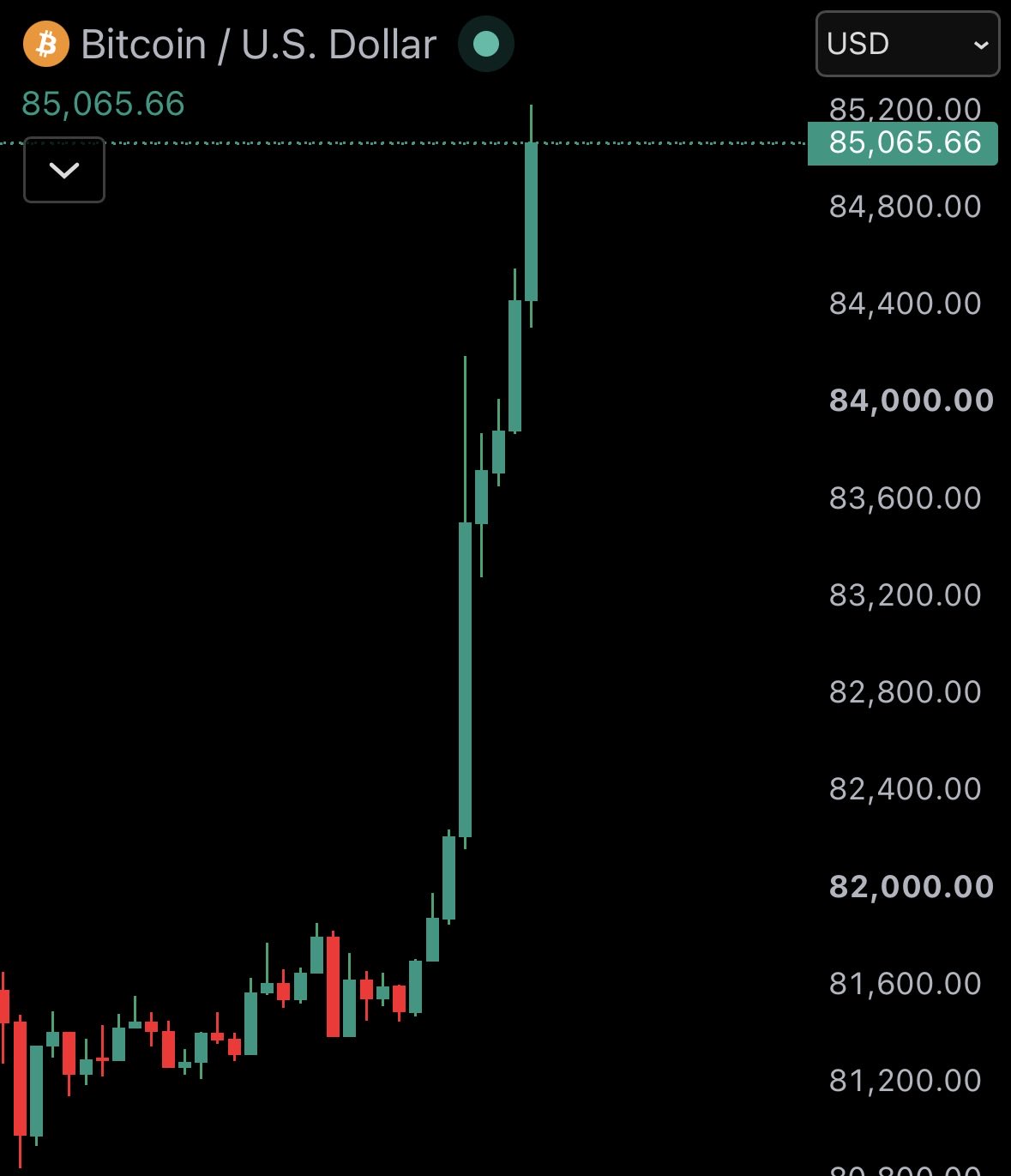
Bitcoin briefly climbed above $85,000 on Monday, touching its highest level since January and capping a striking rebound that has largely shrugged off last week's failure of the U.S. Senate to advance the Clarity Act.
During Asian trading hours, the world's largest cryptocurrency rose as much as 3 per cent in a single hour, a burst of momentum that forced more than $250 million in short liquidations across the network, a cascade in which leveraged traders betting on declines are forced to buy back their positions as losses mount, mechanically amplifying the rally. The advance extended a recovery that began late last week, when Bitcoin reclaimed $80,000 after sliding toward $75,000 in the immediate aftermath of the legislative setback.
A Legislative Blow, Quickly Absorbed
The sell-off's trigger came on September 15, when the Senate voted 49-50 against cloture, the procedural threshold for ending debate and allowing a bill to advance, on the motion to proceed with the Clarity Act, the industry's flagship market-structure bill, which seeks to resolve long-running disputes over whether digital assets should be regulated as securities or commodities. Sixty votes were required for the measure to move forward. Every Democrat present opposed it, joined by three Republicans: Susan Collins, Josh Hawley and Jerry Moran.
Supporters, led by Sen. Cynthia Lummis, described the outcome as a political defeat that all but ended the bill's prospects for passage before the November midterms. Bitcoin sold off sharply that day and the next, breaking below $76,000 as traders priced in prolonged regulatory uncertainty.
The market's resilience since then has been notable. Rather than treating the vote as a lasting blow, buyers stepped back in, supported by spot demand, forced covering of bearish positions and incremental regulatory progress outside Congress.
ETF Flows Turn Positive Again
U.S. spot Bitcoin ETFs absorbed $433 million on September 18 alone, led by Fidelity's FBTC with $310.7 million and BlackRock's IBIT with $108.4 million. Those inflows, widely watched as a barometer of institutional demand because the funds channel brokerage and advisory capital directly into Bitcoin, offset earlier midweek redemptions of roughly $746 million and left the week with a slim net positive of $6.2 million. Cumulative inflows since the products launched in 2024 now stand near $55 billion, with total net assets above $102 billion.
A short squeeze amplified the rebound. Leveraged bets against Bitcoin were unwound as the price pushed through $80,000 and then $82,000, and the squeeze intensified again on Monday, with Coinglass data showing more than $250 million in short liquidations within a concentrated window. Analysts noted that the $83,000–$85,000 zone remains near-term resistance, and that a sustained close above it would open a path toward $87,000–$90,000.
Regulatory Progress Outside Congress
Washington did not go entirely quiet on blockchain policy after the Senate vote. On September 17, the Securities and Exchange Commission opened a limited innovation exemption allowing qualifying tokenised U.S. stocks, blockchain-based representations of traditional shares, to trade on-chain under volume caps. Separately, the Commodity Futures Trading Commission sent broader crypto-market rule proposals to the White House. Market participants characterized these agency actions as a partial substitute for legislation, easing some of the legal fog that had hung over trading venues and issuers.
Macro Tailwinds
Macro conditions also lent support. The Federal Reserve delivered a 25-basis-point rate hike last week — its first since 2023 — yet risk assets recovered as oil prices eased from recent highs near $108 and long-term Treasury yields pulled back. The "debasement trade" narrative, in which Bitcoin and gold serve as hedges against fiscal expansion and dollar weakness, has remained a background theme since the Treasury expanded long-end buybacks in August. That earlier policy shift helped lift Bitcoin roughly 25 per cent that month.
The result is a market that has absorbed two apparent negatives — the Clarity Act failure and a hawkish Fed — and still posted an impressive multi-day run. Bitcoin is now up more than 5 per cent on the week and has reclaimed major short-term moving averages. Total crypto market capitalisation has climbed back above $2.8 trillion, with some altcoins outperforming.
Eyes on Uptober
Attention now turns to the September close and the seasonal pattern known as Uptober. October has historically been one of Bitcoin's strongest months, delivering positive returns in the large majority of years since 2013 and average gains near 20 per cent. Standout performances include 2017 (+47–48 per cent), 2021 (+40 per cent) and 2023 (+24– per cent). The nickname is no guarantee — 2014 and 2018 were exceptions — but the pattern has become a fixture of trading calendars. A firm September finish above $85,000 would position the market for that traditional fourth-quarter window.
Risks remain. Leverage is still elevated, Treasury yields have not fully reversed, and the midterm election calendar could keep policy in flux. A failure to hold $87,000 would likely invite another test of the mid-$70,000s.
For now, though, the tape has sent a clear message: the Clarity Act's defeat in the Senate did not halt institutional demand or the technical recovery already underway. Bitcoin's brief spike to $85,000 on Monday was the latest evidence that the market has chosen to look through the political disappointment and toward the final quarter of the year.

