Crypto Weekly: ADA and Privacy Coins Outperform While XRP Slides
Key Takeaways
- •Aggregate cryptocurrency market capitalization rose from below $2.2 trillion to $2.9 trillion during the first week of August, with Bitcoin gaining over 3% to reclaim the $65,000 level.
- •The U.S. Senate failed to pass the CLARITY Act, delaying a major federal digital asset regulatory framework and leaving the industry under existing agency-level enforcement until the bill is revisited around Sept. 15.
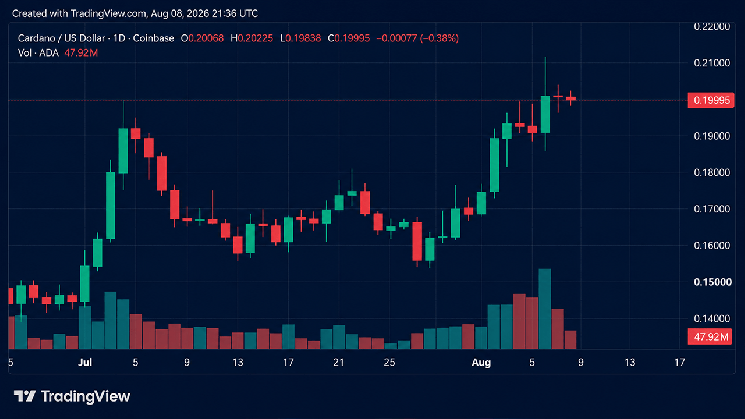
- •Cardano ($ADA) was the week's top performer, climbing from $0.174 to $0.211 following news of a strategic integration with the Injective protocol aimed at expanding cross-chain interoperability.
- •Privacy coins ZEC and XMR gained 8% and 7% respectively, while gold-backed tokens PAXG and XAUT advanced over 7% as spot gold rallied to a Friday high of $4,364 per ounce.
- •XRP was the only top-10 digital asset to register weekly losses, declining 1.5% to slip below $1.02 on Aug. 7.
Crypto Weekly: ADA and Privacy Coins Outperform While XRP Slides
Bitcoin Reclaims $65,000 Despite CLARITY Act Setback
The first week of August brought robust momentum across the cryptocurrency market. Aggregate market capitalization climbed from a low below $2.2 trillion to $2.9 trillion by Aug. 8. Bitcoin led the rally, reclaiming the $65,000 level for the first time in August and pushing its total market capitalization back above $1.3 trillion.
Over a seven-day period, bitcoin gained more than 3%, rising from $62,721 to a Friday peak just above $65,300 before consolidating above key support levels. Notably, bitcoin held these gains despite regulatory headwinds after the U.S. Senate failed to pass the CLARITY Act, a market-structure bill aimed at establishing a clearer federal framework for classifying and regulating digital assets. The legislation has been closely watched by the industry as a potential watershed moment for U.S. crypto oversight, and its delay leaves the sector navigating the existing patchwork of agency-level enforcement and guidance.
While bitcoin anchored the broader market, Cardano ($ADA) stood out as the week's top performer, posting double-digit gains for the second consecutive week. $ADA climbed from $0.174 to $0.211 on Aug. 6—a level last seen on June 4—driven by news of a strategic integration between Cardano and the Injective protocol, a move intended to expand cross-chain interoperability and decentralized finance accessibility between the two ecosystems. Despite the short-term breakout, $ADA remains down nearly 30% on a 90-day basis.
Privacy-focused assets also drew buying interest, with ZEC and XMR gaining 8% and 7%, respectively. The renewed bid for privacy coins comes against a backdrop of sustained regulatory pressure on anonymity-enhancing tokens, which have faced delistings from several major exchanges across multiple jurisdictions in recent years. Among large-cap altcoins, BNB rose 5% to retake the psychologically significant $600 level, while SOL and HYPE posted comparable gains. Gold-backed tokens PAXG and XAUT advanced more than 7%, tracking spot gold, which rallied from $4,233 per ounce to a Friday high of $4,364—a move that reinforced the role of tokenized precious metals as a digital proxy for traditional safe-haven allocation.
Several major altcoins lagged the broader expansion. XRP slipped below $1.02 on Aug. 7, ending the week down 1.5% as the only top-10 digital asset to register weekly losses. Stellar (XLM) declined 3.3%, while sharper corrections hit CC (-20%), CRO (-9%), SHIB (-8.8%), and ONDO (-8%).
Looking ahead, confirmation that the CLARITY Act vote has been delayed removes a major macroeconomic catalyst that market participants had anticipated would fuel a sustained bitcoin rally in the second half of 2026. With federal legislative momentum temporarily stalled, near-term price action is expected to be shaped by sector-specific narratives and native crypto catalysts—such as protocol upgrades, cross-chain integrations, and ETF-related product developments—at least until Sept. 15, when the Senate is expected to revisit the bill.

