Bitcoin Crashes Below $58,000 as Peter Schiff Warns of a Bigger Financial Crisis
Key Takeaways
- •Bitcoin dropped to $57,803.66 after losing the $60,000 psychological support level, declining 6.52% in 24 hours and 13.75% over seven days, according to CoinGecko data.
- •Ethereum slipped below $1,600 as renewed selling pressure extended losses across major digital assets.
- •Peter Schiff argues that rising interest rates could trigger a financial crisis more severe than 2008, with the Federal Reserve potentially responding through inflation that weakens the dollar's purchasing power.
- •Schiff has also warned that Bitcoin could eventually fall below $10,000, representing a decline of more than 90% from its 2025 peak.
- •Trader Matthew Dixon identifies $55,000–$56,000 as the critical decision zone, with a weekly close below $55,000 risking a drop toward $49,000–$50,000 and a recovery above $60,000–$62,000 strengthening a potential relief rally.
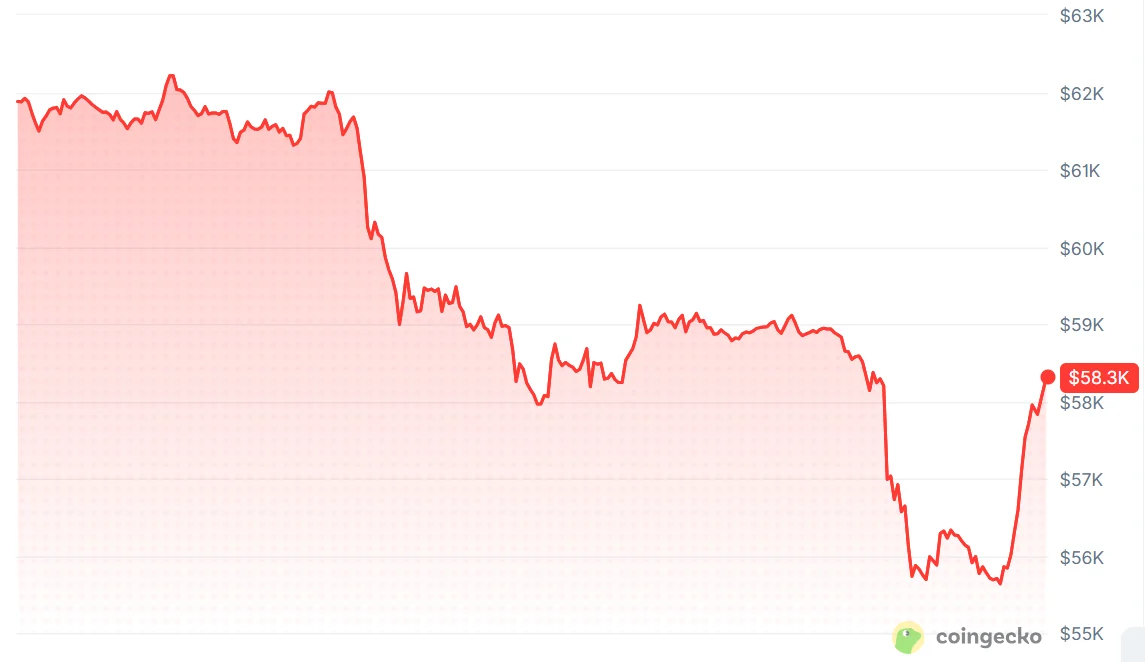
Bitcoin has crashed below $58,000, dropping as low as $57,803.66 after losing the closely watched $60,000 psychological support level. The cryptocurrency was down 6.52% over the past 24 hours and 13.75% over seven days, according to CoinGecko data at the time of publication. Ethereum also slipped below $1,600 as renewed selling pressure swept through crypto markets, extending a stretch of losses across major digital assets.
The latest leg down coincides with a stark warning from Peter Schiff, the financial commentator and longtime Bitcoin skeptic, who argues that rising interest rates could trigger a financial crisis more severe than the one that struck in 2008.
Schiff Warns of a Deeper Financial Crisis
Schiff believes the current financial environment mirrors the conditions that preceded the 2008 crisis, but with potentially greater consequences. In his view, higher interest rates increase borrowing costs and make it harder for borrowers to repay outstanding loans. As defaults rise, lenders face mounting losses from unpaid debts alongside falling collateral values. Banks holding loans and other assets could then come under further pressure, potentially spreading financial stress across markets.
In a post on X dated November 20, 2026, Schiff wrote:
Those who didn't see the 2008 financial crisis coming and don't understand what caused it are just as clueless about the greater financial crisis that's about to hit. There was a financial crisis in 2008 because rising interest rates caused loans to default and collateral to…
— Peter Schiff (@PeterSchiff), November 20, 2026 (X post)
Schiff expects the Federal Reserve to confront a difficult choice: allow financial instability to worsen, or attempt to keep the crisis at bay through inflation. He argues that policymakers may favor the latter, postponing immediate financial problems while weakening the dollar's purchasing power. In his telling, such a response would not resolve the underlying debt problem but merely delay it — potentially at the cost of a deeper dollar and sovereign debt crisis.
The scenario touches a nerve in crypto, where proponents have long pointed to Bitcoin's fixed supply cap of 21 million coins as a hedge against currency debasement — a thesis that Schiff, one of the asset's most prominent critics, has long disputed.
His prediction remains a macroeconomic outlook rather than a confirmed outcome. Even so, the argument places Bitcoin's selloff within a broader debate over debt, interest rates, and financial stability — and underscores how closely the cryptocurrency's fortunes have become tied to broader macroeconomic conditions.
Bitcoin Price Eyes $55K Support as Traders Watch for Recovery
With the price pressing toward lower support levels, Bitcoin's immediate technical outlook has become increasingly important for traders gauging whether the decline can be contained. Veteran financial trader Matthew Dixon identifies the $55,000–$56,000 zone as the next critical decision area for BTC.
Dixon sees the makings of a potential regular bullish RSI divergence — a setup in which Bitcoin prints a lower price low while the Relative Strength Index forms a higher low. Such a pattern can indicate weakening selling momentum, though the signal remains unconfirmed because the weekly candle is still open. Completed weekly closes are commonly treated by technical analysts as firmer confirmation than intra-week moves, since price action can reverse before the weekly period ends.
The immediate decision is at $55–56k. The chart shows a potential regular bullish RSI divergence, with a lower price low and a higher RSI reading. The weekly candle is still open, so I'd compare completed weekly closes at the corresponding RSI pivots before treating it as… pic.twitter.com/82osLeMmoj
— Matthew Dixon – Veteran Financial Trader (@mdtrade), November 21, 2026 (X post)
According to the scenario Dixon outlines, a recovery above $60,000–$62,000 followed by a higher low would strengthen a potential relief rally. Conversely, a weekly close below $55,000 that is not reclaimed could expose Bitcoin to $49,000–$50,000 — an area associated with its major 2024 swing low. Dixon's scenarios frame the levels traders are watching for confirmation of either recovery or further downside.
Schiff, meanwhile, has issued a considerably more bearish long-term call, warning Bitcoin holders that BTC could eventually fall below $10,000. That would represent a decline of more than 90% from its 2025 peak — a prediction that stands well beyond Dixon's near-term technical view.
For now, Bitcoin's next move will hinge on whether buyers can defend the $55,000–$56,000 zone, or whether sellers force another breakdown.

