Prediction Markets Point to Further Bitcoin Downside as Year-End Price Forecasts Sour
Key Takeaways
- •Bitcoin traded at $75,723 as of noon Eastern time on Nov. 7, 2026, marking declines of 2.4% over seven days and 6.6% across the preceding month.
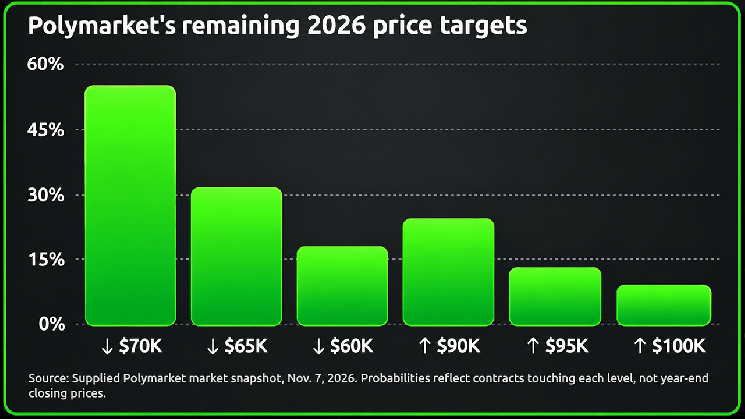
- •Polymarket's 2026 bitcoin price market, with roughly $82.74 million in volume across more than 46 targets, prices a fall to $70,000 at 52% implied probability while assigning only 9% to a touch of $100,000.
- •Kalshi's year-end market concentrates 35.1% of implied probability in the two brackets spanning $70,000 to $79,999.99, settling via the CME CF Bitcoin Real Time Index in the final minute of Dec. 31.
- •November contracts skew bearish, with Polymarket assigning an 81% probability to bitcoin touching $77,500 before December, 61% to $72,500, and approximately 1% to reaching $100,000 during the month.
- •Prediction-market prices represent trader expectations rather than guaranteed forecasts, and contract structures differ, as Polymarket resolves on intraday threshold touches while Kalshi identifies where bitcoin will settle at year's end.
Bitcoin traded at $75,723 as of noon Eastern time on Saturday, Nov. 7, 2026, a decline of 2.4% over seven days and 6.6% across the preceding month. With fewer than eight weeks left in the calendar year, traders on major prediction platforms are showing pronounced skepticism about a meaningful recovery.
Across prediction marketplaces including Polymarket, Kalshi, and Myriad, participants are concentrating positions around lower price thresholds while assigning progressively smaller probabilities to six-figure valuations. These venues allow participants to buy and sell contracts whose payouts depend on whether specified events occur, and because prices update continuously as traders reassess the odds, they are closely watched as a running gauge of how event traders weigh possible outcomes. The figures represent market-implied expectations rather than definitive forecasts, and the structural differences between contract types warrant particular attention.
Polymarket: $70,000 Emerges as the Next Key Level
Polymarket's 2026 bitcoin price market has drawn roughly $82.74 million in trading volume across more than 46 price targets. The most probable unresolved outcome is a fall to $70,000, which carries a 52% implied probability — a threshold sitting roughly 7.6% below bitcoin's current trading price.
Steeper declines command sizable odds as well. A retreat to $65,000 is priced at 31%, $60,000 at 18%, $55,000 at 11%, and $50,000 at 6%.
Upside scenarios carry materially lower probabilities. A touch of $90,000 before year's end stands at 24%, falling to 13% at $95,000 and 9% at $100,000. From current levels, reaching $100,000 would require a rally of roughly 32%. The market places just 3% on $120,000 and approximately 2% on $150,000.
These contracts resolve on whether bitcoin's price touches a designated value at any point, not where it finishes the year. As a result, several thresholds can settle successfully within the same period, making their probabilities fundamentally different from mutually exclusive closing-price predictions.
Kalshi: Year-End Ranges Cluster Near Current Levels
Kalshi's year-end bitcoin price market offers a complementary view, with roughly $46.01 million in cumulative volume. Unlike Polymarket's threshold contracts, Kalshi's ranges identify where bitcoin will settle when 2026 concludes.
The $75,000 to $79,999.99 bracket leads at 17.6%, narrowly ahead of $70,000 to $74,999.99 at 17.5%. The $80,000 to $84,999.99 range follows at 12.5%. Together, the two leading brackets account for 35.1% of implied probability, underscoring the concentration around bitcoin's prevailing valuation, though the remaining probability leaves ample room for outcomes outside that corridor.
Kalshi determines settlement using the CME CF Bitcoin Real Time Index, averaging 60 consecutive one-second observations during the final minute of Dec. 31. That methodology differs from Polymarket's Binance-based intraday threshold measurements.
November Contracts Skew Toward Lower Levels
The shorter November contracts offer an equally revealing picture. Polymarket assigns an 81% probability to bitcoin touching $77,500 before December and 56% to $80,000. Those expectations weaken sharply at higher thresholds: a move to $85,000 carries 23%, $90,000 commands just 9%, and reaching $100,000 during November is priced at approximately 1%.
Downside expectations are more pronounced. Traders assign 61% to bitcoin touching $72,500, 43% to $70,000, and 26% to $67,500.
Kalshi's November high-price contracts broadly echo this caution. Its market assigns 35% to exceeding $82,500, 21% to $85,000, and 15% to $87,500, with approximately $982,199 in cumulative trading volume.
Myriad displays similar November probabilities, but its trading activity is extraordinarily thin compared to the two larger platforms. Its upside market has recorded roughly $96 in volume, while its downside counterpart has attracted just $5.68. Such minimal participation makes Myriad's quotations extremely weak standalone evidence of market consensus, however closely they resemble prices on bigger venues. Even so, its November markets assign bitcoin a 43% chance of falling to $70,000, a 61% probability of touching $72,500, and a 9% likelihood of reaching $90,000.
A Narrowing Window for Bitcoin's Bulls
The distinction between expectations and outcomes remains essential. Prediction-market prices reflect what participants are willing to pay for specific contracts, not a statistically guaranteed probability of future price movements.
Nevertheless, the prevailing message is difficult to overlook. Prediction event traders currently regard another visit to $70,000 as considerably more plausible than a return to $100,000 before January. The calendar now offers two clear checkpoints: the November contracts expire at the end of the month, and Kalshi's year-end ranges settle in the final minute of Dec. 31, giving traders discrete moments to compare these implied probabilities against realized prices. The remaining weeks of 2026 will determine whether that caution proves justified. For now, the most revealing development is not simply the market's tilt toward lower prices, but the increasingly expensive proposition of betting against its prevailing pessimism.

