Bitcoin Prediction 2026: What Kalshi's Betting Markets Say
Key Takeaways
- •Bitcoin was trading in the low $63,000s in mid-August, about 27% below its start-of-year level and nearly 49% under its October 2025 peak.
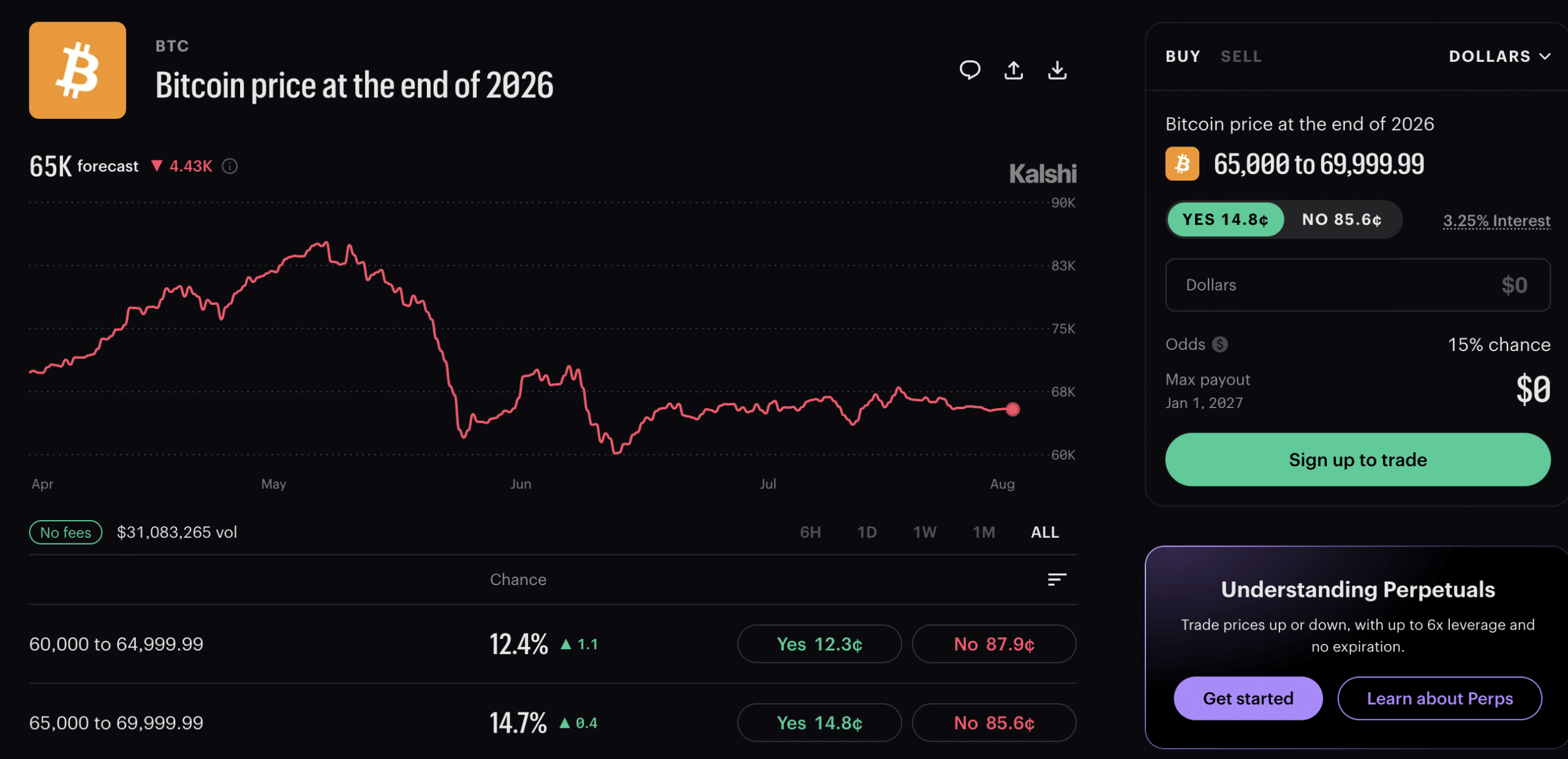
- •Kalshi's end-2026 Bitcoin market places the most probability in the $60,000 to $70,000 range, with adjacent bands around 10% implied probability each.
- •Contracts on Bitcoin returning above $100,000 this year imply roughly an 80% chance that it will not happen.
- •Markets have also priced meaningful downside risk, including periods when a drop below $50,000 before year-end carried a majority probability.
- •The broader backdrop includes a cautious Federal Reserve, choppy spot-Bitcoin ETF flows, and ongoing uncertainty about whether the market is bottoming.
Bitcoin (BTC) has spent much of 2026 grinding sideways in a bear market that has tested the patience of even its most committed holders. With traditional forecasters split on where the world's largest cryptocurrency goes from here, a different kind of signal has emerged: real-money prediction markets. Kalshi, the CFTC-regulated exchange where traders buy and sell contracts tied to the outcome of real-world events — and which drew wide public attention with its contracts on the 2024 U.S. election — now hosts an extensive slate of Bitcoin price markets, and the crowd's collective wager offers a strikingly bearish read on where BTC ends the year. Prediction markets have fast become a go-to venue for assessing price movements across asset classes, and the Bitcoin prediction chatter for 2026 is increasingly centered on what Kalshi bettors are saying.
As of mid-August, BTC was trading in the low $63,000s, having spent the week bouncing between roughly $62,300 and $64,000. That leaves it down close to 27% since the start of the year and nearly 49% off its all-time high of $126,080, set back in October 2025.
What Kalshi Bettors Are Saying
According to Kalshi's long-horizon “price at end of 2026” market (source: Kalshi), which slices possible outcomes into $5,000-wide bands, traders currently see the most probability weighted toward the $60,000-to-$70,000 range, with the $60,000–$64,999.99 and $65,000–$69,999.99 bands both priced at roughly a flat 10% implied probability apiece. Because each Kalshi contract settles at $1 if its outcome occurs, a price quoted in cents translates directly into that implied probability.
That flatness across adjacent bands is itself a signal: rather than clustering around a single target, the market is pricing in genuine uncertainty about where Bitcoin lands, without much conviction that a big rally or a deeper crash is more likely than a continuation of the current range.
The bearish tilt shows up elsewhere too. Separate Kalshi contracts tracking when, or whether, Bitcoin reclaims $100,000 have priced that outcome as a distinct long shot. Contracts asking whether BTC crosses six figures again this year have traded with roughly an 80% implied probability that it does not, and a companion market pricing a return above $100,000 specifically before 2027 has sat in the high teens to low 20s in percentage terms. Traders have also priced in real downside risk, with contracts on Bitcoin falling below $50,000 before year-end carrying a majority probability at various points this year.
ETFs, Federal Reserve Meetings, and the CLARITY Act Leading the Macro Backdrop
That skepticism lines up with the broader macro backdrop. Bitcoin's stall has coincided with a cautious Federal Reserve, thinner institutional buying, and choppy spot-ETF flows that have only recently tilted back toward net inflows. The spot funds, first approved for U.S. listing in January 2024, opened Bitcoin exposure to conventional brokerage accounts and have become a closely watched gauge of institutional appetite. Policy is part of the backdrop as well: the CLARITY Act, the market-structure bill that would divide oversight of digital assets between the SEC and the CFTC, passed the U.S. House in July 2025, a milestone for an industry that has long pushed for clarity on which tokens fall under which regulator.
THE BIG MONEY IS STILL BUYING.
Fidelity's FBTC pulled in $111.9M in fresh capital, leading U.S. spot Bitcoin ETF inflows on Aug. 17.
Retail traders are reacting to every candle. Meanwhile, institutional capital is positioning for the bigger picture.
Short-term noise.… pic.twitter.com/YkWzxmKedG
— MR. WHALE SOL (@airdop_crypto) August 18, 2026
Analysts remain divided on whether the current calm reflects a market quietly building a bottom or simply a pause before another leg down. Commentators have pointed to Bitcoin's unusually low recent volatility as a potential setup for a breakout, while others argue the drawn-out bear market has yet to run its course.
What makes Kalshi's numbers notable is that they represent capital at risk, not just opinion. Unlike a poll or an analyst's price target, every contract has a buyer and a seller putting money behind a specific view, which tends to anchor the odds closer to a consensus probability than sentiment on social media does. For now, that consensus is telling a fairly plain story: Bitcoin bulls hoping for a return to six-figure territory by year-end are, according to the market, still very much in the minority.

