Bitcoin Holds Near $76,000 as Weekly Close Tests Key Support
Key Takeaways
- •Bitcoin fell to $74,762 on Friday, its lowest price since Aug. 21, before recovering to trade up 0.4% near $76,000, leaving it on course for a fifth straight weekly decline.
- •The US economy added 165,000 jobs in October, far exceeding the 65,000 analysts expected, while September job openings jumped by 333,000 to 7.52 million.
- •Market-implied probability of a quarter-point Federal Reserve rate hike at the Dec. 9 meeting rose after the employment data, with estimates placing it near 77% to 79%.
- •Analysts identified the 50-week moving average at $77,533 as a key support level and warned that a breakdown of the $75,500 area could push Bitcoin toward $69,000.
- •Bitcoin spot ETFs recorded $412 million in net outflows on Nov. 6, and Riot Platforms said it sold most of its Bitcoin holdings during the third quarter.
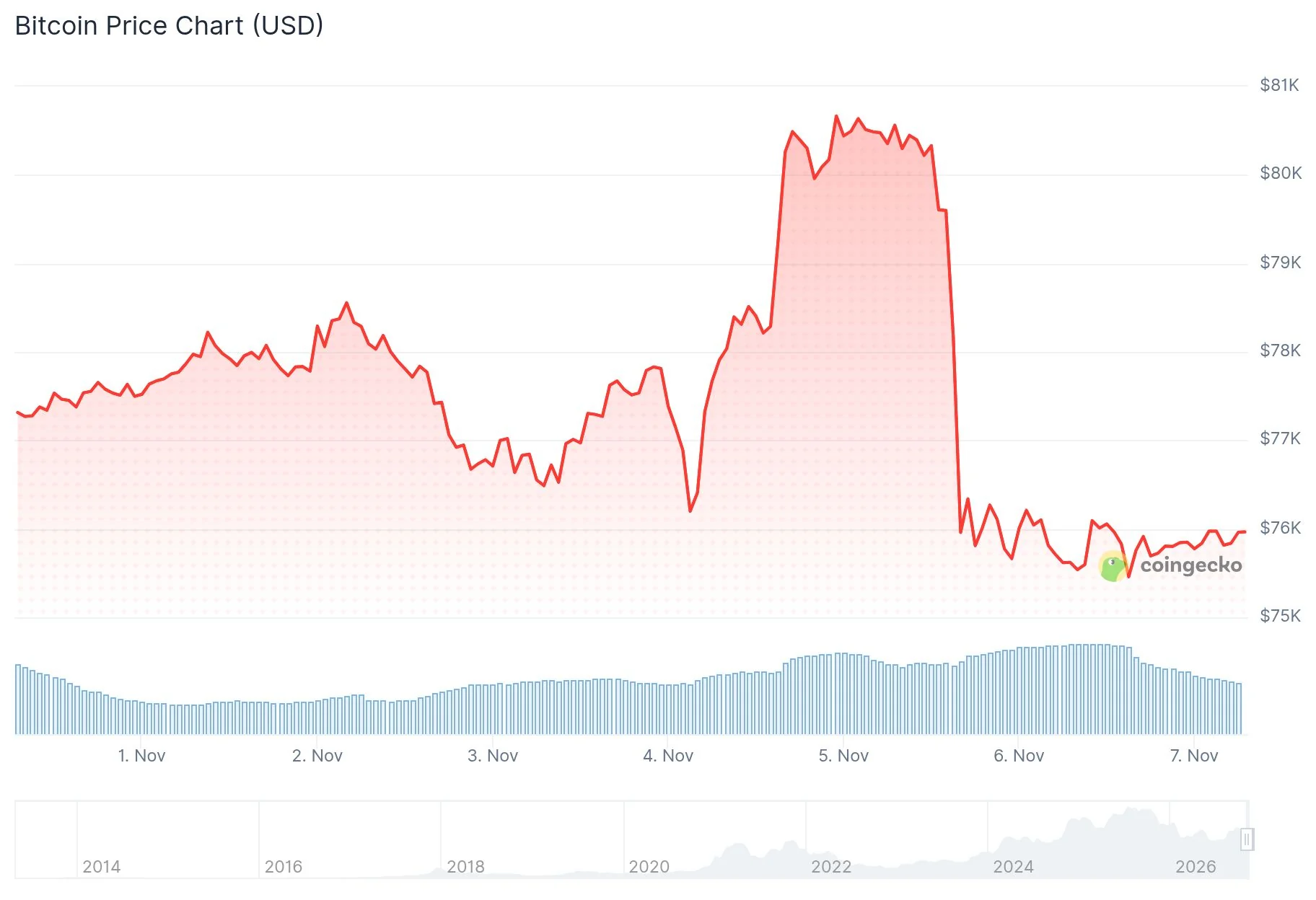
Bitcoin (BTC) traded near $76,000 on Friday after a volatile session, with markets focused on stronger-than-expected US employment data, higher expectations for a December Federal Reserve rate hike and several technical support levels.
BTC fell to $74,762 early in the US session, its lowest price since Aug. 21. The decline followed the US stock-market open, when Bitcoin moved independently of equities. The cryptocurrency later recovered and was up 0.4% at $76,031.60 by 17:30 ET as technology shares on Wall Street rebounded.
Despite the recovery, Bitcoin was on track for a 2% weekly decline, which would mark its fifth consecutive weekly loss.
The October jobs report was a central focus for markets. The US economy added 165,000 jobs during the month, well above the 65,000 analysts had expected. The Bureau of Labor Statistics also revised earlier figures higher, showing that August and September had produced a combined 84,000 more jobs than previously reported. September’s increase was revised from 29,000 to 60,000. Upward revisions matter for rate expectations because they show hiring was stronger than first estimated — the kind of data the Fed weighs when deciding whether to tighten further.
The unemployment rate fell to 4.1% from 4.2%, against forecasts for it to remain at 4.2%. Job gains came from professional services, health care and transportation.
The Kobeissi Letter also reported a sharp increase in US job openings in September:
BREAKING: US job openings jumped +333,000 in September, to 7.52 million, the 3rd-highest reading since November 2024. This marks the largest monthly increase since April and the 3rd-largestsince October 2024. The surge was led by professional and business services, which added… pic.twitter.com/nMVU6mywlC — The Kobeissi Letter (@KobeissiLetter) November 6, 2026
The report said job openings rose by 333,000 to 7.52 million, the third-highest reading since November 2024 and the largest monthly increase since April. Professional and business services led the increase.
Jobs data raises rate-hike expectations
The Federal Reserve raised interest rates by 25 basis points in September. Policymakers said persistent inflation could lead to additional increases, with the next rate decision scheduled for Dec. 9. Rate decisions are among the most closely watched macro events in crypto, since policy settings shape liquidity conditions for risk assets.
CME FedWatch data showed that the probability of a quarter-point hike at that meeting increased after the employment data. Cointelegraph cited a rise from 66.9% to 76.8%, while Investing.com reported that the probability had moved to nearly 79%, up from almost 73%.
Equities moved differently from crypto during the session. The Nasdaq Composite gained as much as 1.8% during the first hour after Thursday’s sell-off. SanDisk and Micron each rose 6.3%. The total cryptocurrency market capitalization, however, was down 0.5% on the day.
Bitcoin tested its 50-week simple moving average at $77,533, a level that had acted as support since mid-September. The 50-week average is built from about a year of weekly closes and is watched as a long-term trend line. Keith Alan, cofounder of Material Indicators, wrote on X that the support could not be confirmed before the weekly close. He said Bitcoin could fall to $69,000 if the $75,500 area failed, while a recovery would require higher highs and higher lows on lower time frames.
Analyst Ash Crypto said Bitcoin was trading between its weekly 50- and 100-period moving averages, a setup he compared with market conditions in 2023. He identified support at $75,500 and $67,800, along with resistance at $82,000 and $87,400.
Bitcoin is showing a familiar setup on the weekly chart. We saw something similar in 2023, when BTC consolidated between the weekly MA 50 and MA 100 before breaking out and starting its next major rally. Now in 2026, Bitcoin is once again trading between these two moving… pic.twitter.com/aYHtVudJVN — Ash Crypto (@AshCrypto) November 6, 2026
Ash Crypto added that Bitcoin’s weekly relative strength index was near 50, while the Stochastic RSI appeared weak. He said the RSI could fall toward 44 before another move higher.
Regulatory concerns and miner selling
Bitcoin’s fifth consecutive weekly decline comes as early optimism surrounding the US midterm elections has faded and traders assess the possibility of a Democrat-led Congress.
Democrats have historically been more skeptical of cryptocurrency. Senator Elizabeth Warren has called for a broader crypto crackdown, while Democratic opposition helped sink the Clarity Act in Congress earlier this year.
The last Democrat-led Congress, in 2021 and 2022, coincided with a 43% decline in Bitcoin. That period also included interest-rate increases and the bankruptcies of Terra, FTX and Celsius.
Riot Platforms said this week that it had sold most of its Bitcoin holdings during the third quarter. The company’s shares closed 13.21% higher at $16.71. Sales by listed miners are tracked alongside ETF flows because they are another channel through which coins reach the market.
Bitcoin’s decline has also coincided with outflows from US spot exchange-traded funds. Spot ETF flows are followed as a public gauge of institutional demand, since the funds hold Bitcoin directly and report net flows each trading day. Wu Blockchain, citing SoSoValue data, reported that Bitcoin spot ETFs recorded $412 million in net outflows on Nov. 6. Fidelity’s FBTC led the group in daily net inflows with $42.82 million. Ethereum spot ETFs recorded $93.19 million in net outflows.
Bitcoin Spot ETFs See $412M in Net Outflows, Ethereum Spot ETFs Lose $93.19M on November 6 (ET) According to SoSoValue data, Bitcoin spot ETFs recorded total net outflows of $412 million on November 6 (ET). Fidelity's FBTC led Bitcoin spot ETFs in daily net inflows with $42.82… pic.twitter.com/kJbFrw0CdU — Wu Blockchain (@WuBlockchain) November 7, 2026

