Bitcoin Miners' Output Falls 47% as Network Hashrate Reclaims 1 ZH/s
Key Takeaways
- •Five publicly traded miners — IREN, Core Scientific Bitfarms, TeraWulf and Cipher — produced 7,075 BTC between January 1 and October 19, a 47% year-on-year decline from the 13,263 BTC mined over the same period in 2025.
- •The output drop stems largely from corporate AI pivots, with firms converting mining sites into high-performance computing data centers and Bitfarms shutting down its US Bitcoin mining operations entirely.
- •Bitcoin's hashrate fell from a peak of roughly 1,123 EH/s in October 2025 to about 850 EH/s by February 2026, marking the deepest drawdown since China banned mining in 2021.
- •Hashrate has since recovered to approximately 1,004 EH/s, about 8.8% below the all-time high and back above the 1 zettahash per second threshold, after rising more than 11% from this year's low.
- •Miners that remain focused on Bitcoin have lifted production by more than 16% over the past year, with Hive nearly doubling output, while mining difficulty is climbing again and could raise production costs.
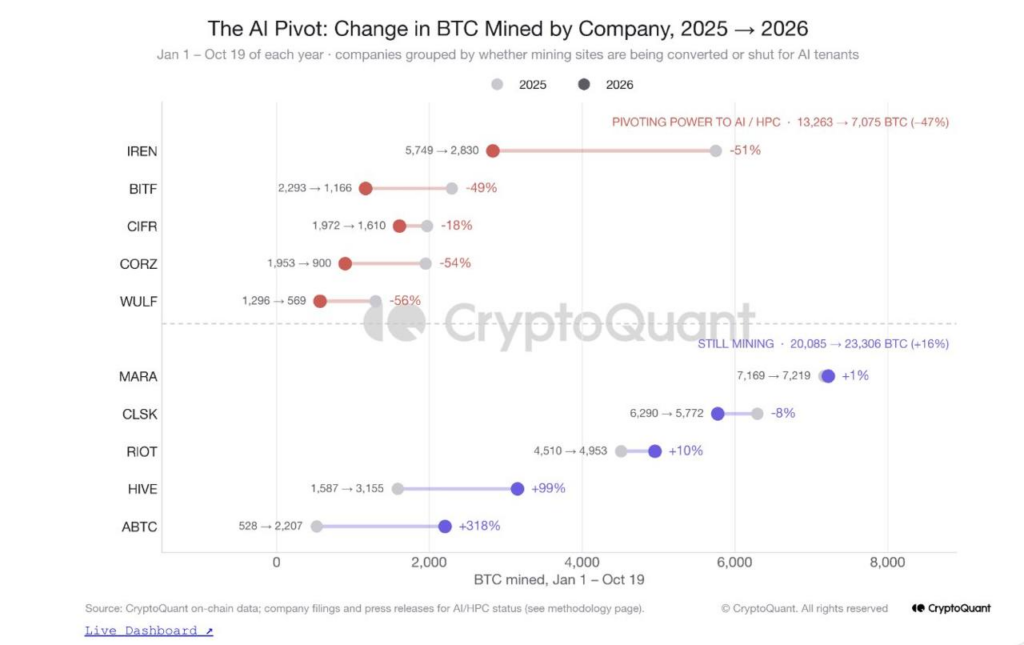
Bitcoin miners listed on public markets are producing far fewer coins as the industry redirects capacity toward artificial intelligence, even as the network's total computing power climbs back toward record levels. According to a new research report from CryptoQuant, five publicly traded mining companies — IREN, Core Scientific, Bitfarms, TeraWulf and Cipher — produced 47% less BTC year-on-year, with individual firms seeing output cut by as much as 56%.
The five companies mined 7,075 BTC between January 1 and October 19, a steep decline from the 13,263 BTC they produced over the same period in 2025. The drop is largely explained by corporate strategy: several of these firms are converting mining sites into data centers that host high-performance AI computing, a natural fit since both workloads run on the same core ingredients — high-capacity power connections, industrial cooling and data-center-ready buildings. Bitfarms went furthest, shutting down its Bitcoin mining operations in the United States entirely in an all-in pivot to AI in that market.
AI Pivot Drives Deepest Hashrate Drawdown Since 2021
The migration of computing capacity away from Bitcoin was a major reason behind this year's decline in hashrate, the measure of total computing power securing the network. According to CryptoQuant, the 2026 drawdown was the deepest since China banned Bitcoin mining in 2021.
Hashrate peaked at roughly 1,123 exahash per second (EH/s) on the seven-day moving average in October 2025, then slid to around 850 EH/s by February 2026. Analysts noted that the metric spent more than 242 days in 2026 at least 10% below its peak, including 83 days more than 15% below. The 30-day average told a similar story: after peaking at 1,101 EH/s on November 11, 2025, it fell 18.3% 899 EH/s on August 6, 2026. For comparison, hashrate bottomed 10.3% below peak during the 2022 bear market.
Hashrate Recovers to Within 8.8% of All-Time High
A turnaround is already underway. Hashrate now stands at 1,004 EH/s — approximately 8.8% below the all-time high and back above the symbolic threshold of 1 zettahash per second (ZH/s), equivalent to 1,000 EH/s. The metric has risen for the past two months, gaining more than 11% from this year's low. The level carries weight beyond symbolism: hashrate reflects the amount of computing work needed to alter the shared ledger, so each step back toward the record means more processing power standing between the network and any attempt to rewrite confirmed transactions.
The recovery is being fueled by miners coming back online. Publicly traded companies that remain focused on Bitcoin have increased production by more than 16% over the past year. Hive has nearly doubled its output compared with a year ago, while MARA, Riot, American Bitcoin and CleanSpark have also lifted production.
New hashrate is not coming from public miners alone. CryptoQuant noted that sovereign countries, private operators and non-US miners are also expanding their involvement in Bitcoin mining. Some firms, such as Bitdeer, are combining an AI pivot with continued mining expansion. Even companies that have exited mining appear to be offloading their machines, potentially allowing that equipment to return to the network under new operators.
Bitcoin prices have also supported the resurgence. The rise in hashrate coincided with Bitcoin's climb above $80,000 and the return of mining profitability. Whether the rebound can be sustained remains an open question, particularly as Bitcoin struggles to break above the $80,000 range. Mining difficulty is also climbing again after weeks of decline, a shift that could push production costs higher: the protocol recalculates difficulty every 2,016 blocks — roughly every two weeks — to keep average block intervals near ten minutes, so renewed participation feeds directly into a higher bar for every miner competing for the same block rewards. The next difficulty adjustment, and whether hashrate can hold above the 1 ZH/s line, will be the near-term markers to watch.
This article is for informational purposes only and does not constitute financial advice. Bitcoin and cryptocurrency-related investments carry substantial volatility and potential financial losses. Readers should conduct independent research before making investment decisions.
This article is based on reporting originally published by The Market Periodical.

