Bitcoin Maintains $64,500 Support as Short Liquidations Decline Amid BIP 110 Debate
Key Takeaways
- •Bitcoin held support above $64,500 on Thursday and has gained approximately 3% since the start of the month, with its market capitalization nearing $1.3 trillion.
- •Liquidated short positions in bitcoin totaled over $30 million, representing a decline of more than 10% from the $35 million recorded on Wednesday.
- •The BIP 110 proposal has sharply divided the community, with supporters emphasizing spam reduction and lower node costs while opponents warn of chain split risks and protocol-level censorship.
- •Critics of BIP 110 express concern that governance friction could disrupt the Ordinals and NFT ecosystems and dampen broader market momentum.
- •If BIP 110 results in a network fork, bitcoin holders prior to the snapshot date would receive equivalent balances of any newly created token on the resulting chain.
Bitcoin Maintains $64,500 Support as Short Liquidations Decline Amid BIP 110 Debate
Intraday Price Action and Market Momentum
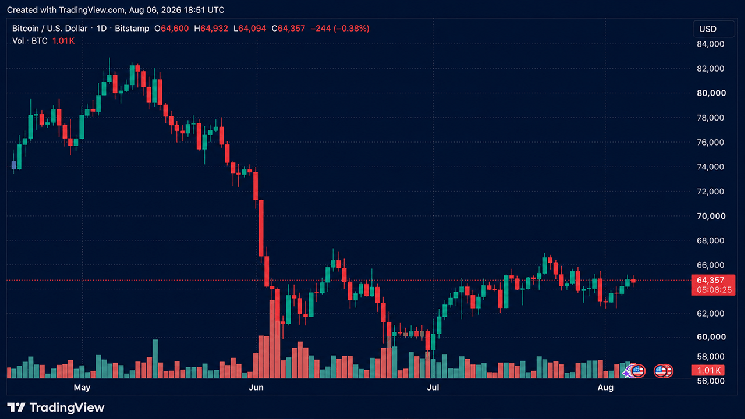
Bitcoin approached the $65,000 level on Thursday, extending a gradual upward trend that has persisted since the beginning of the month. Selling pressure periodically weighed on the market, but the daily chart indicated consistent support above $64,500 during pullbacks.
Bitcoin did dip below that threshold in two distinct trading sessions. The first decline took place between 9 p.m. and midnight, with the price falling to approximately $64,480 or lower. Bitcoin recovered to surpass $64,900 by 1:30 a.m. EST, but a second drop followed shortly after 8 a.m., sending the asset to a 24-hour low of $64,144. A rapid rebound erased those losses, pushing bitcoin back above $64,800.
At the time of writing, bitcoin was trading above $64,500, registering a modest 0.2% gain on the day. Since the start of the month, the cryptocurrency's U.S. dollar value has climbed by more than $2,000, representing an increase of roughly 3%.
Market Capitalization and Derivatives
Bitcoin's market capitalization stood just a few million dollars short of $1.3 trillion, while the broader cryptocurrency economy's total market cap rose toward $2.29 trillion.
In the derivatives market, bitcoin's price movements resulted in fewer liquidations. Liquidated short positions totaled over $30 million, representing a decline of more than 10% from the $35 million recorded on Wednesday. Across the wider crypto market, total liquidations reached $212 million, divided nearly evenly between short and long positions. The decline in short liquidations suggests that bearish leverage had already been substantially unwound in prior sessions, a pattern that typically accompanies periods of reduced directional conviction among futures traders.
BIP 110 Controversy Dominates Market Sentiment
While the CLARITY Act controversy and Middle East geopolitical tensions have shaped bitcoin's trajectory in recent weeks, Thursday's market sentiment appeared more directly influenced by the debate surrounding BIP 110 and the possibility of a chain split.
Bitcoin Improvement Proposals, or BIPs, are the formal mechanism through which developers propose protocol changes to the Bitcoin network. BIP 110 in particular has drawn sharp scrutiny because of its potential implications for transaction filtering and data inscription on the base layer—capabilities that underpin the Ordinals protocol and the broader NFT ecosystem that emerged on Bitcoin in 2023.
On social media platforms including X, opinions remained sharply divided. Supporters argue that BIP 110 is essential for pruning non-financial spam, lowering node operating costs, and safeguarding Bitcoin's core function as a monetary network.
A vocal majority of traders and developers, however, strongly oppose the proposal. Critics warn of chain split risks, potential protocol-level censorship, and disruption to the Ordinals and non-fungible token (NFT) ecosystems. They express concern that governance friction could dampen market momentum.
The episode echoes earlier episodes of Bitcoin governance disputes, most notably the 2017 scaling debate that culminated in the Bitcoin Cash hard fork. During that period, market volatility intensified as stakeholders positioned themselves ahead of chain splits, and trading volumes surged around snapshot dates.
Potential Fork Dynamics
Some traders view the situation as a potential opportunity. If the proposal leads to a network split producing two separate chains, investors holding bitcoin before the snapshot date would expect to receive an equivalent balance of the new token on the resulting chain. This anticipation frequently generates pre-fork buying pressure, as traders accumulate the asset to claim newly created tokens, thereby establishing price floors.
On the other hand, if buying activity is driven primarily by snapshot eligibility, significant profit-taking would likely follow the fork's execution, potentially triggering short-term pullbacks. Historically, once a hard fork concludes and technical uncertainty dissipates, bitcoin has tended to resume its broader macroeconomic upward trend—a pattern that may reassure cautious market participants.

