Bitcoin and Ethereum Prices Surge as Short Liquidations Top $4B
Key Takeaways
- •Bitcoin and Ethereum, the two largest cryptocurrencies by market value, both climbed sharply this week.
- •Forced closures of short positions exceeded $4 billion market-wide, and the required buy-backs intensified upward price pressure into a short squeeze.
- •Liquidation cascades of this scale appear more often in crypto because derivatives exchanges permit higher leverage through perpetual futures than traditional equity venues.
- •Recent on-chain data showed larger wallets accumulating Bitcoin, suggesting steady demand rather than panic buying.
- •A near-billion-dollar catalyst was cited alongside the move, but its exact figure and source were not confirmed.
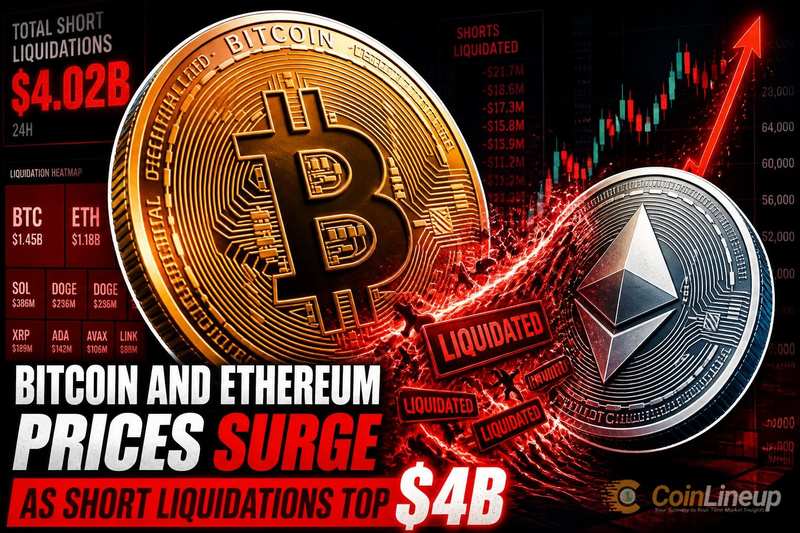
Bitcoin and Ethereum prices soared this week as more than $4 billion in short liquidations added fuel to a sharp crypto market rally, drawing fresh attention from traders and newcomers alike.
Bitcoin and Ethereum Lead This Week's Crypto Rally
Bitcoin and Ethereum, the two largest cryptocurrencies by market value, both climbed this week. Bitcoin's live spot price can be followed on its CoinGecko market page, and cross-checked against its CoinMarketCap page.
This is a fast-moving market update, not a long-term forecast. For someone holding a little Bitcoin or Ethereum, the simple takeaway is that prices rose quickly — and rapid moves work in both directions. One reason crypto moves can feel abrupt is that these markets trade around the clock, unlike traditional stock exchanges with set trading hours, so rallies and reversals can build at any time.
The current strength echoes an earlier stretch in which cryptocurrency stocks rallied as Bitcoin broke above $72,000 and Ethereum jumped 4%, showing how tightly the two coins tend to move together.
Why $4+ Billion in Short Liquidations Supercharged the Move
Short sellers bet that a price will fall. A liquidation happens when the market moves against that bet and an exchange automatically closes the position to cover losses.
This week, forced closures of short positions reportedly reached more than $4 billion across the market. Each closure requires buying back the asset, which adds buying pressure on top of an already rising price. Such closures typically occur on derivatives exchanges, where traders use leveraged perpetual futures; these venues allow higher leverage than traditional equity markets, which is part of why liquidation cascades of this scale appear in crypto more often than in stocks. Aggregate liquidation figures are compiled across major exchanges rather than from any single platform.
The backdrop matters too: in recent sessions, Bitcoin held the $70,500 support level as oil surged above $103, while a Ukraine oil attack was viewed as derailing Trump's price plan and raising Bitcoin's macro risk.
In plain terms, traders who bet against Bitcoin and Ethereum were pushed out, and their exits pushed prices even higher. That feedback loop is what turned a rally into a sharper squeeze — a pattern traders call a short squeeze, in which forced buying by trapped shorts accelerates the upward move.
Similar dynamics have appeared before. Analysis from Gate Research of how short covering and ETF inflows can release pent-up momentum pointed to the same forces now lifting Bitcoin and Ethereum.
The Near-Billion-Dollar Catalyst Traders Should Watch Next
Beyond the short squeeze, an additional near-billion-dollar catalyst has been cited alongside this week's move. The exact figure and its source were not confirmed in the available research, so this detail should be treated with caution.
Why it matters: large capital flows, whether into funds or onto exchanges, can either reinforce a rally or signal that early buyers are preparing to sell. That is the kind of shift worth watching after an initial surge fades.
Two standard gauges help here: open interest, the total value of outstanding derivatives contracts, and funding rates, the recurring payments that keep perpetual futures aligned with spot prices. After a liquidation event, traders commonly watch whether open interest rebuilds, as a read on how much leverage has returned to the system.
On-chain activity offers one clue. Recent data showing larger wallets accumulating Bitcoin suggests steady demand rather than panic buying.
For a regular holder or a first-time buyer, the practical lesson is simple: rallies driven by liquidations can reverse just as fast as they rise, so understand what is moving the price before acting on it.
Disclaimer: This article is for informational purposes only and does not constitute financial or investment advice. Cryptocurrency and digital asset markets carry significant risk. Always do your own research before making decisions.

