US Spot Bitcoin and Ethereum ETFs Extend Inflow Streaks to Nine Sessions
Key Takeaways
- •U.S. spot Bitcoin ETFs posted $242.30 million in net inflows on August 27, marking nine consecutive trading sessions of inflows.
- •U.S. spot Ethereum ETFs recorded $235 million in net inflows on August 27, also extending their streak to nine straight sessions.
- •Spot Solana ETFs attracted $60.91 million on August 27, while spot Hyperliquid ETFs received $24.42 million.
- •Bitcoin and Ethereum ETFs together drew $2.3 billion over the latest week discussed in the report, their largest combined week since October.
- •The reported flows indicate broader demand across crypto ETF categories, even though Bitcoin and Ethereum remain far larger than the smaller funds.
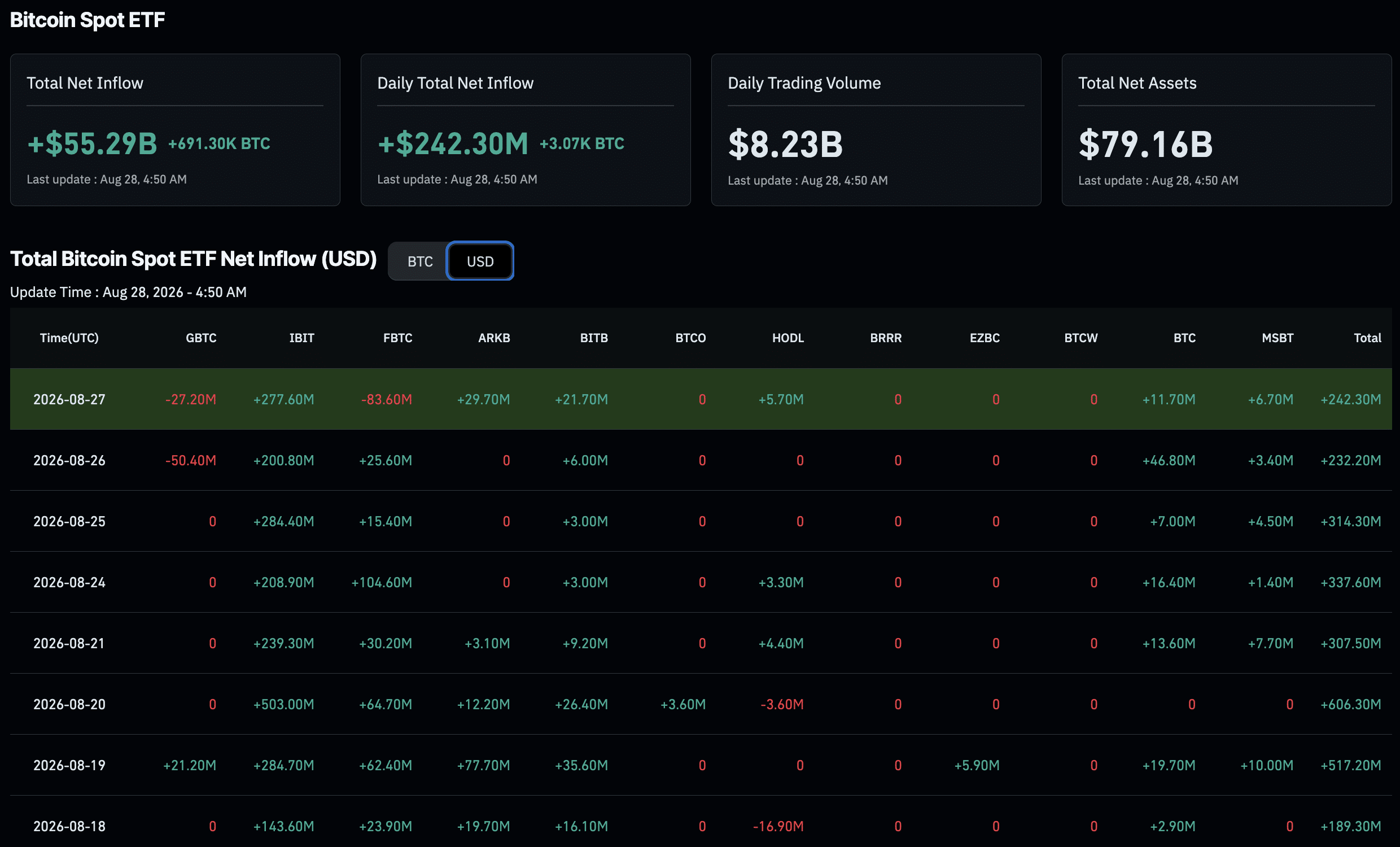
US spot Bitcoin exchange-traded funds (ETFs) recorded $242.30 million in net inflows on August 27, extending their streak to nine consecutive trading sessions. BTC traded near $79,500 on August 28, up +1.1% over 24 hours.
Spot Ethereum ETFs matched the pattern on the same day, taking in $235 million to mark a ninth straight session of inflows, while ETH changed hands at around $2,490.
Spot Solana ETFs added $60.91 million on August 27, and spot Hyperliquid ETFs drew $24.42 million. The figures suggest institutional demand is spreading beyond the two largest crypto assets, although the smaller funds remain far behind Bitcoin and Ether in scale.
The flows were first highlighted by Wu Blockchain:
Bitcoin Spot ETFs See $242 Million in Net Inflows, Extending 9-Day Inflow Streak
On Aug. 27 (ET), U.S. spot Bitcoin ETFs recorded $242 million in net inflows, extending their streak to nine consecutive days. Spot Ethereum ETFs saw $235 million in net inflows, also marking nine… pic.twitter.com/JLJpZ8CGyy
— Wu Blockchain (@WuBlockchain) August 28, 2026
What the BTC and ETH Streak Shows
Wu Blockchain reported on August 28, 2026, that US spot Bitcoin ETFs took in $242 million and spot Ethereum ETFs took in $235 million on August 27, with both categories logging nine consecutive days of inflows.
The synchronized run traces back to August 17, when both categories began climbing together, and it continued uninterrupted through August 27. These inflows have fuelled the rally across the crypto markets over the past ten days, according to the reporting.
The reported daily figures show a sustained run of inflows across both major categories. Because spot ETFs hold the underlying coins directly rather than tracking derivatives, their creations and redemptions are watched as a direct gauge of traditional-finance demand for the assets themselves. Steady inflows can reduce available supply on spot exchanges, a dynamic that has historically supported price during past accumulation phases. (SOURCE: CoinGlass)
Bitcoin and Ethereum Set the Baseline, Solana and Hyperliquid Extend It
The scale gap between the flagship categories and the smaller funds is stark. US spot Bitcoin ETFs began trading in January 2024 after the SEC approved the structure following years of rejected applications, and spot Ethereum ETFs followed in July 2024, establishing the two categories as the longest-running US spot crypto funds. BlackRock's iShares Bitcoin Trust (IBIT), the largest of the spot Bitcoin funds, contributed $209 million of a $338 million Bitcoin ETF inflow on August 24. Its Ethereum fund, ETHA, added $90.92 million of that day's $116 million Ethereum ETF haul. Both figures exceed the combined reported totals for Solana and Hyperliquid on August 27.
Still, the $60.91 million into spot Solana ETFs and $24.42 million into spot Hyperliquid ETFs on August 27 add to the evidence that fund demand extended beyond Bitcoin and Ether. The reported gains point to broader interest across crypto ETF categories, even as Bitcoin and Ethereum remain the dominant products by scale.
The primary evidence does not establish whether the Solana and Hyperliquid vehicles carry the same registration status or disclosure standards as US spot Bitcoin and Ethereum ETFs. The August 27 figures support an inference of broader appetite, rather than proof that institutions are accumulating Solana and Hyperliquid in the same way they have accumulated Bitcoin and Ethereum.
Why Scale Still Separates the Two Stories
Total net assets across spot BTC ETFs stood at $79.16 billion, with trading volume across the category reaching $8.23 billion. Bitcoin and Ethereum ETFs together drew $2.3 billion over the latest week discussed in the reporting, their biggest combined week since October.
That pattern suggests institutions are building positions across both major assets rather than simply rotating capital between them. Against that backdrop, the Solana and Hyperliquid inflows read as a supporting signal alongside a much larger trend in Bitcoin and Ethereum ETFs.
Commentator Kyle Chassé framed the flows as part of a broader allocation shift:
$1.92B flowed into Bitcoin ETFs last week.
This week? Already nearly $900m, So maybe this isn't just a crypto rally.
Bitcoin and gold are pulling in serious money at the same time and that looks more like a scarcity trade.
Institutions don't need to believe in Bitcoin. They… pic.twitter.com/55d5hzcKbY
— Kyle Chassé (@Kylechasse) August 28, 2026
The Verdict Is Suggestive, Not Conclusive
Nine straight sessions of inflows in both US spot Bitcoin and Ethereum ETFs remain the strongest evidence in the data, while the August 27 Solana and Hyperliquid figures extend the reported breadth of those gains beyond the two largest assets. Whether that appetite holds into the following week may depend on whether Bitcoin and Ethereum can extend their recent price gains, after each hitting +5.4% over the past seven days.
The reported flows indicate that demand extended beyond Bitcoin and Ethereum on August 27. At the same time, the evidence does not establish that the smaller ETF categories are comparable to the Bitcoin and Ethereum categories in terms of registration status or disclosure standards. The available figures therefore point to a broader institutional appetite while leaving the nature of the Solana and Hyperliquid vehicles unaddressed.
