Bitcoin ETF Inflows Hit Record Low of $205M in July 2026, Raising August Risk Questions
Key Takeaways
- •US spot Bitcoin ETFs recorded approximately $205 million in net inflows for July 2026, the smallest monthly total since the products debuted in January 2024.
- •Combined net outflows across May and June 2026 reached $6.95 billion, with June's $4.52 billion in redemptions ranking as the largest single-month withdrawal in Bitcoin ETF history.
- •Ethereum ETFs attracted $342.85 million in July inflows, outpacing Bitcoin ETF totals and coinciding with an approximately 11% rise in the ETH/BTC trading pair on Binance.
- •Analysts identify $63,300, the 200-week moving average, as a critical support level for Bitcoin, with a break below $62,500 potentially driving the price toward $60,000.
- •Federal Reserve hawkishness, stalled CLARITY Act legislation, and the expansion of real-world asset tokenization present competing pressures that could further weaken institutional Bitcoin ETF demand.
- •On July 31, spot Bitcoin ETFs recorded 3.64K BTC in daily inflows, led by BlackRock's IBIT with 2.87K BTC, while GBTC reported zero outflows.
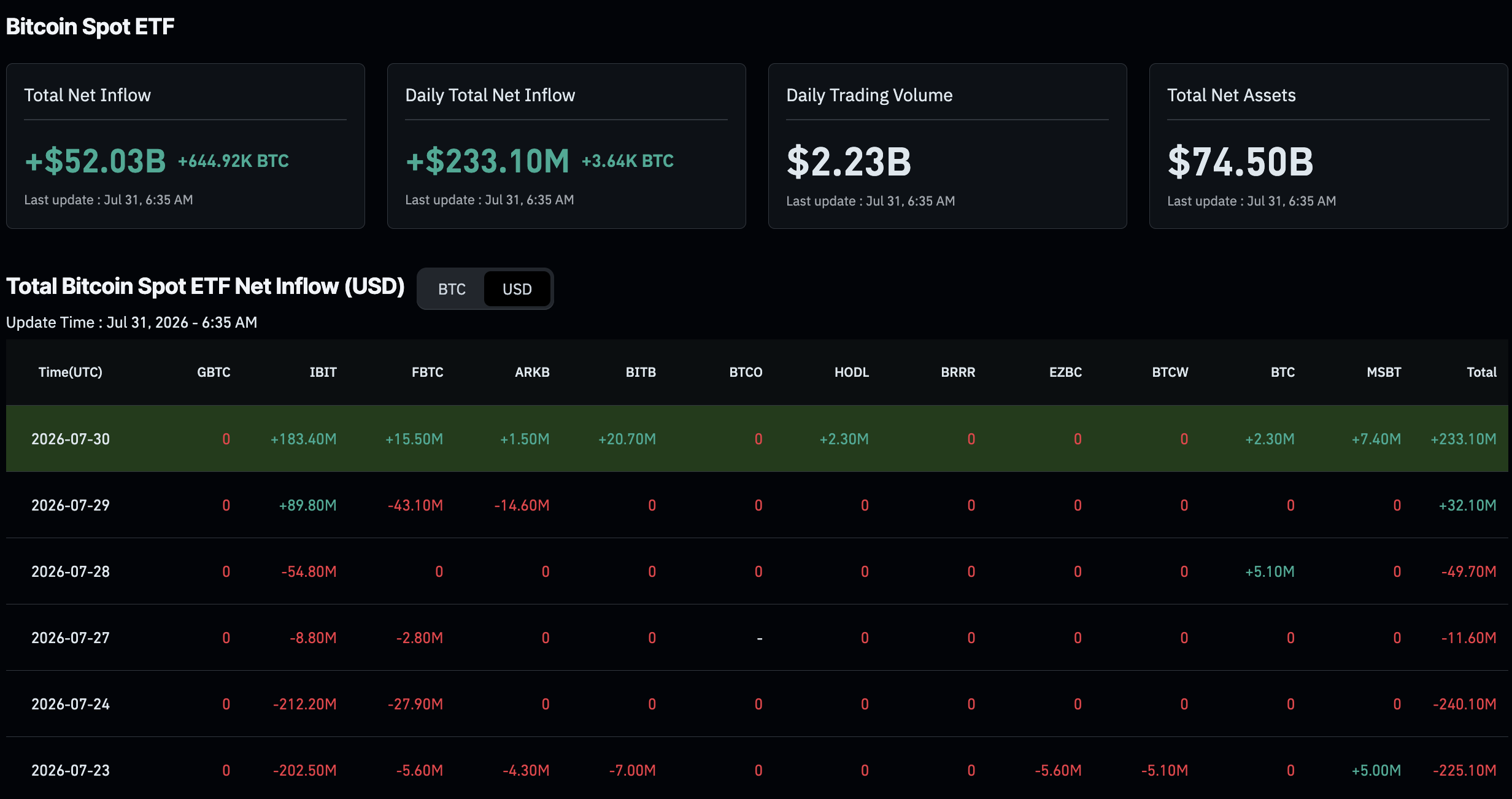
US spot Bitcoin ETF products are closing July 2026 with approximately $205M in net inflows, the smallest monthly total on record since the products launched in January 2024, according to SoSoValue data reported on July 30, 2026.
This figure follows two consecutive months of significant outflows: $2.43Bn in net redemptions during May and $4.52Bn in June, the latter marking the largest single-month redemption in Bitcoin ETF history. Combined outflows across May and June totaled $6.95Bn, reflecting active institutional de-risking.
BTC was priced at $63,900 as of July 31, holding above key technical support levels but showing little directional conviction. The central question facing the market is whether July's near-zero flow environment signals a temporary institutional pause before renewed capital deployment, or the beginning of a structural downturn in Bitcoin ETF demand.
On the final day of the month, spot Bitcoin ETFs saw a return to positive flows. According to a post on X by That Martini Guy (@MartiniGuyYT) on July 31, 2026, ETFs recorded +3.64K BTC in inflows for the day. BlackRock led with +2.87K BTC added through IBIT, while Fidelity contributed +242 BTC and Bitwise added +324 BTC. GBTC recorded no outflows.
Institutional Positioning Behind the Record-Low July Total
July's $205M inflow total stands in sharp contrast to April's $1.97Bn, indicating a pronounced decline in institutional demand for Bitcoin ETF exposure. While May and June reflected active de-risking through heavy outflows, July's near-zero figure suggests a halt in fresh capital allocation rather than continued exits. Daily buying pressure generated by ETF creation activity has diminished notably.
Fund-level rotation was evident throughout the month. Fidelity's FBTC recorded a single-day intake of $165.96M on July 2, while BlackRock's IBIT experienced a $40M outflow during the same period. By July 6, however, IBIT rebounded, signaling concentrated demand returning to the fund. IBIT, which holds the largest AUM among spot Bitcoin ETFs, has consistently attracted the bulk of new allocations since launch, making its flow trajectory a key barometer for broader institutional appetite.
Ethereum ETFs outperformed their Bitcoin counterparts in July, attracting $342.85M in inflows and nearly matching April levels. XRP ETFs recorded modest inflows of $13.61M, and Solana ETFs brought in $13.82M. This relative disparity is consistent with ETH's price strength, as the ETH/BTC trading pair on Binance rose approximately 11% during July. (CoinGlass)
Price Vulnerability and August Risk Factors
Without consistent inflows from ETF creation, Bitcoin's price becomes more susceptible to macroeconomic and regulatory developments. In August, this vulnerability was underscored by the Federal Reserve's hawkish posture, which maintained steady interest rates while signaling the potential for further tightening. Consequently, the 30-year Treasury yield reached its highest level since 2007, enhancing the appeal of yield-bearing assets relative to non-yielding assets such as BTC.
Analysts identify $63,300 — the 200-week moving average — as a critical support level for BTC's near-term price trajectory. Sustaining this level would signal resilience; however, a decline below $62,500 could precipitate a move toward $60,000, underscoring Bitcoin's reliance on technical indicators amid waning ETF-driven demand.
Regulatory uncertainty surrounding the CLARITY Act continues to weigh on market sentiment. Bipartisan negotiations are underway to revise the legislation's provisions, but the absence of a confirmed vote before the August congressional recess has kept institutional participants cautious.
Additionally, the expansion of real-world asset (RWA) tokenization is creating yield-bearing alternatives that compete for institutional capital, potentially diverting allocations away from Bitcoin ETFs.

