Bitcoin ETFs See $265 Million in Outflows as Analysts Flag Short Setup for August
Key Takeaways
- •US-listed spot Bitcoin ETFs recorded $265.38 million in combined net outflows on July 31, 2026, with BlackRock's IBIT accounting for $122.66 million of the total.
- •Bitcoin faced rejection at the $65,000 level, fitting an "overshoot" technical pattern that analyst Ardi warns can deceive bullish traders before the broader downtrend resumes.
- •Glassnode reported that Bitcoin spot trading volume has dropped to its lowest level since 2019, reflecting weak institutional demand and subdued market activity.
- •Bitcoin's three-month futures basis yield has remained below the U.S. two-year Treasury yield since February, redirecting investor capital toward cash and government bonds.
- •Analyst Ali Martinez flagged a sell signal on the BTC chart just ahead of August, a month that has historically been associated with Bitcoin price declines.
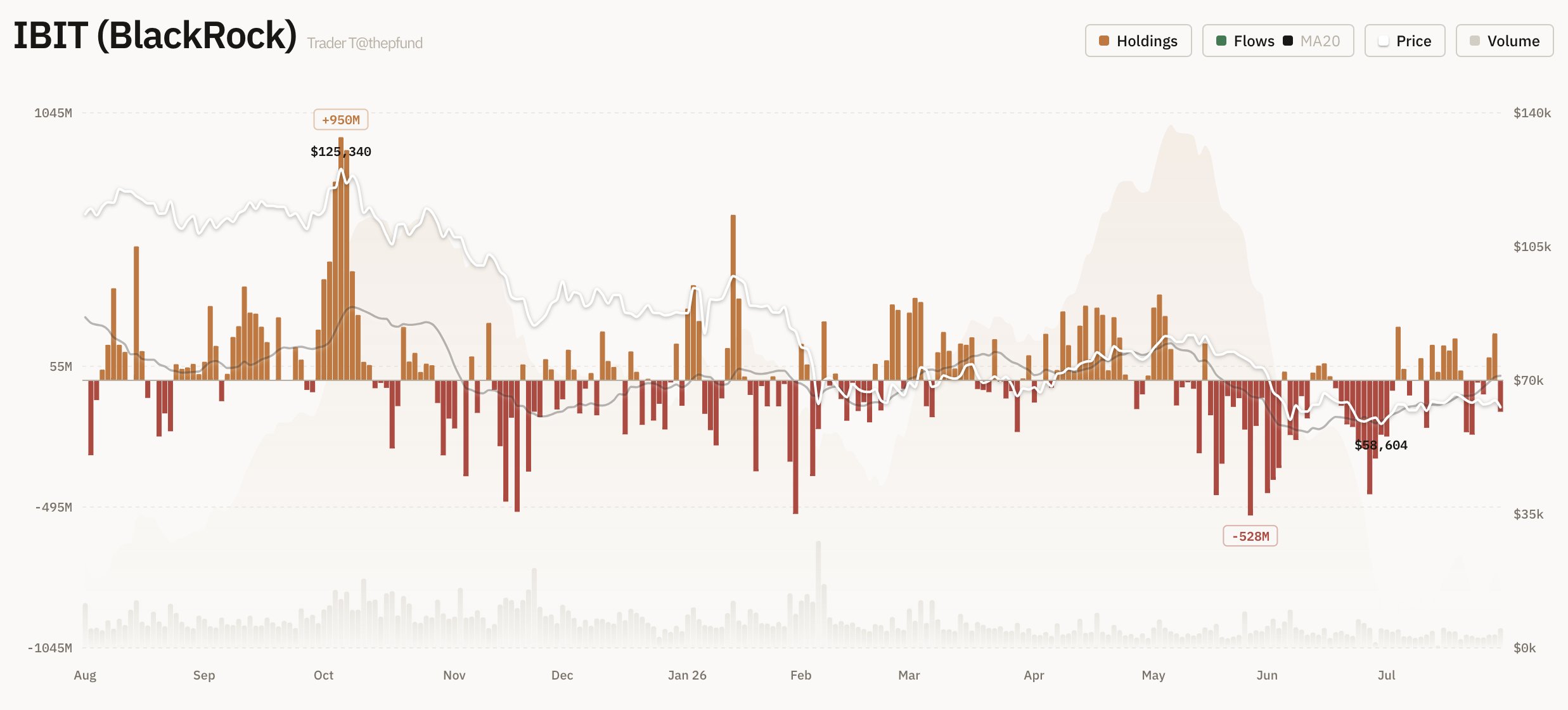
US-listed spot Bitcoin ETFs closed July 2026 with substantial net outflows, while Bitcoin's price continued to face rejection at the $65,000 level. Market analysts have identified a bearish technical setup heading into August, a month historically associated with BTC pullbacks.
Spot Bitcoin ETFs Record $265.38 Million in Net Outflows
On Friday, July 31, spot Bitcoin ETFs recorded cumulative net outflows of $265.38 million, with several major funds experiencing significant investor withdrawals. Since their approval by the SEC in January 2024, spot Bitcoin ETFs have become a primary vehicle for institutional and retail exposure to BTC, making their daily flow figures a closely watched barometer of investor sentiment.
BlackRock's iShares Bitcoin Trust (IBIT) led the outflows with $122.66 million, equivalent to approximately 1,948 BTC sold on the open market. IBIT's trading volume on Friday reached $2.0 billion, according to data from Farside Investors.
Fidelity's FBTC followed with $54.78 million in net outflows, while Grayscale's GBTC recorded $52.63 million. Bitwise's BITB and ARK 21Shares' ARKB also saw outflows of $17.77 million and $17.54 million, respectively. All other spot Bitcoin ETFs reported zero net flows during the session.
The ETF outflows coincided with sustained selling pressure on BTC, which encountered firm rejection at the $65,000 threshold.
Analysts Identify "Overshoot" Pattern on BTC Chart
Crypto analyst Ardi identified an "overshoot" pattern forming on the Bitcoin price chart. This technical setup typically emerges within an existing downtrend and can trap bullish traders before the broader downtrend resumes.
According to Ardi, the pattern develops after Bitcoin establishes a series of lower highs and lower lows. A temporary rally then creates a higher low and breaks above a local resistance level. This move can convince traders that a trend reversal is underway, attracting new long positions while forcing short sellers to cover.
The analyst noted that the bullish structure is invalidated once Bitcoin falls below the higher low that supported the breakout. Ardi said BTC recently followed this exact pattern, rallying toward the previous lower high near $65,500 before rejecting at that level and losing support around $63,700.
Separately, analyst Ali Martinez flagged a warning sign on the BTC chart, stating that a sell signal had appeared just ahead of August — a month that has historically been associated with Bitcoin pullbacks.
Bitcoin Spot Trading Volume Falls to Lowest Since 2019
Blockchain analytics firm Glassnode reported that Bitcoin's spot trading volume has dropped to its lowest level since 2019, reflecting subdued activity across the market as institutional demand remains weak.
In its weekly on-chain report, Glassnode noted that Bitcoin's three-month futures basis yield has remained below the U.S. two-year Treasury yield since February. According to the firm, this yield inversion has shifted investor capital away from Bitcoin and toward cash or government bonds. The persistent gap reflects a broader macroeconomic environment in which higher-risk assets face competition from relatively low-risk, yield-bearing instruments.
Glassnode further observed that exchange inflows and outflows, as well as spot Bitcoin ETF demand, remain muted. The firm noted that the BTC price continues to trade within a major cost basis cluster between $62,000 and $68,000, with $69,000 identified as a key resistance level.

