Bitcoin at $63,000 Faces Dual Uncertainty as Fed's Inflation Weighting Remains Opaque
Key Takeaways
- •Federal Reserve Chair Kevin Warsh has defined his policy reaction function around 'underlying inflation' but has not disclosed the specific weights he assigns to various inflation indicators, leaving markets uncertain about the path of future rate decisions.
- •The Fed's official inflation measures range from 3.7% headline PCE to 2.2% trimmed-mean PCE, a 1.5 percentage point spread across a single economy, with the FOMC maintaining its target range at 3.50%–3.75% through a 9-3 vote.
- •The Federal Reserve established five monetary-policy task forces on July 9, including groups focused on data sources and inflation frameworks, with Warsh planning to review their work before the Jackson Hole symposium in August.
- •The 30-year Treasury yield reached 5.274% in July, its highest level in 19 years, producing an expected real rate near 2.31% that raises the opportunity cost of holding non-yielding assets like Bitcoin.
- •US-traded spot Bitcoin funds recorded $233.1 million in inflows on July 30 followed by $87.9 million in net redemptions on July 31, bringing cumulative net inflows to approximately $51.56 billion.
Bitcoin at $63,000 Faces Dual Uncertainty as Fed's Inflation Weighting Remains Opaque
Bitcoin is trading near $63,000 as rate markets assign roughly 66% odds to a September Federal Reserve rate hike — all under a policy framework whose internal mechanics Fed Chair Kevin Warsh has deliberately left partly concealed.
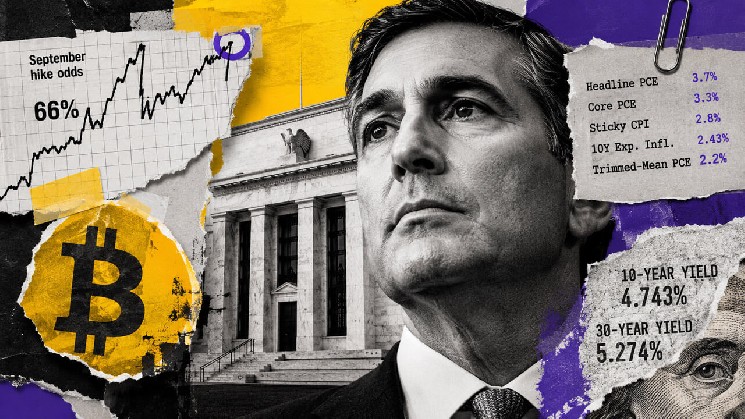
Warsh has defined his reaction function around the concept of "underlying inflation" but has declined to specify how he weighs the various indicators that feed into that judgment. The result is an official inflation dashboard spanning a striking 1.5 percentage points: headline PCE at 3.7%, core PCE at 3.3%, the Atlanta Fed's sticky-price CPI at 2.8%, the Cleveland Fed's 10-year expected inflation at 2.43%, and the Dallas Fed's trimmed-mean PCE at 2.2%. A single economy is thus producing readings ranging from nearly double the Fed's 2% target to barely above it.
Warsh told reporters that the Fed's January strategy document retains PCE as its formal objective. He invoked Goodhart's Law — the principle that once a metric becomes a policy target, behavior shifts and the measure loses its reliability — and noted the central bank could revisit its strategy in January 2027. He described a broader data initiative aimed at separating "the noise from the signal." His operative judgment, therefore, may draw from a wider set of inputs than the formal framework identifies.
That distinction leaves Bitcoin traders simultaneously pricing two unknowns: the next inflation readings and the weight Warsh assigns to each one. A 3.7% headline figure would support tighter policy, while a 2.2% trimmed mean could give the Fed room to wait — particularly when long-term expected inflation sits near 2.43%.
The Fed Rebuilds Its Inflation Lens
On July 9, the Federal Reserve established five monetary-policy task forces. The Data Sources group, led by Raj Chetty, Doug McMillon, and Kevin Murphy, will pursue timelier economic information. A separate Inflation Frameworks group will reconsider how the central bank interprets the drivers of inflation.
Warsh plans to review the groups' work before Jackson Hole — the Kansas City Fed's annual symposium in Wyoming that has historically served as a venue for signaling policy shifts — and has left open the possibility that early findings could shape his August speech. The next hard policy deadline arrives September 15-16, when the FOMC convenes alongside a new Summary of Economic Projections. January 2027 then offers the first formal opening for a revised strategy statement.
The FOMC maintained its target range at 3.50% to 3.75% through a 9-3 vote, with Beth Hammack, Neel Kashkari, and Lorie Logan advocating for a quarter-point increase. September hike odds neared 65% on July 31, while the Atlanta Fed tracker had placed the probability at 83.05% on July 29 — illustrating how rapidly traders reprice the expected rate path.
The 10-year Treasury yield ended July near 4.743%, and the 30-year reached 5.274%, its highest level in 19 years. Subtracting the Cleveland Fed's 10-year expected inflation of 2.434% from the nominal 10-year yield produces a simple expected real rate near 2.31%. That real return competes directly with Bitcoin, which offers zero cash yield. Higher real rates raise the opportunity cost of holding BTC, support the dollar, and reduce the balance sheet capacity available for risk assets — a dynamic that extends across the crypto sector and growth-equity markets more broadly.
Bitcoin's drift toward $63,000 has unfolded within this tighter liquidity environment. US-traded spot Bitcoin funds absorbed $233.1 million on July 30, only to record $87.9 million in net redemptions on July 31. Cumulative net inflows stand near $51.56 billion, providing Bitcoin an institutional demand channel whose daily support can still reverse.
Scenario One: Headline PCE Drives Policy
The bearish scenario begins with Warsh treating headline PCE at 3.7% and core PCE at 3.3% as the best evidence of generalized inflation. Higher oil prices, firmer inflation expectations, and continued economic resilience would reinforce that interpretation, strengthening the case the three July dissenters could make for September.
Under this path, rate markets would push hike odds higher, Treasury yields would remain firm, and the dollar would gain additional support. Bitcoin would face tighter financial conditions alongside mixed ETF flows, placing renewed pressure on the $62,000 area. A sustained break below $62,000 would bring $60,000 into focus, while the late-June zone near $58,000 would only come into play once sellers establish acceptance beneath $60,000. Confirmation of such a move would come from higher real yields, firmer breakevens, a stronger dollar, and another round of ETF redemptions.
The lower inflation gauges would carry less policy weight under this scenario. Warsh could conclude that trimmed measures remove too much of the tariff and energy transmission entering household prices, rendering the 2.2% reading insufficient to justify patience.
Scenario Two: Trimmed Inflation Guides the Fed
The bullish scenario requires Warsh to classify energy and other volatile categories as noise, assigning greater weight to trimmed-mean PCE at 2.2%, sticky-price inflation at 2.8%, and 10-year expected inflation near 2.43%. Continued cooling across those measures would give the Fed room to hold rates steady in September.
Lower hike odds would ease real yields and weaken the dollar's support, reopening liquidity for Bitcoin. BTC would first need to reclaim $64,500, then clear the Friday high near $65,300. A decisive move through that zone would reopen $66,000 and $68,000. Spot-market buying, falling open interest during the rebound, and renewed ETF creations would strengthen the case — tying the advance to genuine spot demand and reduced hedging pressure rather than a derivatives-led burst.
Jackson Hole may deliver the first public clue about Warsh's weighting system, and September 16 brings both the rate decision and fresh projections. By then, markets may know every major inflation print and still lack the formula that converts those readings into policy. Bitcoin is already trading that gap.

