Bitcoin ETF Flows Reverse $11B Quarter-Over-Quarter as BTC Price Holds Above $85K
Key Takeaways
- •Third-quarter net inflows into U.S. spot Bitcoin ETFs reached $6.34 billion, a swing of more than $11 billion from the roughly $5 billion that left the products in Q2.
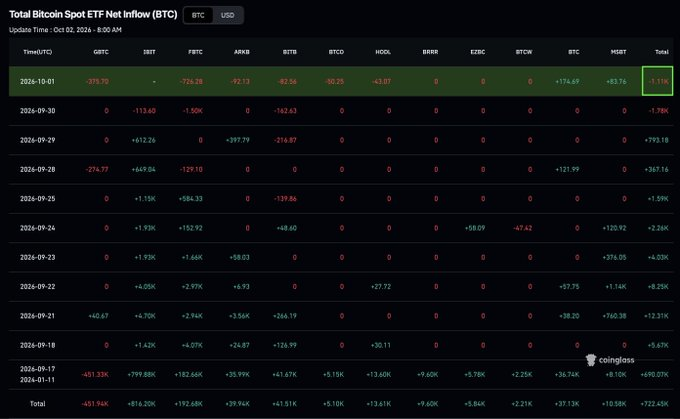
- •Daily ETF flows weakened at the start of October, with net outflows of $148.7 million on Sept. 30 and $92.9 million on Oct. 1, driven by redemptions from Fidelity's FBTC and Grayscale's GBTC.
- •Bitcoin traded near $85,967 on Oct. 2 after gaining about 2% in 24 hours, keeping the $82,000 area that acted as resistance in late September below the spot price.
- •BlackRock's iShares Bitcoin Trust reported $67.06 billion in net assets on Sept. 30, making it the largest U.S. spot Bitcoin ETF by assets, though Farside reported no IBIT flow for Oct. 1.
- •Late September saw strong inflows of $999 million on Sept. 21 and $714.7 million on Sept. 22, showing that quarterly totals can obscure substantial daily volatility.
U.S. spot Bitcoin exchange-traded funds reversed a weak second quarter with $6.34 billion in third-quarter net inflows, restoring institutional demand after roughly $5 billion exited the products during Q2. Bitcoin traded near $85,967 on Oct. 2, holding above $85,000 even as daily ETF flows turned negative at the start of October — a sign that fresh demand remains uneven despite the stronger price. Figures below draw on data from Farside Investors, Benzinga, CoinMarketCap, TradingView, and the Chicago Mercantile Exchange.
Quarterly Swing Tops $11 Billion After Q2 Redemptions
A Benzinga data compilation put third-quarter Bitcoin ETF inflows at $6.34 billion, following a second quarter in which about $5 billion left the U.S. spot products. The swing between the two quarters exceeded $11 billion and eased the pressure created by earlier institutional redemptions. The products, which began trading in January 2024, hold Bitcoin directly and give traditional investors exposure through standard brokerage accounts — a structure that has made their daily creations and redemptions a closely tracked gauge of institutional demand.
The quarterly figures showed a broader improvement even as day-to-day fund activity remained erratic. Farside Investors recorded several negative sessions earlier in September before late-month inflows accelerated — a reminder that quarterly totals can hide substantial daily volatility and temper the stronger institutional-demand picture entering the fourth quarter.
Daily Outflows Return as October Trading Begins
Farside Investors data showed U.S. spot Bitcoin ETF flows weakening sharply at September's close. The funds recorded $148.7 million in net outflows on Sept. 30, and the pressure carried into Oct. 1, when combined net outflows reached $92.9 million.
Fidelity's FBTC lost $60.7 million and Grayscale's GBTC lost $31.4 million in the Oct. 1 session. Morgan Stanley's MSBT attracted $7 million, while Grayscale's lower-fee Bitcoin product added $14.6 million — gains that failed to offset redemptions across several larger funds.
The two negative sessions stood in sharp contrast to a much stronger late-September stretch, when Farside recorded $999 million of inflows on Sept. 21 and $714.7 million on Sept. 22.
BTC Price Builds Above a Key Reference Zone
CoinMarketCap data showed Bitcoin trading near $85,967 on Oct. 2. The asset gained about 2% over 24 hours, with trading volume near $38.1 billion, and had already moved above levels seen during much of September.
TradingView data showed Bitcoin repeatedly testing the $82,000 area during late September. That zone now sits below the spot price and remains an important near-term reference; a break below it would weaken the recent recovery structure.
The stronger spot market has also supported exchange-traded product valuations. BlackRock's iShares Bitcoin Trust reported $67.06 billion in net assets on Sept. 30, and BlackRock listed IBIT's closing price at $47.34 that day. The fund holds Bitcoin and tracks the CME CF Bitcoin Reference Rate, a benchmark calculated from spot trading activity across major Bitcoin exchanges.
BlackRock's fund remains the largest listed product by assets among U.S. spot Bitcoin ETFs. Its scale can translate modest percentage moves into large dollar flows, meaning its creations and redem can dominate aggregate ETF demand.
Farside, however, reported no IBIT flow for Oct. 1. That left Fidelity and Grayscale redemptions driving the aggregate daily result — a divergence showing why headline ETF totals can mask fund-level differences.
ETF Flows Contrast With Futures Positioning
Chicago Mercantile Exchange data showed October Bitcoin futures near $83,930 on Sept. 28, a level that sat below the latest spot BTC price. The gap indicated that spot Bitcoin had advanced after that futures snapshot, and it underscores why traders compare ETF demand with derivatives pricing.
CME's contract remains active through Oct. 30. That gives traders another benchmark for positioning into month-end and can show whether futures pricing confirms movements in the spot market.
ETF flows measure net creations and redemptions across listed products. Futures markets instead reflect leveraged positioning, hedging demand, and settlement expectations, and those signals can diverge across several trading sessions. Strong quarterly ETF inflows therefore do not guarantee uninterrupted daily buying.
The latest flow pattern supported that distinction. Institutional demand improved during Q3, but two consecutive outflow sessions opened the fourth quarter — leaving the near-term picture less uniform than quarterly figures suggest.
$82K Zone in Focus as Flows Stay Mixed
Bitcoin's next market test sits near the $82,000 area identified by recent TradingView data. That zone acted as resistance before the latest move higher.
ETF flow data will provide another daily confirmation. Farside updates U.S. spot Bitcoin ETF creations and redemptions after each trading session. If flows return positive while the BTC price holds above prior resistance, institutional demand would align with spot momentum. Continued outflows would leave the quarterly rebound intact but weaken the near-term setup.
Source: The Market Periodical

